
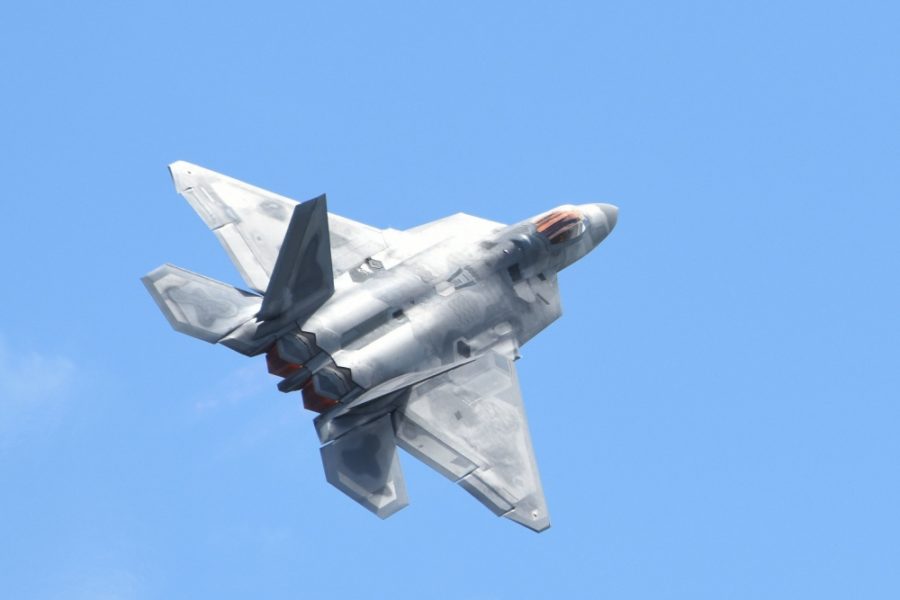
The F-22 is a stealthy, penetrating, air dominance fighter built for day, night, and adverse weather, full-spectrum operations. The prototype YF-22 first flew as part of USAF’s Advanced Tactical Fighter competition on Sept. 29, 1990, followed by the flight of the first F-22 test aircraft in 1997. The Raptor debuted in combat striking Islamic State ground targets during Inherent Resolve in 2014 and achieved its first air-to-air kill downing a Chinese surveillance balloon off the coast of North Carolina on Feb. 3, 2023. It is the world’s most advanced fighter and its mix of stealth, long-range supercruise, and multitarget engagement capability make it a key platform in USAF’s Indo/Asia-Pacific strategy.
F-22’s advanced flight controls and high-performance thrust-vectoring engine enable extreme maneuverability. The Raptor features six LCD color cockpit displays, APG-77 AESA radar, EW system with RWR and missile launch detection, and advanced comm/navigation and data links. USAF is aggressively testing enhancements to ensure the F-22’s “first-shot, first-kill” advantage against advanced threats until replaced or augmented by the F-47 Next-Generation Air Dominance (NGAD) fighter in the 2030s.
Combat-coded aircraft recently completed Increment 3.2B software upgrades adding high-resolution ground-mapping SAR, threat geolocation, EA capability, and integrated SDB I, AIM-120D, and AIM-9X. The program employs an “agile” strategy to continuously develop, test and rapidly field improvements, including rolling F-47 technologies back into the Raptor. Ongoing efforts include a distributed IRST system to passively track and target airborne threats, stealthy external fuel tanks/pylons to extend unrefueled range, AIM-260 Joint Advanced Tactical Missile integration, radar electronic hardening, and jam-resistant navigation.
Supporting efforts include the Reliability, Availability, and Maintainability Program (RAMP), Link 16, IFF enhancement, and engine reliability and performance improvements. RAMP improves electrical power, replaces avionic-fiberoptics, adds more durable LO, and fixes structures and wiring. Link 16 will enable two-way networking with legacy aircraft via Multifunctional Information Distribution System/Joint Tactical Radio System (MIDS/JTRS). Initial installs began in FY22 and fleetwide upgrade has been extended to FY27.
F-22 mission capable rates dropped to 40 percent in 2024, and USAF proposed retiring noncombat-coded Block 20s to fund the F-47. Congress blocked the move pending cost analysis to upgrade the jets to Block 30 combat-capability. FY26 launches IR defensive system upgrades to surface-to-air/air-to-air missile launch detection, and development of a Helmet Mounted Display Cueing System (HMDCS). Both the Low Drag Tanks and Pylons to extend range without compromising maneuverability and stealth as well as the IR search and track targeting pods are undergoing developmental and operational flight-testing at Edwards.
F-22 Raptor Technical Data
Contractors: Lockheed Martin; Boeing (production partner).
First Flight: Sept. 7, 1997.
Delivered: Oct. 23, 2002-May 2, 2012.
IOC: Dec. 15, 2005.
Production: 195.
Inventory: 184.
Operator: ACC, AFMC, AFRC (associate), PACAF, ANG.
Aircraft Location: Edwards AFB, Calif.; JB Elmendorf-Richardson, Alaska; JB Langley-Eustis, Va.; JB Pearl Harbor-Hickam, Hawaii; Nellis AFB, Nev.
Active Variant: •F-22A. Fifth-generation air dominance fighter.
Dimensions: Span 44.5 ft, length 62 ft, height 16.6 ft.
Weight: Max T-O 83,500 lb.
Power Plant: Two Pratt & Whitney F119-PW-100 augmented turbofans, each 35,000 lb thrust.
Performance: Speed Mach 2 with supercruise capability, ferry range 1,850+ miles with two external wing fuel tanks (farther with air refueling).
Ceiling: Above 50,000 ft.
Armament: One internal M61A2 20 mm gun (480 rds); two AIM-9 Sidewinders inside internal weapons bays; six AIM-120 AMRAAMs (air-to-air loadout), or two AIM-9, two AIM-120s, two GBU-32 JDAMs or eight SDBs (air-to-ground loadout) in main internal weapons bay.
Accommodation: Pilot on ACES II zero/zero ejection seat.