


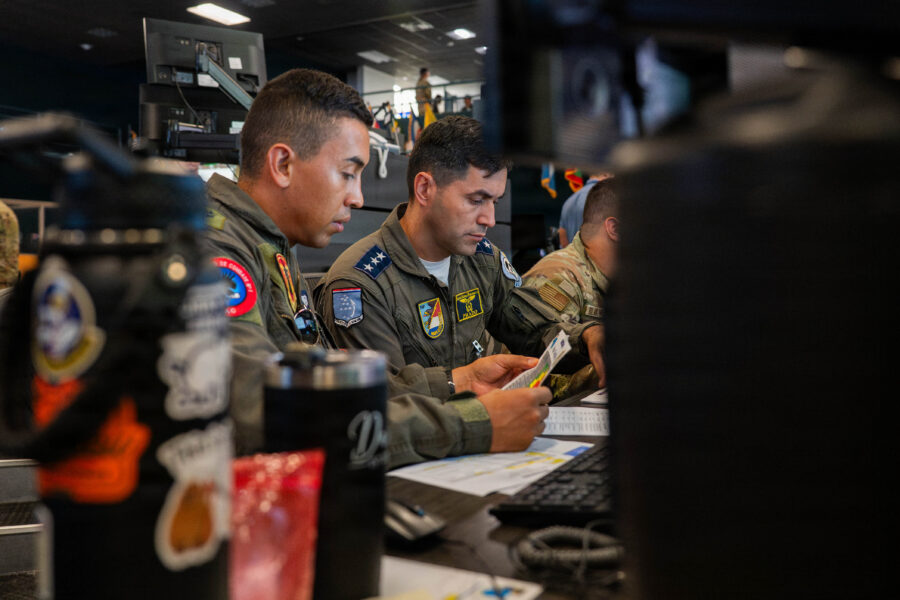
A major U.S. Southern Command exercise this month brought representatives from 10 Latin American countries to Davis-Monthan Air Force Base, Ariz., for the air component of the event, with a focus on intelligence sharing for coordinating air operations.
PANAMAX, which ran Aug. 3-14, is one of Southern Command’s biggest annual multinational exercises, and Air Forces Southern regularly hosts participants at Davis-Monthan to contribute to running an air operations center like AFSOUTH’s 612th AOC.
This year’s edition had a few new wrinkles. For one, it was the first time Ecuador sent an air intelligence officer, as the violence-stricken nation receives direct U.S. military support.
“Collaborating in a combined air component environment allows us to synchronize our procedures and learn from each other’s expertise,” Lt. Col. Andres Acosta, operations, intelligence, and analysis officer for the Ecuadorian Air Force, said in a release. “This training ensures that if we are called upon to respond to a real-world contingency, we can operate seamlessly as one united team to preserve regional stability.”
Including the new intelligence officer deepened key goals for the exercise, an Air Forces Southern spokesperson said in an email response to Air & Space Forces Magazine.
“Having Ecuadorian intelligence embedded in the 612th AOC allowed the combined air component to process simulated scenario data in real-time, building the exact trust and joint operational habits required for a rapid coalition response,” the spokesperson wrote.
The bilateral training focused “heavily” on standardizing communication protocols and “operationalizing shared air doctrine,” the spokesperson wrote.
“While we cannot discuss specific communication architecture, the exercise prioritized integrating intelligence-sharing frameworks to establish a common, rapid threat-assessment process across participating Western Hemisphere nations,” the spokesperson added.
SOUTHCOM did not respond to a request for comment.
This year’s exercise also unfolded against the backdrop of a larger shift in U.S. military posture across the Western Hemisphere and a growing emphasis on the counternarcotics mission, including the formation of the Americas Counter Cartels Coalition, a 19-nation partnership across the region.
“Over time the exercise has expanded to include counternarcotics, cybersecurity, as well as medical missions to nearby communities,” Henry Ziemer, a fellow with the Americas Program at the Center for Strategic and International Studies, told Air & Space Forces Magazine. “This year the exercise has taken on added significance as an opportunity for the United States to reiterate its commitment to its Western Hemisphere partners following the launch of the Americas Counter Cartel Coalition.”
On Aug. 3, SOUTHCOM head Marine Corps Gen. Francis L. Donovan announced that the temporary Operation Southern Spear would transition to Joint Task Force-Western Hemisphere, a more permanent presence to counter cartels, narco-terrorists, and traffickers in the command’s area of operations. The task force will be the “action arm for confronting threats across the hemisphere,” Donovan said.
The new task force synchronizes wider military operations with partner nations in the Americas Counter Cartel Coalition as well as rapid response to various crises and humanitarian needs. That’s in addition to the long-running Joint Interagency Task Force-South, which is meant to find, fix, and target illicit drug trafficking and other cross-border criminal networks in both maritime and air domains.
Secretary of Defense Pete Hegseth traveled to Panama last week to participate in PANAMAX and to address a conference for the ACCC
“The new motto of the ACCC is we do bad things to bad people,” Hegseth said. “That’s the mentality I want to have inside this room. Now we’re good people that do good things. But ultimately, we’re dealing with bad people that have done a lot of bad things to a lot of good people for a very long time.”
While air strikes on alleged drug boats in the Caribbean and the eastern Pacific were the initial public displays of Southern Spear, a shift to more internal operations with the cooperation of partner and ally nations looks forthcoming.
Ecuador was the first nation to receive such direct support under the new ACCC framework within its own borders.
Ecuador’s Role
Under previous Ecuadorian presidential administrations, military cooperation with the United States was virtually nonexistent, Ziemer said.
But it has “surged” as Ecuador confronts criminal violence and insecurity.
“Today, Ecuador is engaging in unprecedented levels of cooperation with SOUTHCOM and has become one of the foremost advocates for Washington’s more hardline security strategy in the Americas,” Ziemer said.
On March 3, the United States began direct military support to Ecuador to combat ongoing violence triggered in 2024 when gang leader Adolfo “Fito” Macías escaped prison, and cartel members attacked a live TV broadcast in Guayaquil and set off car bombs in various locations.
Those actions have escalated over the past two years in a series of incidents that have included attacks by local cartels Los Choneros and Los Lobos.
Ecuador has been part of PANAMAX for the past 15 years, primarily in maritime and land components. This was the first time the exercise has had a field component since 2012, which started in 2003 with Chile, Panama, and the United States.
Ecuador’s geographic position, an Andean nation between Colombia and Peru, the two top cocaine producers in the world, makes it a crucial ally for intelligence gathering against cartel operations and countering other types of trafficking, retired Air Force Lt. Gen. Norman Seip told Air & Space Forces Magazine.
“It’s critical when you take a look at what goes on in Colombia from drug trafficking. We’ll just talk drug trafficking. What goes on in Colombia? What goes on in Panama? What goes on in Central America? And look at Ecuador. It sits smack in the middle of all that, as well as Peru,” Seip said. “Their participation, their involvement, their collaboration, their coordination is critical, at least from the standpoint of the counter-narcotics fight that we’re in, to have them on board.”
The former 12th Air Force commander, who now serves as president of the nonprofit think tank American Security Project, said that having intelligence inside partner and allied nations in the counter-cartel fight is vital.
Ziemer added: “The presence of the first-ever contingent of Ecuadorian Air Force intelligence personnel at PANAMAX indicates the growing strength of the U.S.-Ecuador security partnership. Their presence will likely strengthen interoperability between Ecuador and the United States along with regional partners.”
The Air Focus
As exercises like PANAMAX expand and the new joint task force revs up, work for the 12th Air Force and other air components is likely to grow. Building intelligence capacity and sharing with the regional partners will be key to managing this.
The primary assistance the 12th Air Force can provide to Ecuador and other allies, both Seip and Ziemer told Air & Space Forces Magazine, is intelligence, surveillance, and reconnaissance assets.
“Transitioning key regional partners from information consumers to active, mutual contributors exponentially enhances regional air domain awareness,” the AFSOUTH spokesperson wrote. “Standardizing and expediting intelligence-sharing frameworks enables more immediate, coordinated responses to illicit aerial trafficking, ultimately creating a more robust, collective air shield against transnational criminal organizations.
The 66th Annual Conference of American Air Chiefs, held in the Dominican Republic in June, focused on airspace control, a historic strategic shift and a new “third line of effort,” according to a June release from Air Forces Southern.
The Fuerza Aérea Ecuatoriana, the Ecuadorian Air Force, operates the Embraer A-29 Super Tucano, a turboprop light attack aircraft, and the Airbus C-295, De Havilland DHC-6 Twin Otter. As part of the partner capacity-building work in the region, the 12th Air Force also coordinated a $13 million modernization program for FAE surveillance radars for domestic air domain awareness, the spokesperson wrote.