


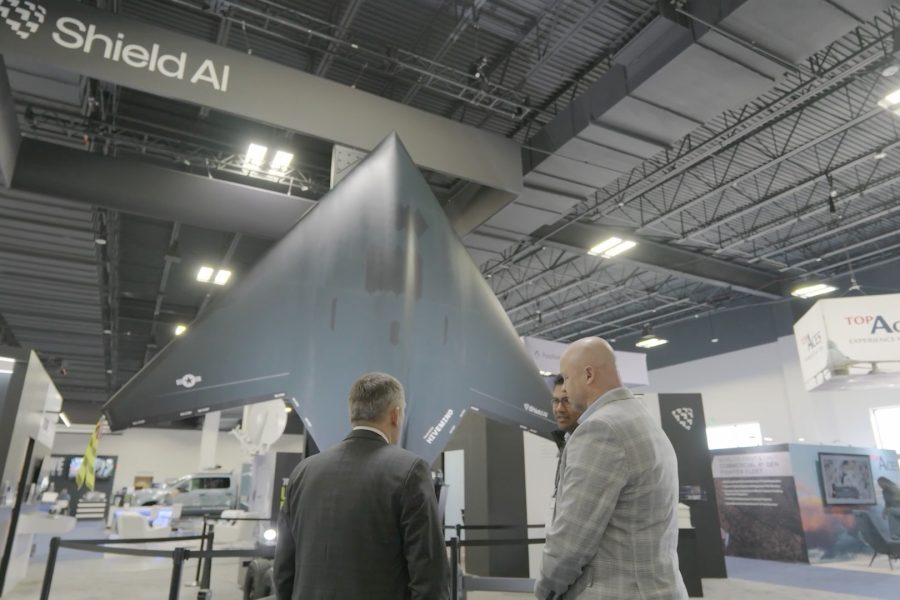
Shield AI, a specialist vying to provide the autonomy software for the Air Force’s autonomous Collaborative Combat Aircraft, has won government backing for its X-BAT drone—but not from USAF.
The $50 million cash infusion comes from the Navy and the Defense Innovation Unit, which see intriguing possibilities for a jet designed to take off and land vertically from a trailer. The aircraft is powered by the same F-110 General Electric engine that powers an F-16. With an airframe smaller and lighter than the Viper, the engine can generate enough thrust for vertical takeoff and to land in a manner similar to SpaceX’s reusable rockets.
Shield has not flown X-BAT yet; it unveiled the concept in October 2025 and the company has promised its maiden flight this year. Company president and cofounder Brandon Tseng said in October that “airpower without runways is the holy grail of deterrence: It gives our forces persistence, reach, and survivability, and it buys diplomacy another day.”
Retired Air Force Gen. James M. “Mike” Holmes agrees. The former commander of Air Combat Command said runway independence also could be useful to the Air Force, particularly for “agile combat employment,” where small teams of Airmen move between remote locations to make it harder for an adversary to target them.
“If the Air Force was going to look into it, it would be … not necessarily eliminating the big, fixed bases that need a lot of defense but allow you to generate high-tempo operations—if you can protect them,” he said. “But [it would be] to augment that by complicating an enemy’s targeting problem. It’s distributing your airpower and making it easier to survive and and stay active in future fights.”
Both Holmes and Heather Penney, director of studies and research at AFA’s Mitchell Institute for Aerospace Studies, said runway independence comes with challenges, however.
“It’s one thing to say, ‘Hey, we’re going to have truck-based X-BATs that can move all around the Philippines and hide in places, and pop up to launch, and then go hide somewhere, and then pop up to recover the system and turn it and do it again,” Holmes said. But “you also have to have the capability to get fuel and munitions to those sites and be able to link them up with X-BAT and reload it and redeploy it again.”
For the Navy, the potential benefit of X-BAT is clear, Holmes and Penney agreed: X-BAT could launch and return to surface combatants of all kinds, not just aircraft carriers. It would give the Navy more ways to deploy airpower. Navy destroyers and amphibious ships already carry munitions and fuel, so they don’t have the logistical problems the Air Force would have in its ACE concept of operations.
“I’m not surprised that the Navy moved first to take a look at what it offers them,” Holmes said.
The Air Force, meanwhile, is still sorting through the logistics and operational concepts for its Collaborative Combat Aircraft. The mainstream competitors for the program are all runway-dependent aircraft. Penney said adding a new kind of plane and figuring out different concepts for it would strain limited resources right now.
“If the Navy is interested in developing this air vehicle, then that could potentially become something in the future … for the Air Force,” she said. For now, though, it makes sense for the sea service to take the lead.
Technology
Another consideration for the Navy, Air Force, and any other potential X-BAT customer is the technology underpinning the drone. Shield boasts that its Hivemind autonomy software is “the world’s best AI pilot” and has delivered “real battlefield outcomes.” But Penney noted that mission autonomy—the ability for software to execute complex air missions—is “a lot harder” than most people realize and something the Air Force is still ironing out through the CCA program.
On top of that, X-BAT’s signature ability to take off and land vertically is a technically complex, though not unheard of, undertaking. Shield AI has shown it can do VTOL with its smaller V-BAT aircraft that has a propeller, but the X-BAT is as large as a fighter jet. It will need to generate large amounts of thrust to take off and be extremely responsive and stable to land.
Rockets like SpaceX’s Falcon 9 have shown it is possible to launch and land vehicles vertically, then reuse them—Holmes said that technology “if not routine, is understood.”
But Penney noted that the wings on X-BAT will function as a sail as it comes in for landings, catching wind and challenging the drone’s ability to stay steady.
“If they actually are able to reliably do this and do it in winds that are greater than like two knots in any direction, it’ll be an amazing technical feat,” Penney said.
Shield AI says it will conduct X-BAT’s first test flight before the end of 2026.
Priorities
As the Air Force weighs the operational and technological considerations of X-BAT, a key question arises, Holmes and Penney both said: Is it worth it given everything else the service wants to buy?
The Air Force is pursuing not only Collaborative Combat Aircraft, but also the F-47, the B-21, and the Sentinel intercontinental ballistic missile. It is spending billions of dollars buying the F-35 and KC-46.
The ability to operate unconstrained by runways can be a priority, Holmes said, “but that doesn’t mean that the Air Force already has more priorities than it has money.”
Shield says X-BAT will be relatively affordable compared to a manned fighter at about $27 million; right around the price target the Air Force has set for CCAs. But that price point could very well change through development and production.
For now, there are enough questions about the platform and enough priorities otherwise that it makes sense for the Air Force to merely watch, not invest in, X-BAT’s development, the experts said.
“If the Navy is willing to and DIU is willing to put funding into it, then let them pay for it,” Penney said. “If it it ends up demonstrating the cost and the business case, then let the Air Force buy it military off the shelf. But given where the Air Force is right now, it doesn’t even have enough resources for current recapitalization programs. Continuing to put pressure on that by adding one more rock in the jar just doesn’t make sense.”
“I understand why the Navy is interested in it,” Holmes added. “I think it’s an interesting capability for the Air Force to try to free itself from its dependence on airfields. You still have to figure out a way to sustain it in combat … You’ve got to work that [concept of operations] and then you’ve got to decide, what is the best bang for your buck?”