
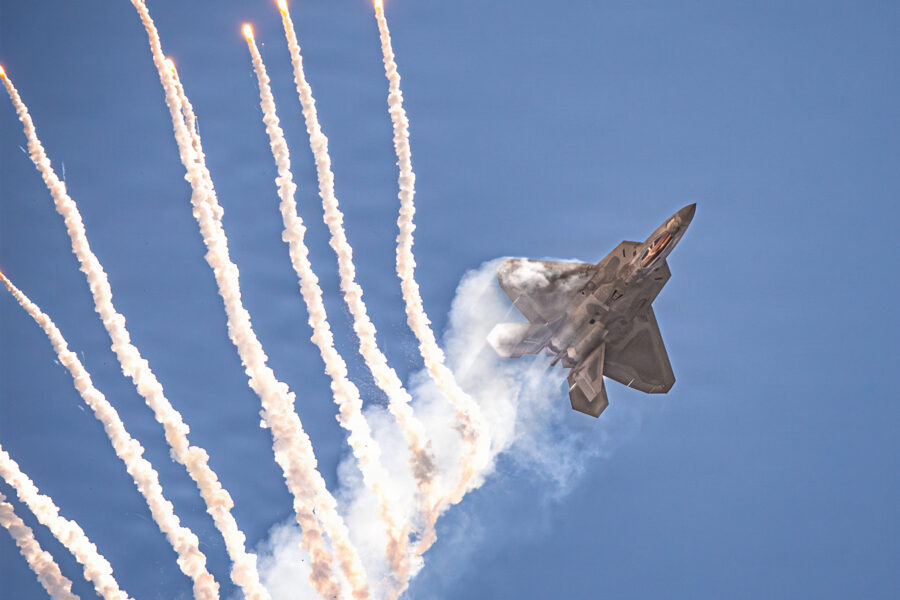
The Air Force would keep all of its 184 F-22 Raptors until at least the end of fiscal 2032 under an amendment added to the House Armed Services Committee’s version of the National Defense Authorization bill.
In a June 4 markup, the committee approved by voice vote a plethora of amendments related to the Air Force and its fleet. They include provisions that would allow the Air Force to buy more F-15EX Eagle II fighters and find new ways to accomplish the A-10 Warthog’s missions—including potentially using autonomous capabilities.
One of the most noteworthy amendments, though, came from Rep. Austin Scott (R-Ga.), who proposed extending the current prohibition on retiring any Raptors until Sept. 30, 2032.
The F-22 is a fifth-generation stealth fighter introduced in the 1990s that is often acclaimed as the best air superiority fighter in history. The Air Force originally expected to buy 750 of the Lockheed Martin-made jets, but that procurement plan was whittled down over the years, until former Defense Secretary Robert Gates ultimately capped it at 187 in 2009. There are 184 still in service.
Congress initially included language in the 2023 NDAA prohibiting the Air Force from retiring any F-22s in response to an attempt by the service to divest 32 of its oldest “Block 20” Raptors. Air Force officials said at the time that the jets were not combat-capable, could only be used for training, and would cost too much to upgrade to a more capable configuration.
The original language, still on the books today, prohibits any F-22 divestments through fiscal 2027, which ends Sept. 30, 2027. Scott’s amendment extends that through fiscal ’32—several years beyond the 2030 timeline the Air Force once envisioned for starting to sunset the F-22, though that plan already seemed to be shelved.
The Air Force and Boeing are currently working on a sixth-generation fighter known as the F-47, which would succeed the F-22. But the overall fighter fleet is aging and slowly shrinking, and the service has stopped asking to retired the Block 20 F-22s. An extension of the F-22’s retirement prohibition into at least 2032 would help the service retain some of its airpower capabilities while the F-47 comes online, Boeing continues to build F-15EXs, and Lockheed further upgrades the F-35.
Another amendment approved by the House committee as part of a larger package would allow the Air Force to increase its planned procurement of F-15EXs beyond 267 jets, without specifying how many.
The Air Force’s plans for the F-15EX fleet have fluctuated in recent years. Most recently, the service said it wanted to more than double the planned size of its F-15EX fleet, from 129 to 267, in part because of delays to the F-35 Joint Strike Fighter’s upgrades.
The committee’s original bill, released May 26, would also allow the military to award multiyear contracts for the F-15EX and the F-35.
Another Scott amendment the committee adopted that would require the Air Force to send lawmakers a briefing by March 1, 2027, assessing how feasible it might be to restart the production line of the C-17 Globemaster mobility aircraft.
The briefing would study whether Boeing—which now owns the original C-17 manufacturer, McDonnell Douglas—has enough tools, workforce, and a viable supplier base to restart the line, as well as what it might cost to do so and how long it might take to deliver the first new Globemaster.
Interest in the A-10
Another amendment adopted by voice vote came from Rep. Abe Hamadeh (R-Ariz.) and would require the Air Force to put together a plan for using autonomous, semi-autonomous, or artificial intelligence-enabled capabilities to carry out the missions of the A-10. The A-10 was originally built to be a Soviet tank-killer during the Cold War, but it became famed for its close air support capabilities in the Middle East during the Global War on Terror. Earlier this year, A-10s played a key role in the rescue of two F-15E crew members who were downed in Iran.
The plan should include ways to ensure operational experiments are done “in a manner consistent with meaningful human command and control, by a qualified military aviator,” the amendment said. That should include mission-critical functions such as target engagement, weapons release, and decisions to abort a mission, the amendment said.
The plan should also consider how to make a limited number of A-10s, its components, or support equipment available to study how to make autonomous or semi-autonomous aircraft able to carry out A-10 missions, the amendment said. It could include participation from nontraditional or venture-backed defense companies, commercial technology firms, or other companies that could rapidly develop the necessary hardware, software, autonomy, sensing, communication, or mission system capabilities.
The Air Force would also be required to keep the capacity to train new A-10 pilots, as well as to maintain and repair and supply the jets, to ensure the Warthog fleet can keep flying its missions—including combat search-and-rescue missions known as “Sandy”—through fiscal 2030, an amendment said. This will include maintaining a formal training unit to teach pilots.
Another amendment the HASC adopted would require the Pentagon to evaluate A-10s that are slated for retirement, to see if they could be transferred to another military department. That would expand a similar provision from the 2024 NDAA, which required the Pentagon to consider whether retiring A-10s could be transferred to an ally or partner’s military.