


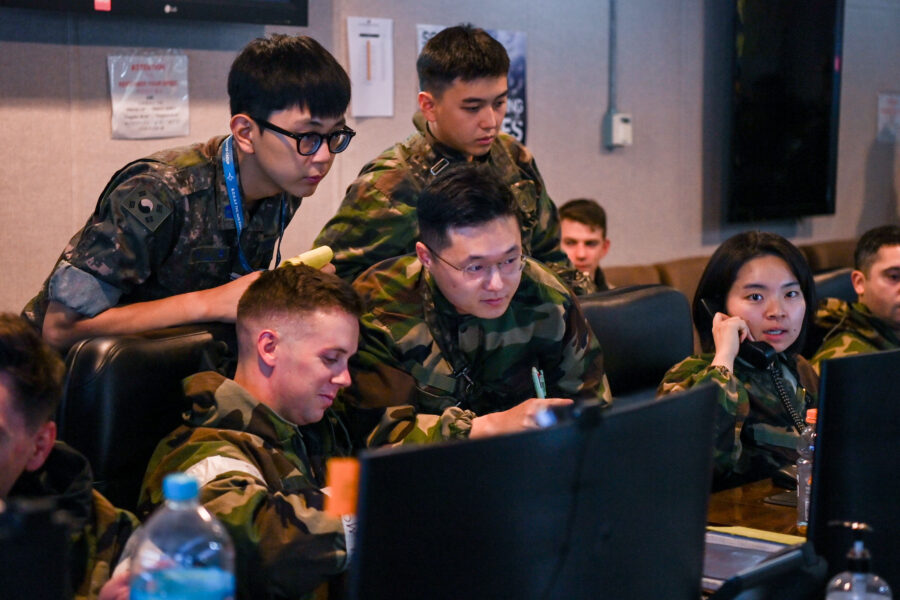
The joint U.S.-South Korea Ulchi Freedom Shield exercise will end Aug. 21, a week earlier than previously planned, at the behest of President Donald Trump—a move that comes as U.S Air Force is already reviewing its exercise schedule in the Pacific.
Both the U.S. and South Korean militaries confirmed the schedule change Aug. 19, after Trump directed the Pentagon to “substantially reduce” the exercise in an Aug. 16 social media post, citing his relationship with North Korean leader Kim Jong Un and South Korea’s refusal to join the U.S. war with Iran.
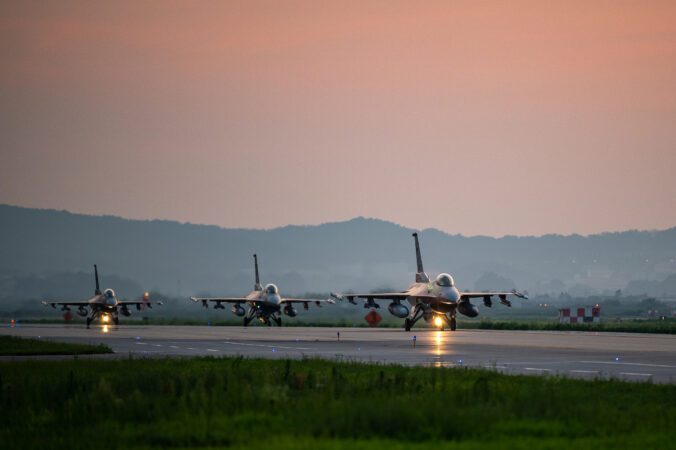
Ulchi Freedom Shield was originally scheduled to run from Aug. 17-27. The largest annual exercise on the Korean peninsula, it typically involves about 18,000 uniformed personnel from the U.S., the Republic of Korea, and other partner nations. The exercise features assets on land, at sea, and in the air. The U.S. Air Force has flown F-16 Fighting Falcon, F-35 Lightning II, and F-22 Raptor fighters in previous editions. South Korea has flown its F-35A, F-15 Slam Eagle, and FA-50 Golden Eagle fighters.
South Korea’s Joint Chiefs of Staff issued a statement saying that based on the U.S.’s request, the two countries “have decided to partially adjust the exercise period and scale.”
A Pentagon spokesperson told Air & Space Forces Magazine that based on Trump’s orders, “the Department has substantially reduced Exercise Ulchi Freedom Shield while continuing training that enhances tactical capability. These adjustments preserve essential readiness and training objectives. There will be no degradation to U.S. training objectives.”
The spokesperson’s reference to readiness echoes comments made by Pacific Air Forces Commander Gen. Kevin B. Schneider last month during an event with AFA’s Mitchell Institute for Aerospace Studies. Schneider said at the time he was reviewing the more than 45 exercises PACAF participates in each year to determine which ones were worth the strain.
“They’re all valuable, they all have benefits, but we’re taking a look at which ones are readiness gainers. What are the ones that are maybe not high on that list of building readiness for our Airmen?” he said.
The four-star then said that, after the review, PACAF leadership would decide whether to continue participating in some exercises or adjust the volume of participation, such as the number of personnel and assets sent.
Spokespeople for PACAF and the 7th Air Force, which oversees USAF units in Korea, deferred queries to the Pentagon.
Retired Col. John “JV” Venable told Air & Space Forces Magazine that while reducing sorties can hurt readiness, too many exercises can crowd out work in certain areas of tactical proficiency that are vital to keeping pilots and crews sharp.
The former fighter pilot and squadron commander, now a senior resident fellow at the Mitchell Institute for Aerospace Studies, said that sorties are the fundamental currency of readiness and necessary to maintaining it. However, there’s a sweet spot for training and exercise participation.
“Large exercises build high-end combined skills and interoperability,” Venable said. “The right number at the right pace keeps the large force employment skids greased. Too many of them, however, especially in a sortie-limited environment, can crowd out wing-level training that new personnel need before they can contribute effectively to big events. Finding a healthy balance is a challenge.”
The Tick Tock
Ahead of Ulchi Freedom Shield, the North Korean military conducted short-range ballistic missile tests Aug. 6 and Aug. 12. North Korea frequently conducts missile tests around U.S.-South Korea exercises and denounces the events as provocations.
China has also criticized the U.S. alliance structure in the Pacific, dubbing it an outdated Cold War mentality, said J. Michael Dahm, a retired Navy intelligence officer and China expert.
“The Chinese government and China’s military are likely pleased with the scaling back of U.S.-South Korean exercises on the peninsula,” said Dahm, now a senior fellow at the Mitchell Institute.
“On the other hand, Beijing recognizes that U.S.-South Korean military capacity and ability to defend itself against North Korean aggression is probably a necessary evil to deter Pyongyang and keep an unpredictable Kim Jung Un in check,” he added.
There is no indication Ulchi Freedom Shield, which is held each August, was expected to be any larger than previous drills. However, South Korean officials had said they intended to hold a more technologically complex exercise and incorporate tactical lessons from the Russia-Ukraine War.
Exercise plans called for a South Korean four-star general to serve as the commander of the Combined Forces Command, and the ROK had planned for the exercise to finalize the full operational capability assessment, which allows military leaders to transfer wartime operational control from Washington, D.C., to Seoul, the Kyungyang Shinmun newspaper reported.
The Pentagon spokesperson declined to comment on this.
“For operational security reasons, we do not publicly discuss details of bilateral assessments or certification activities,” the spokesperson said. “The Republic of Korea and the United States continue to work toward [operational control] transition through longstanding bilateral coordination and joint assessments.”
North Korea, meanwhile, has bolstered its own military prowess in recent months by sending troops to fight alongside Russian counterparts in Ukraine and, experts say, adapting new tactics for its own military use to include cyberattacks, GPS jamming, and drone swarms.