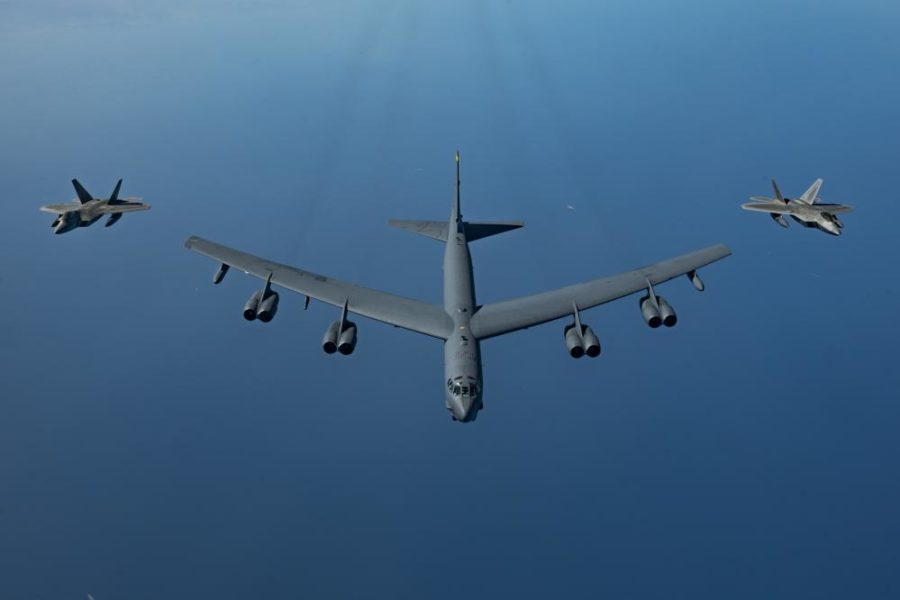
U.S. Air Force F-22 Raptors fly alongside a U.S. Air Force B-52H Stratofortress above the Arabian Gulf, March 29, 2022. The presence of the B-52H and F-22s showcased U.S. Central Command's ability to deliver combat airpower at a moment's notice, as well as its commitment to partners and regional security. U.S. Air Force photo by Staff Sgt. Jerreht Harris
Audio of this article is brought to you by the Air & Space Forces Association, honoring and supporting our Airmen, Guardians, and their families. Find out more at afa.org
A USAF B-52 flew through the U.S. Central Command area of responsibility on March 29, integrating with American F-22s and aircraft from nine other countries over the Middle East, U.S. Air Forces Central Command announced April 2.
The B-52 bomber, assigned to the 5th Bomb Wing at Minot Air Force Base, N.D., flew over the East Mediterranean, Arabian Peninsula, and Red Sea after taking off from RAF Fairford in the United Kingdom, where it is deployed as part of a bomber task force mission.
The F-22s, from the 1st Fighter Wing at Joint Base Langley-Eustis, Va., that joined the bomber have been in CENTCOM since February—a squadron deployed to the United Arab Emirates to respond to recent drone and missile strikes by Iranian-backed Yemeni Houthi rebels.
A KC-10 also joined the mission, refueling the B-52 over Saudi Arabia, according to images released by AFCENT.
The B-52 also flew with nine other nations’ aircraft, AFCENT commander Lt. Gen. Gregory M. Guillot said in a statement. According to official images released by AFCENT and other nations’ ministries of defense, those included Typhoons from the Royal Air Force, F-15s from the Israeli Air Force, F-15s from the Royal Saudi Air Force, F-15s from the Qatar Emiri Air Force, and F-16s and Typhoons from the Royal Air Force of Oman.
“With each bomber task force mission, [AFCENT] and partner air forces demonstrate the strength of regional airpower,” Guillot said in a statement “An unprecedented nine countries flew with our B-52 today, so this mission clearly signaled our ability to quickly bring forces to the theater and operate seamlessly with our partners during a training event that signals our combined commitment to regional stability and defense.”
This is the second Bomber Task Force mission to fly in CENTCOM this year—the first took place Feb. 14, when a Minot B-52 flew from RAF Fairford and integrated with a pair of Marine Corps F/A-18s.
Audio of this article is brought to you by the Air & Space Forces Association, honoring and supporting our Airmen, Guardians, and their families. Find out more at afa.org
The Marine Corps recently conducted its first-ever “ripple” release of eight Small Diameter Bomb IIs from an F-35B, a key early step in proving out the capability for all F-35 variants.
The Air Force will field operational prototypes for an autonomous drone to replace its MQ-9 Reaper in 2028, Secretary of the Air Force Troy Meink said Oct. 14.
One of the Air Force’s critical B-2 Spirit stealth bombers has returned to Whiteman Air Force Base, Mo., after an extensive course of maintenance to restore its stealth coating and preserve its structural integrity.
BAE Systems has received a contract from Lockheed Martin to install an upgraded Block 4 electronic warfare system into new F-35 Joint Strike Fighters, as well as to retrofit some older jets.
The Air Force has figured out a way for maintainers to inspect what had been a “blind spot” in F-16 engines, after problems in that area led to the catastrophic crashes of two jets in recent years.
The Air Force has begun evacuating stealth fighters, gunships, and special operations planes ahead of Hurricane Isaias expected landfall over the Gulf Coast this weekend.
The Air Force’s B-52 bomber may soon be able to carry up to 20 stealthy long-range anti-ship missiles to strike moving targets at sea, a key capability in a potential fight with China.
A reported surge of MQ-9 Reaper drones to Latin America could widen the scope of intelligence gathering and free up more strike options against cartels in the region, experts tell Air & Space Forces Magazine.
Northrop Grumman has broken ground on a major new production facility for the B-21 Raider, the company and the Air Force announced Oct. 6. The construction comes as a top service official said testing on the bomber is going well in the lead up to its planned introduction into the…
✓
Thank You!
Check your inbox to verify your email address and finish setting up your AFA account.
★
Welcome Back!
An account with this email already exists. Please log in to continue.
Subscribe to the Air & Space Forces Daily Report
The latest news from Air & Space Forces Magazine, as well as news from other leading publications, delivered right to your inbox every morning!
We’re sorry, there has been an error. Please review your input or try again later.