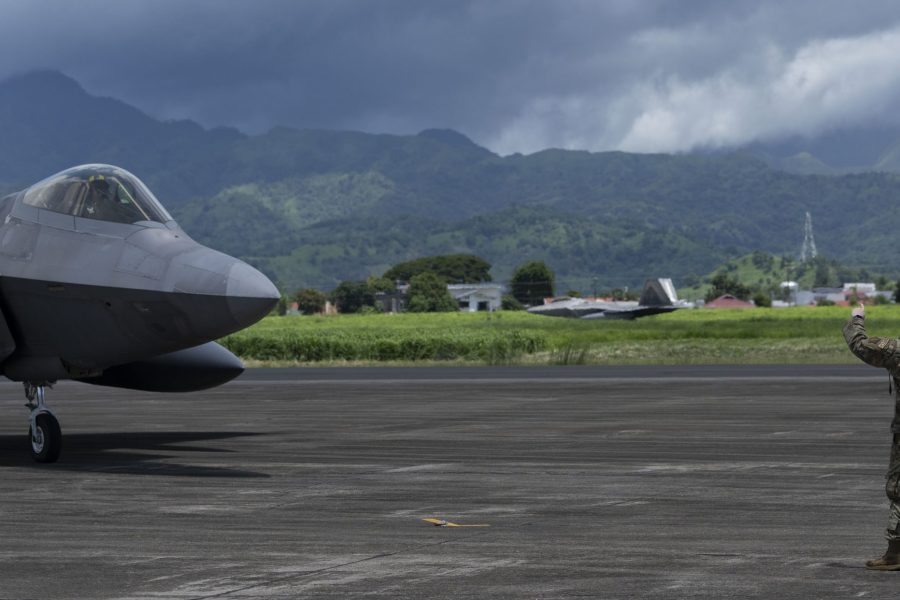
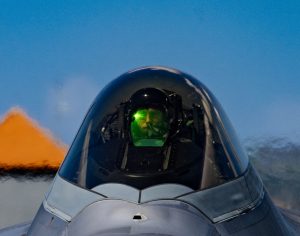
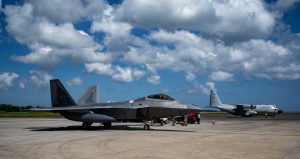
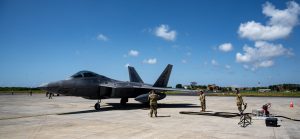
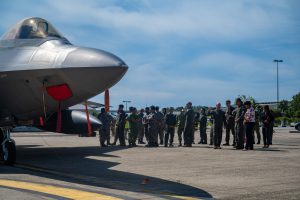
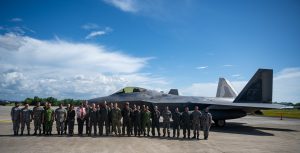
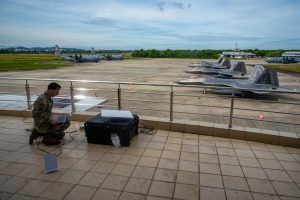
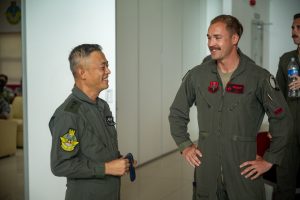
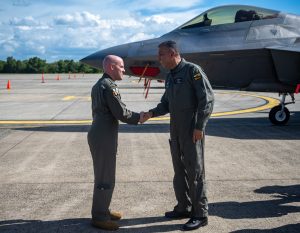
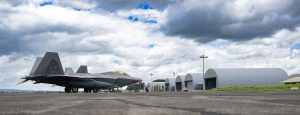
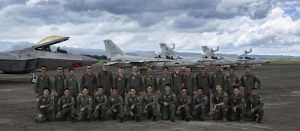
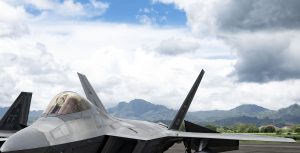
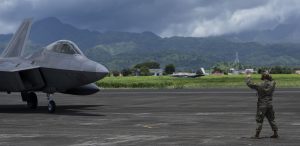
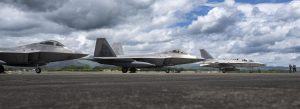
U.S. Air Force Senior Airman Emmitt Niemi, 27th Expeditionary Fighter Generation Squadron dedicated crew chief, marshals a F-22 Raptor from the 27th Expeditionary Fighter Squadron during dynamic force employment operations at Basa Air Base, Philippines, Aug. 8, 2024. U.S. Air Force photo by Staff Sgt. Edward Coddington
Audio of this article is brought to you by the Air & Space Forces Association, honoring and supporting our Airmen, Guardians, and their families. Find out more at afa.org
F-22 Raptors from Joint Base Langley-Eustis, Va., landed in Indonesia, Brunei, and the Philippines last week, in a widespread display of fifth-generation airpower across crucial regions in the Indo-Pacific.
The F-22s, designated the 27th Expeditionary Fighter Squadron, recently wrapped up Pitch Black, an air combat exercise, in Australia. From there, they deployed throughout the region as part of an exercise dubbed Iron Blade.
Four fighters went to I Gusti Ngurah Rai Air Force Base, Indonesia, on Aug. 6. U.S. Airmen and members of the Indonesian Air Force trained together and conducted hot-pit refueling. The Indonesian Air Force wrote on social media that this is the first time F-22s have landed in Indonesia.
On the same day, four fighters landed at Rimba Air Force Base, Brunei, to kick off three days of briefings, static displays, and tours. This was also the first time F-22s have landed in Brunei, a small nation on the South China Sea—this March, USAF F-35s became the first fifth-generation fighters to land there.
Finally, on Aug. 8, six F-22s landed at Basa Air Base in the Philippines. Two participated in formation flights with Philippine Air Force FA-50 fighters, according to the PAF. Basa, newly renovated to accommodate more aircraft, has hosted American fighters over the past few years as part of Cope Thunder exercises between the two nations.
In each visit, the F-22s were supported by C-130 cargo aircraft carrying parts and personnel.
Indonesia, Brunei, and the Philippines each occupy key strategic territory along the South China Sea, and the U.S. Air Force has sought to bolster ties with all three through deployments and exercises in recent years—part of a concerted effort to build partnerships and counter the growing influence of China in the region. The F-22 remains one of the most potent symbols of American airpower, and Raptors are currently stationed at Kadena Air Base, Japan, as part of a rotation of fighters through the base.
Audio of this article is brought to you by the Air & Space Forces Association, honoring and supporting our Airmen, Guardians, and their families. Find out more at afa.org
The Air Force’s future strategy for fighting wars could include arming bombers with air-to-air strike capabilities, the service said in a new report to Congress.
The Pentagon has concluded a new agreement to buy laser-guidance kits that turn rockets into drone-killing weapons. BAE Systems and the Defense Department announced a framework deal of up to seven years for 25,000 Advanced Precision Kill Weapon System guidance kits annually for the U.S. military.
The Pentagon and Lockheed Martin on Oct. 22 announced a framework agreement to buy F-35 Joint Strike Fighters for the next 10 years. But the deal, touted by the Pentagon as “landmark” and a first of its kind, depends on Congress granting the military authority to enter into such a…
At least two KC-135 Stratotankers that were seriously damaged during Operation Epic Fury are still undergoing extensive maintenance depot repairs, the head of Air Force Materiel Command said Oct. 21.
As the Air Force wrestles to solve the logistics of dispersed operations in the vast Indo-Pacific, it’s investing $3.5 million to help develop a new kind of aircraft: a blended-wing body freighter that’s smaller than a C-130 but larger than a Cessna for “sub-tactical” lift.
Roughly two of every five fighters in the Air Force fleet could be F-35As by 2035, according to a new fighter force structure report the service submitted to Congress on Oct. 16. Lt. Gen. David Tabor, deputy chief of staff for plans and programs, revealed the new estimate during an…
The Air Force Life Cycle Management Center is moving forward with a program to upgrade a quarter-century-old computing system for some F-16 fighter jets.
The U.S. Navy on Oct. 15 accepted a C-130J-30 Super Hercules plane that it will modify to become the first of its new nuclear command, control, and communications aircraft—a route the Air Force is considering for a similar NC3 mission under congressional direction.
More than 40 years after the original YF-117 operational prototype flew test runs from a Lockheed Martin Skunk Works facility, an F-117 returned for a $1 million refurbishment to look its best when it assumes its place in history alongside other iconic aircraft on permanent exhibit at the National Air…
✓
Thank You!
Check your inbox to verify your email address and finish setting up your AFA account.
★
Welcome Back!
An account with this email already exists. Please log in to continue.
Subscribe to the Air & Space Forces Daily Report
The latest news from Air & Space Forces Magazine, as well as news from other leading publications, delivered right to your inbox every morning!
We’re sorry, there has been an error. Please review your input or try again later.