


The Air Force has embraced new technical approaches like open mission systems and rapid software updates for cutting-edge aircraft like the B-21 and Collaborative Combat Aircraft. Increasingly, though, the service is also working to apply these to its older, “legacy” aircraft, officials said this week.
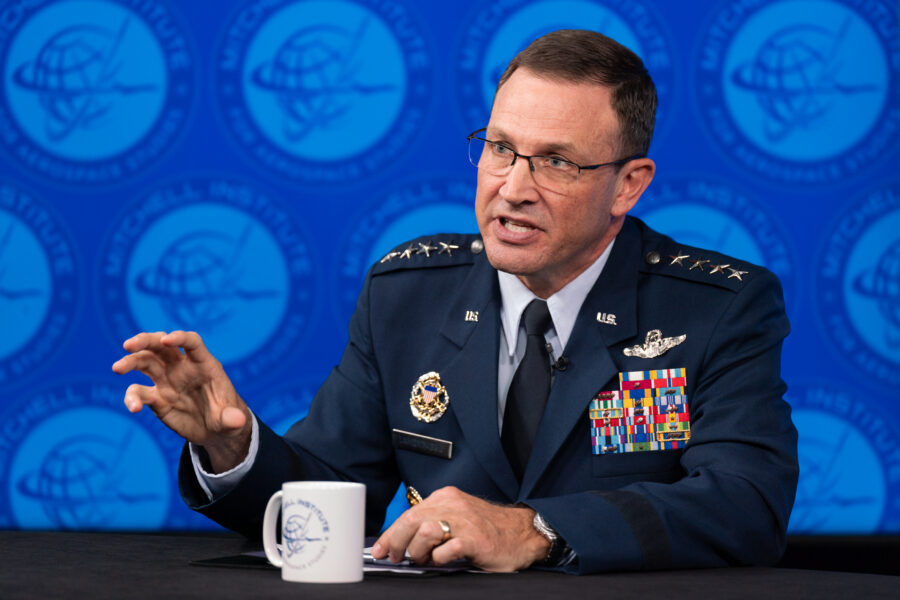
“That is where we’re headed on just about every platform going forward,” Vice Chief of Staff Gen. John Lamontagne said June 4 at AFA’s Mitchell Institute for Aerospace Studies. “ … We’re very much looking to prioritize those open mission systems that are government owned that we can upgrade at the time and place of our choosing.”
Open mission systems are sets of specifications for the core architecture of an aircraft’s software that allow any other software programs compliant with those specifications to seamlessly plug in.
That approach is critical, Lamontagne said, because it both prevents “vendor lock” and makes it easier for contractors to push updates without needing to revalidate the entire system.
“Going forward, what we’d like to do is separate the flying safety side of the airplane from the mission systems,” Lamontagne said—that separation means that crucial parts of an aircraft’s software, such as the software for its radar, can be updated without the need to pull the entire platform out of operations.
It’s an approach that the service has already adopted with the CCA program, allowing for fast and frequent updates. By comparison, Lamontagne said, legacy aircraft can sometimes go 18 months between updates.
The service is trying to change that. For example, Air & Space Forces Magazine reported in 2024 that the B-2 Spirit’s upgrade to new open mission systems software allowed the aircraft to remain relevant and credible as the Air Force transitions to the B-21 Raider.
Rapid software upgrades are important, experts say, and have proven to be a key feature in recent combat.
“You’ve got an environment where both sides are adapting at an increasing rate,” said Bryan Clark a senior fellow with the Hudson Institute think tank. “So even against an adversary like Iran, which seems like it’s not very sophisticated technologically, they’ve still got access to a lot of the same underlying digital technologies that we do.”
That means aircraft must update weapons mission profiles and electronic warfare systems to accommodate threats on the ground, said Clark.
“You’ve got GPS jamming happening basically on both sides around the Persian Gulf, and so you’re having to come up with ways to reprogram your aircraft to maybe either discount or to manage the fact that your GPS signal may be get periodically spoofed or jammed right, because you want the airplane … to kind of take that into account as it’s deciding where it thinks it is in the world,” Clark said.
Tools exist to manage these frequent updates. Rob Slaughter, CEO of the startup Defense Unicorns, said his company’s Unified Defense Stack-Fleet system can load new software packages onto a squadron or more worth of aircraft or other platforms using nothing more than an Android application on a tablet device.
“I have these 35 different weapon systems and assets I can actually manage the software deployments across all of them,” Slaughter said.
The UDS Fleet tool is one part of a larger stack of software that works together, he said. Fleet is for managing groups of platforms with individual software loading: one device for multiple platforms as compared to previous methods that required a dedicated device for each platform.
UDS Enterprise serves as a tool for engineers and cybersecurity teams to manage both cloud and onsite data centers. The pair of tools work together to conduct software updates in forward-edge environments.
Defense Unicorns specializes in air-gapped technology, meaning users are not connected to the internet to safeguard the systems from outside threats.
In March, Defense Unicorns used UDS to deploy software upgrades to the F-22 Raptor at Edwards Air Force Base, Calif., partnering with the Air Force Sustainment Center Software Directorate, according to a company release.
“This demonstration lays the groundwork to enable future Air Force personnel, including pilots and maintainers, to update software capabilities within an Open Mission Systems (OMS) computing environment on the aircraft,” according to the March release.
The demonstration conducted the software update in minutes, Slaughter said.