
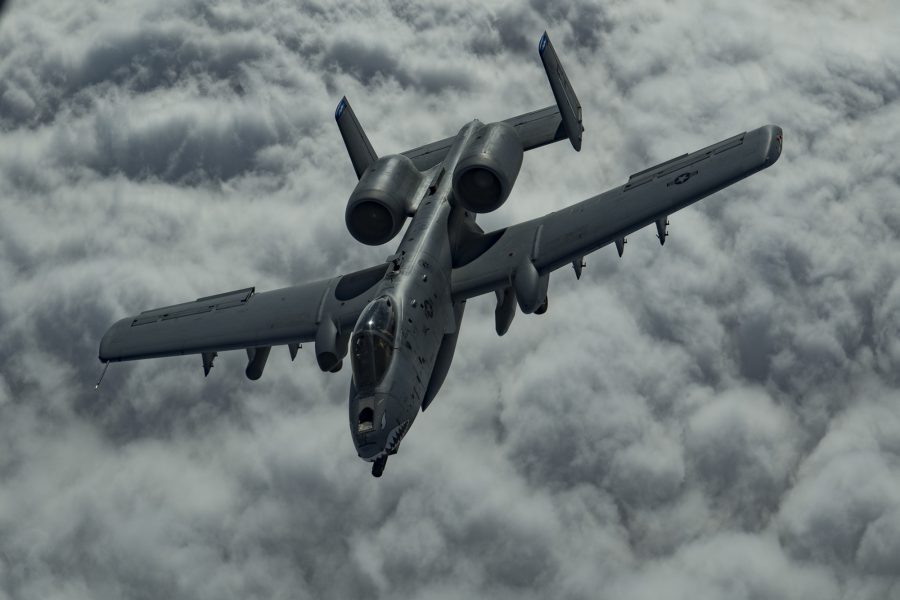
The A-10 “Warthog” is a specialized CAS aircraft tasked with interdiction, Forward Air Controller-Airborne (FAC-A), CSAR, and Strike Control & Reconnaissance. It combines a heavy, diverse weapons load with low-level maneuverability, a large combat radius, and long loiter time. The A-10 carries up to 16,000 lb of ordnance in addition to its 30 mm cannon which can destroy heavy armor while the pilot is protected by a titanium-armored cockpit.
The prototype YA-10A first flew on May 10, 1972, winning USAF’s A-X competition for a new attack aircraft. The A-10A development aircraft first flew on Feb. 15, 1975, and A-10As were delivered between October 1975 and March 1984. USAF declared A-10A IOC in October 1977.
The fleet was modernized under the Precision Engagement Program, resulting in the A-10C, which first flew at Eglin in 2005. The A-10C adds color cockpit MFDs, a Helmet Mounted Cueing System (HMCS), Hands-on-Throttle and Stick, digital stores management, improved fire-control, GPS-guided weapons, Litening/Sniper pods, advanced data links, and integrated sensors. The A-10C debuted in combat during Iraqi Freedom in 2007. With NVGs and targeting pods, the A-10C can operate under ceilings as low as 1,000 ft including at night.
USAF has not requested modernization funding since fleet divestment began in FY23, but continued installing previously funded high-resolution digital glass cockpit instruments, directional audio threat cueing, UHF/VHF comms, Ethernet, and Small Diameter Bomb I integration, transitioning to Onboard Oxygen Generation Systems (OBOGS). Fleetwide rewinging Staff Sgt. Tylin Rust was completed in 2024, extending remaining airframes to 10,000 flying hours.
USAF requested to accelerate retirement by three years to FY26, but Congress limited retirement to 59 aircraft this year to ensure orderly transition to unit’s new missions. The Maryland ANG’s 175th Fighter Wing ended A-10 operations on Sept. 23, 2025, followed by Osan and the A-10 test unit at Eglin in December, ending overseas basing. Divestments from Davis-Monthan, Moody, and the Idaho ANG’s 124th Fighter Wing continue, and fleetwide retirement is now expected by 2030. A-10s continue combat operations flying maritime interdiction over the Straits of Hormuz, as well as CAS and combat search and rescue over Iran supporting Operation Epic Fury. The final class of A-10 pilots graduated training in April 2026.
A-10 Thunderbolt II Technical Data
Contractors: Fairchild Republic (Lockheed Martin); Boeing/Korean Aerospace Industries (re-wing).
First Flight: Jan. 20, 2005 (A-10C).
Delivered: 2006-2012 (A-10C).
IOC: September 2007 (A-10C).
Production: 713.
Inventory: 163.
Operator: ACC, ANG, AFRC.
Aircraft Location: Boise Air Terminal, Idaho; Davis-Monthan AFB, Ariz.; Moody AFB, Ga.; Nellis AFB, Nev.; Selfridge ANGB, Mich.; Whiteman AFB, Mo.
Active Variant: •A-10C. Upgraded version of the A-10A ground attack aircraft.
Dimensions: Span 57.5 ft, length 53.3 ft, height 14.7 ft.
Weight: Max T-O 51,000 lb.
Power Plant: Two GE Aviation TF34-GE-100 turbofans, each 9,065 lb thrust.
Performance: Speed 518 mph, range 800 miles (further with air refueling).
Ceiling: 45,000 ft.
Armament: One internally mounted 30 mm, seven-barrel GAU-8/A cannon (1,174 rd of high-explosive incendiary (HEI) or HEI/armor-piercing incendiary); four AIM-9 Sidewinders, AGM-65 Mavericks, laser-guided rockets, most free-fall or guided air-to-surface weapons in USAF inventory, as well as ECM and advanced targeting pods.
Accommodations: Pilot on ACES II zero/zero ejection seat.