
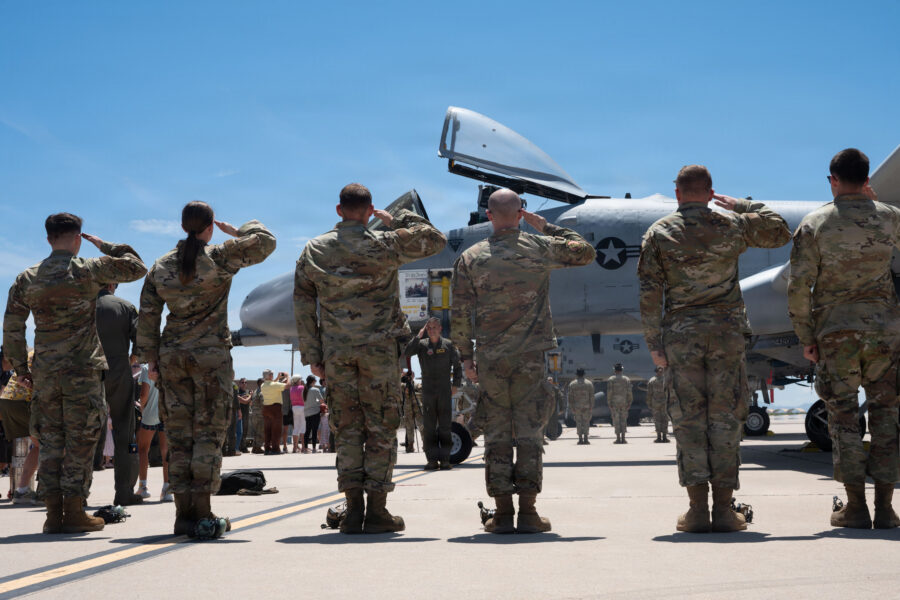
As the last few A-10 Warthogs leave Davis-Monthan Air Force Base, Air Force Special Operations Command is accelerating plans to move a new wing to the Arizona base.
The 492nd Special Operations Wing, now located at Hurlburt Field, Fla., is expected to completely finish its move to Davis-Monthan in fiscal 2028, a spokesman for the wing said. That is almost three years earlier than the original plan of reaching full operational capability in fiscal 2031.
The 492nd is shedding its old mission as a training wing and transforming into a power projection wing, which will be able to carry out strikes; mobility operations; intelligence, surveillance and reconnaissance operations, and other special operations missions.
An initial detachment for the 492nd stood up at Davis-Monthan in fall 2024 to pave the way for the wing’s broader move, a wing spokesperson said. The new headquarters for the 492nd will stand up there in summer 2027.
Additional units—including the 492nd Special Operations Theater Air Operations Squadron, 319th Special Operations Squadron, and an Air Combat Command intelligence squadron that has yet to be activated—will follow in phases through 2028.
More than 1,300 positions will relocate to Davis Monthan in the process, the spokesperson said. The phased approach to moving wing elements is being taken to minimize the effect on Airmen and their families, the spokesperson said.
Davis-Monthan has also been identified as the preferred location for the 34th and 20th Special Operations Squadrons and the 20th Special Operations Aircraft Maintenance Squadron, although a final decision on those units has not yet been made.
The 319th and 34th squadrons, which currently fly the U-28 Draco, will change their missions and start flying the OA-1K Skyraider II at Davis-Monthan. CV-22 Ospreys will also move to Davis-Monthan, the 492nd spokesperson said. The numbers of aircraft that will move are still being determined.
No units will be deactivated in the process, the 492nd spokesperson said, and the wing is in close coordination with Davis-Monthan’s 355th Wing “to ensure a seamless transition.”
“This process is by design as AFSOC develops the right mixture of capabilities in its wings to ensure alignment with the Department of War and the ability to meet National Defense Strategy priorities,” the spokesperson said.
End of Five Decades of the Warthog
While AFSOC moves its pieces into place, Davis-Monthan is closing its book on nearly five decades of A-10 operations. Davis-Monthan’s A-10s—which at one point numbered 78—had their fini, or final, flight there in a July 29 ceremony.
Three of Davis-Monthan’s four remaining A-10s flew to Moody Air Force Base, Georgia, on Aug. 5, where they will replace older Warthogs that are being divested, said Maj. Claire Fitle, head of public affairs for the 355th Wing at Davis-Monthan. The final A-10 will join them at Moody sometime in the next few weeks.
All other A-10s at Davis-Monthan have already been retired as of mid-July and were sent to the 309th Aerospace Maintenance and Regeneration Group near Tucson, commonly known as the Boneyard.
The A-10 retirements are part of the Air Force’s overall effort to reduce, and eventually fully retire, its fleet of the venerable attack planes. The A-10 was originally introduced as a tank-killer to fight the Soviet Union, but ended up seeing heavy action in Iraq and Afghanistan, where its low-and-slow flying style, armored frame, and punishing GAU-8 cannon made it ideal to provide close air support for ground troops.
But the Air Force has long feared the A-10 would not be survivable in a fight against a high-end adversary, and struggled to get Congress’ permission to retire the platform. In recent years, Congress agreed to allow A-10 retirements, and the service originally planned to divest its remaining roughly 162 Warthogs by 2029, if not earlier. After the launch of the Iran war, however, the Air Force announced it would keep three remaining squadrons of A-10s until at least 2030.
The 355th Operations Group now has a skeleton crew of fewer than a dozen Airmen remaining from the 550 it once had. The four units that used to have A-10 missions—the 355th, its 357th Fighter Squadron and 355th Training Squadron, and the 357th Fighter Generation Squadron—will inactivate on Sept. 18.
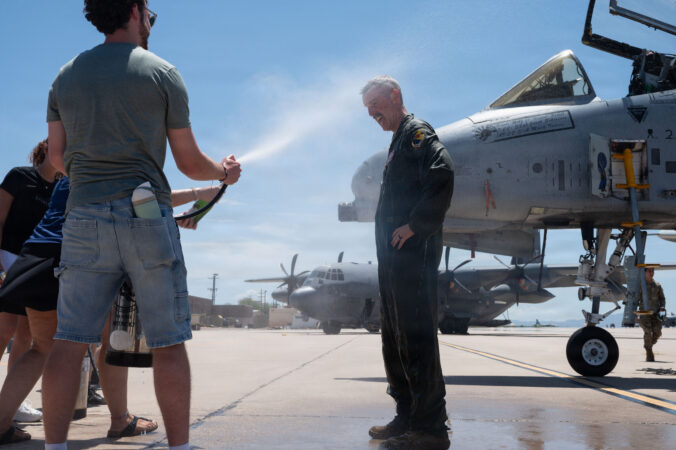
Lt. Col. Rodney Dwyer, commander of the 355th Operations Group, piloted the A-10 that made the farewell flight at Davis Monthan. Family and friends sprayed Dwyer with water after he landed, in an old aviation tradition for celebrating final fights.
“We’ve always had A-10s on the ramp; for the last 50 years they’ve been on the ramp,” Dwyer said in a July 31 statement. “To see the sunshades get torn down, to see the jets divest, fewer and fewer A-10s out there … it’s definitely bittersweet.”
