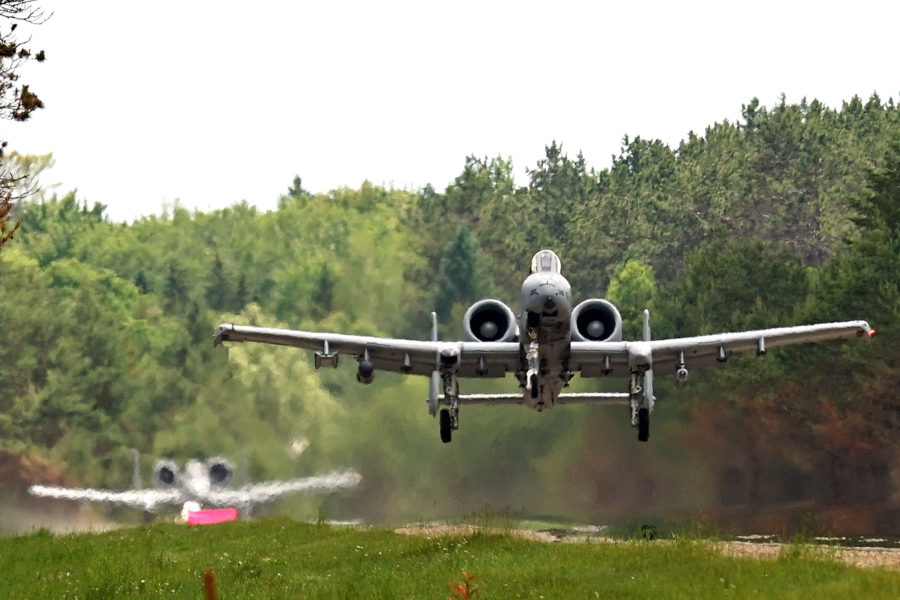
An A-10 Thunderbolt II from the 107th Fighter Squadron, 127th Wing, Michigan Air National Guard, lands on and takes off from a highway during agile combat employment training at Northern Agility-1 22 in Alger County, located in the Upper Peninsula of Mich., June 29, 2022. Air National Guard photo by Master Sgt. David Kujawa.
Audio of this article is brought to you by the Air & Space Forces Association, honoring and supporting our Airmen, Guardians, and their families. Find out more at afa.org
A Michigan highway traded pickup trucks and minivans for A-10s and U-28s as members of the Air National Guard, Air Force Reserve, and Air Force Special Operations Command trained for agile combat employment.
All told, five different kinds of fixed-wing aircraft landed on and took off from a 9,000-foot section of Michigan Highway M-28, located on the state’s upper peninsula, on June 28 and 29, according to a Michigan National Guard release—the A-10, U-28A, C-145, C-146, and MC-12W.
Not only did the aircraft land on the highway, they also performed integrated combat turns, in which Airmen quickly refuel and rearm the aircraft while the engines are still running, enabling the jets to take off again as quickly as possible. It is the first time integrated combat turns have been executed on a public highway in the United States, according to the release.
The training was part of the Michigan Air National Guard’s exercise Northern Agility 22-1 and builds off of Exercise Northern Strike 21-2 last summer, in which four A-10s and two C-146As landed on a different highway in Michigan. That was believed to be the first time the Air Force has purposely landed modern aircraft on a civilian roadway in the U.S.
A month later, a C-130J landed on a highway in rural Wyoming. The Air Force’s interest in landing aircraft on civilian roads is part of its overall larger push to embrace and develop the concept of agile combat employment, in which smaller teams of Airmen are able to move quickly and operate in austere, nontraditional locations.
During this exercise, Airmen from six different units were involved in the highway landings: AFSOC’s 1st Special Operations Group and 6th Special Operations Squadron; the Air Force Reserve’s 119th Special Operations Wing; the Michigan ANG’s 127th Wing; the Oklahoma ANG’s 137th Special Operations Wing; and the Maryland ANG’s 175th Fighter Wing. An MQ-9 Reaper drone from the North Dakota ANG and operated by the Michigan ANG was also involved.
“Northern Agility 22-1 is an historic exercise that supports the Air Force’s directive to ‘accelerate change or lose,’ as well as the ability of our Airmen to generate combat power anytime, anywhere,” Brig. Gen. Bryan J. Teff, commander of the Michigan ANG, said in a statement. “Michigan is a champion for Agile Combat Employment, so when it comes to leveraging our state’s unique partnerships, training environment and resources to ensure the Joint Force stays one step ahead of our adversaries, today was a huge success.”
Audio of this article is brought to you by the Air & Space Forces Association, honoring and supporting our Airmen, Guardians, and their families. Find out more at afa.org
BAE Systems has received a contract from Lockheed Martin to install an upgraded Block 4 electronic warfare system into new F-35 Joint Strike Fighters, as well as to retrofit some older jets.
The Air Force has figured out a way for maintainers to inspect what had been a “blind spot” in F-16 engines, after problems in that area led to the catastrophic crashes of two jets in recent years.
The Air Force has begun evacuating stealth fighters, gunships, and special operations planes ahead of Hurricane Isaias expected landfall over the Gulf Coast this weekend.
The Air Force’s B-52 bomber may soon be able to carry up to 20 stealthy long-range anti-ship missiles to strike moving targets at sea, a key capability in a potential fight with China.
A reported surge of MQ-9 Reaper drones to Latin America could widen the scope of intelligence gathering and free up more strike options against cartels in the region, experts tell Air & Space Forces Magazine.
Northrop Grumman has broken ground on a major new production facility for the B-21 Raider, the company and the Air Force announced Oct. 6. The construction comes as a top service official said testing on the bomber is going well in the lead up to its planned introduction into the…
An OA-1K Skyraider II belonging to Air Force Special Operations Command went off the runway while landing at a small Oklahoma City airport Oct. 5 and is waiting to be moved, according to officials and flight tracking data.
More than two dozen F-35 Lightning II fighters are heading to Kingsley Field, Ore., after Air Force Secretary Troy Meink signed the official record of decision to base the jets there on Oct. 5, clearing the last bureaucratic hurdle for the Air National Guard base to host the service’s third…
✓
Thank You!
Check your inbox to verify your email address and finish setting up your AFA account.
★
Welcome Back!
An account with this email already exists. Please log in to continue.
Subscribe to the Air & Space Forces Daily Report
The latest news from Air & Space Forces Magazine, as well as news from other leading publications, delivered right to your inbox every morning!
We’re sorry, there has been an error. Please review your input or try again later.