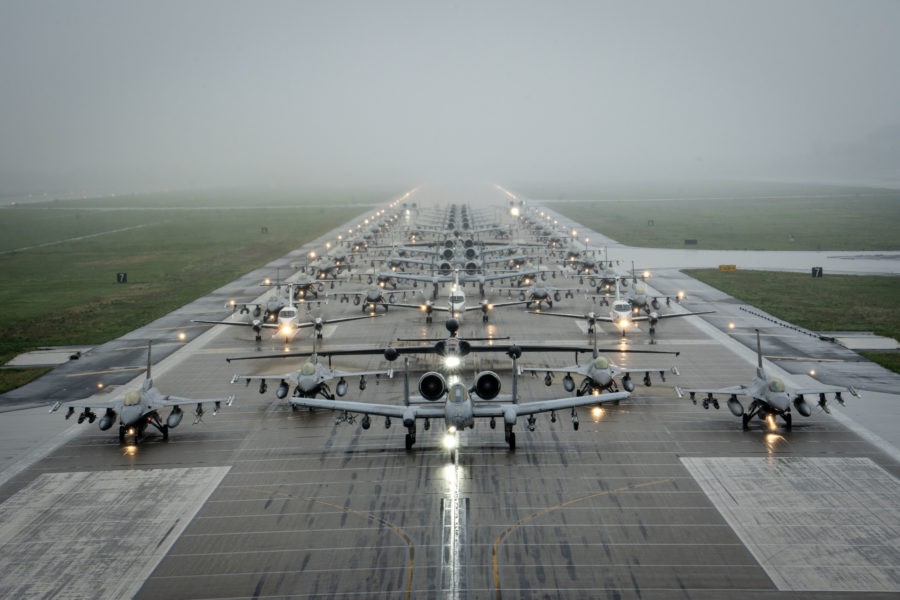
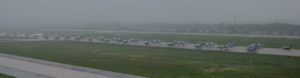
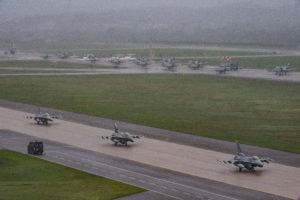
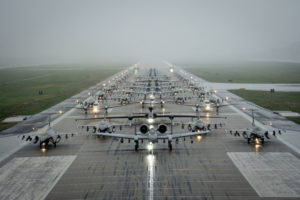
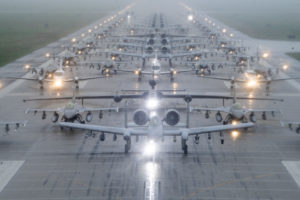
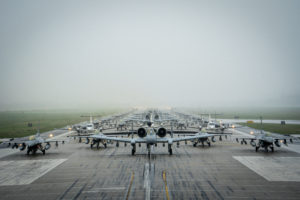
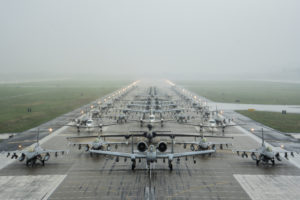
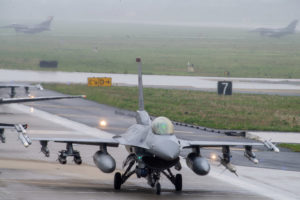
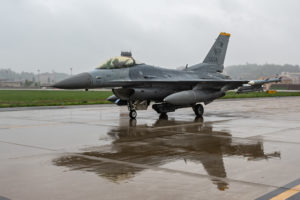
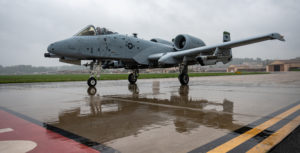
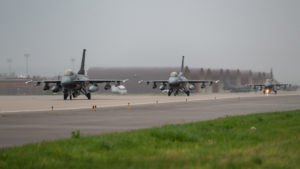
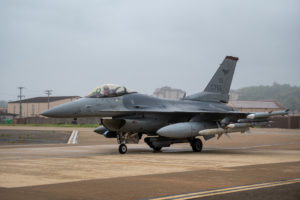
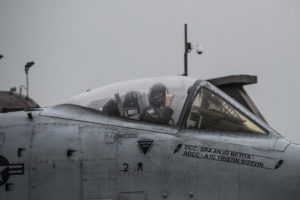
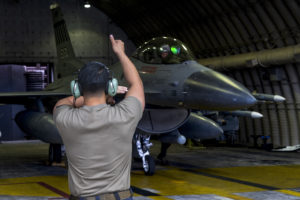
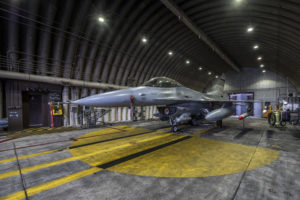
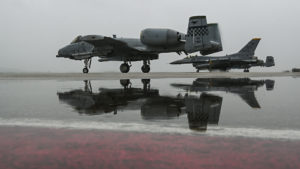
F-16 Fighting Falcons, A-10C Thunderbolt IIs, U-2 Dragon Ladys, and C-12 Hurons taxi stand parked on the runway at Osan Air Base during the Mammoth Walk training event on May 5, 2023. U.S. Air Force photo by Master Sgt. Joshua J. Garcia
Audio of this article is brought to you by the Air & Space Forces Association, honoring and supporting our Airmen, Guardians, and their families. Find out more at afa.org
The Air Force’s surge of “elephant walks” in recent moves has showcased airpower and Airmen’s ability to rapidly generate airpower.
But at Osan Air Base, South Korea, in early May, Airman took the concept to another level: more than 50 aircraft from two bases on the Korean peninsula.
Two U-2 Dragon Ladys, three C-12 Hurons, 12 A-10 Thunderbolt IIs, and 36 F-16 Fighting Falcons all gathered at Osan for a large-scale training event on May 5. In images released May 31, the 51st Fighter Wing referred to the event as a “mammoth walk,” typically used to describe an elephant walk that features all of the available aircraft at a base.
The 51st Fighter Wing at Osan contributed A-10s and F-16s to the exercise, while the 8th Fighter Wing at Kunsan Air Base added F-16s. The U-2s belong to the 5th Reconnaissance Squadron stationed at Osan.
“The large aircraft generation training event demonstrated the wings’ rapid generation capabilities and response readiness,” the 51st FW said in a press release. “The combined ability of 7th Air Force and our partner units at Osan Air Base to generate combat airpower at a moment’s notice affirm that our commitment to the Republic of Korea remains ironclad and ensure regional stability throughout the Indo-Pacific.”
The presence of the 8th Fighter Wing at Osan comes amidst runway repair work at Kunsan, which is expected to be completed by August.
Exercise Beverly Midnight 23-1 in South Korea stretched from May 4-12, on the heals of the Korea Flying Training exercise that took place April 17-28. B-1 and B-52 bombers have flown repeated sorties over or near the Peninsula throughout the year, in shows of force intended to reassure South Korea and remind North Korea of U.S. reach.
Also in May, a U.S. F-16 from the 8th Fighter Wing crashed near Osan, bursting into a fiery wreck after the pilot safely ejected.
The “mammoth walk” in South Korea was at least the seventh elephant walk or mass generation exercise at a USAF base in the past four months:
Seven E-3 Sentry airborne warning and control, or AWACS, aircraft participated in a “weather flush” on March 21 at Tinker Air Force Base, Okla.
20 mobility aircraft—seven KC-135 Stratotankers, eight C-17 Globemaster IIIs, and five KC-46 Pegasus—also participated in a severe weather exercise March 24 at Altus Air Force Base, Okla.
21 tankers—16 KC-46s and five KC-135s—lined up as part of an Agile Combat Employment exercise at McConnell Air Force Base, Kan., also on March 24.
4,000 Airmen and 80 trainer aircraft gathered on the runway at Sheppard Air Force Base, Texas, on April 7, to showcase the power of its people as well as its planes.
18 KC-135 Stratotankers lined up on the runway at MacDill Air Force Base, Fla., on April 26.
Going back a few months further, Airmen at Kadena Air Base, Japan, executed a 36-airframe elephant walk featuring six aircraft types in November 2022.
Audio of this article is brought to you by the Air & Space Forces Association, honoring and supporting our Airmen, Guardians, and their families. Find out more at afa.org
The Air Force Life Cycle Management Center is moving forward with a program to upgrade a quarter-century-old computing system for some F-16 fighter jets.
The U.S. Navy on Oct. 15 accepted a C-130J-30 Super Hercules plane that it will modify to become the first of its new nuclear command, control, and communications aircraft—a route the Air Force is considering for a similar NC3 mission under congressional direction.
More than 40 years after the original YF-117 operational prototype flew test runs from a Lockheed Martin Skunk Works facility, an F-117 returned for a $1 million refurbishment to look its best when it assumes its place in history alongside other iconic aircraft on permanent exhibit at the National Air…
A U.S. Air Force F-22 pilot controlled a YFQ-44A Fury Collaborative Combat Aircraft this month while both aircraft were in flight, according to an Oct. 16 release, another milestone in the service’s ambitious CCA efforts.
The Marine Corps recently conducted its first-ever “ripple” release of eight Small Diameter Bomb IIs from an F-35B, a key early step in proving out the capability for all F-35 variants.
The Air Force will field operational prototypes for an autonomous drone to replace its MQ-9 Reaper in 2028, Secretary of the Air Force Troy Meink said Oct. 14.
One of the Air Force’s critical B-2 Spirit stealth bombers has returned to Whiteman Air Force Base, Mo., after an extensive course of maintenance to restore its stealth coating and preserve its structural integrity.
BAE Systems has received a contract from Lockheed Martin to install an upgraded Block 4 electronic warfare system into new F-35 Joint Strike Fighters, as well as to retrofit some older jets.
The Air Force has figured out a way for maintainers to inspect what had been a “blind spot” in F-16 engines, after problems in that area led to the catastrophic crashes of two jets in recent years.
✓
Thank You!
Check your inbox to verify your email address and finish setting up your AFA account.
★
Welcome Back!
An account with this email already exists. Please log in to continue.
Subscribe to the Air & Space Forces Daily Report
The latest news from Air & Space Forces Magazine, as well as news from other leading publications, delivered right to your inbox every morning!
We’re sorry, there has been an error. Please review your input or try again later.