


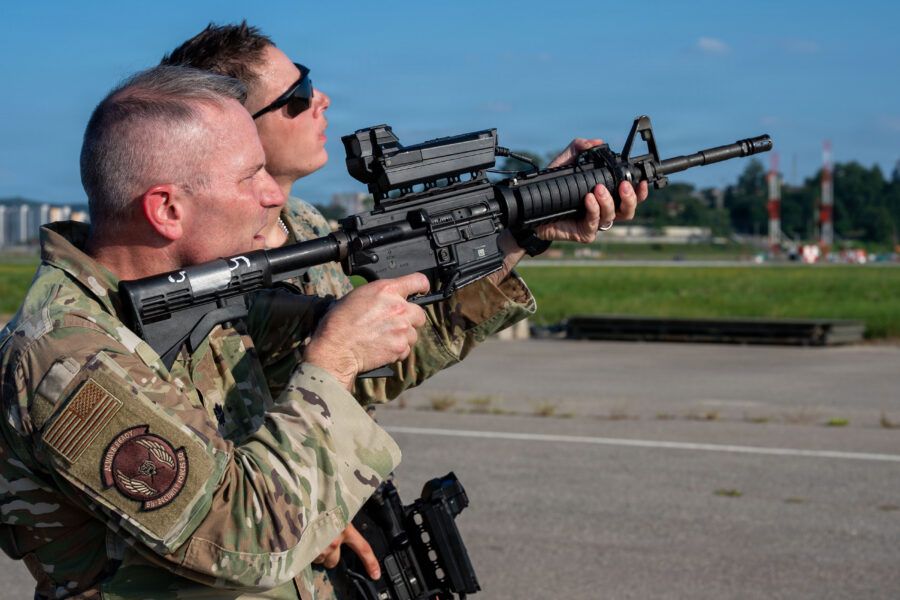
Some 50 miles from the border with North Korea, U.S. and South Korean forces recently executed their first counter-drone defense drills targeting medium-sized systems, which the North Korean military has has prioritized based on Russia and Iranian models.
Airmen, Soldiers, and Marines conducted exercise Dragon Flight from Aug. 2-6 at Osan Air Base, according to a 51st Fighter Wing release. The drills were conducted before President Donald Trump scaled back the recent larger, peninsula-wide, annual Ulchi Freedom Shield.
The exercise helped service members practice defending the F-16C/D fighters at Osan, which in turn defend against threats such as North Korea. The base’s primary mission is to launch waves of fighter jets in a potential conflict.
“This exercise helped all the involved agencies assess and validate their respective C-UAS defense systems,” 1st Lt. Thu Le with the 51st Security Forces Squadron said in the release. “I hope that this event gives the 51st Fighter Wing confidence in its current air defense capabilities and just shows how crucial such systems are to the defense of the base, its assets, and all 16,000 joint-force personnel.”
The exercise gave Osan a chance to train on a portion of air defense it hasn’t always focused on: Group 3 drones. These systems fall between smaller Group 1 and 2 threats and larger, legacy ballistic missiles, both of which personnel at Osan and Kunsan Air Bases have trained to defeat.
Alongside the service members conducting the counter-drone training were contractors from Griffin Aerospace, which operated the Outlaw Drone to simulate hostile aircraft.
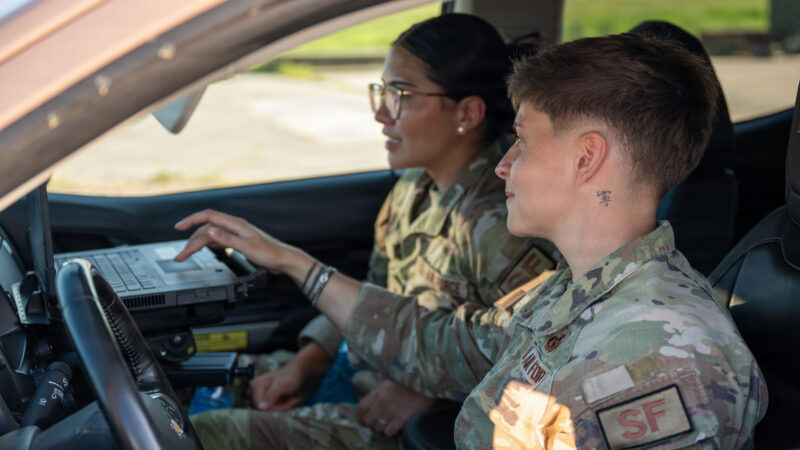
Members of the 51st Security Forces Squadron used the Expeditionary Mobile Air Defense System to beat back the threat.
Soldiers with the 35th Air Defense Brigade used the AN/TWQ Avenger system while Marines with the 2nd Low Altitude Air Defense Battalion used Stinger man-portable missiles with Smart Shooter SMASH optics, according to the release.
Republic of Korea personnel also worked in the exercise with their own equipment.
The Bigger Picture
This training comes as U.S. bases and forward-deployed units face an ever-increasing drone threat, especially from Group 3 drones, which weigh between 50 and 1,320 pounds, fly up to 18,000 feet at speeds under 250 knots, and cost between $20,000 and $50,000 to produce.
During Operation Epic Fury, Iran has launched an estimated 2,000 Shahed-136 drones, which are Group 3, at U.S. and allied forces in the region, forcing the U.S. to use expensive munitions to take them down.
An Iranian one-way drone hit a U.S. facility in the Port of Shuaiba, Kuwait, on June 1, killing six U.S. soldiers.
Russia has used Iranian technology to build its own one-way attack drones, and North Korea has contributed troops and weapons to Russia in its war against Ukraine. In turn, Russia has reportedly helped North Korea to copy the Shahed and begin building factory lines to produce the knockoffs in 2025. North Korean leader Kim Jong Un has called drone production an “essential requirement” and a “top priority and important task” for modernizing the nation’s military.
Prior to the Shahed focus, North Korea used its own drones to conduct perimeter incursions into the Demilitarized Zone between North and South Korea in December 2022.
Since then, local news reports say smaller reconnaissance drones have been spotted in South Korean border cities from 2024 to 2025.
While both Osan and Kunsan Air Bases in South Korea have MIM-104 Patriot Systems for ballistic missiles, cruise missiles, and fighter jets, as well as short-range air defense systems such as the AN/TWQ Avenger system, those are mainly geared toward low-altitude aircraft, cruise missiles, and helicopters.
Kunsan has not yet conducted a specific counter-drone exercise for Group 3 drones. However, Kunsan personnel have conducted exercises such as Beverley Sentinel, using red teams to test defenses against Group 1 and 2 drones.