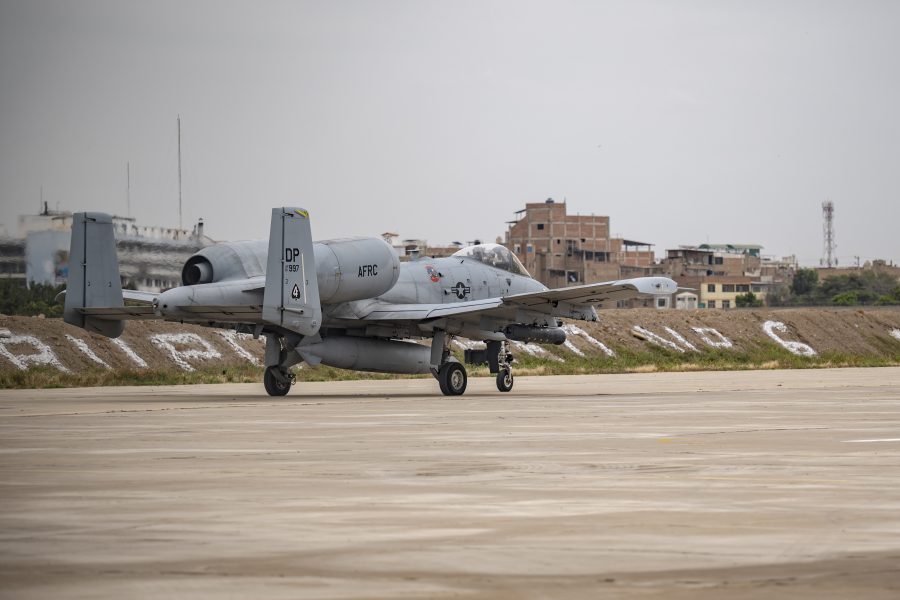
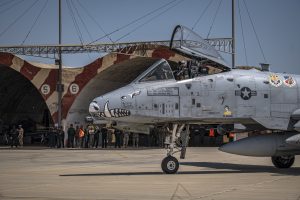
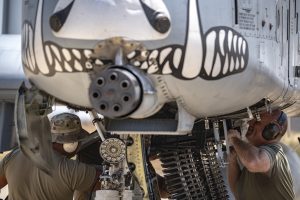
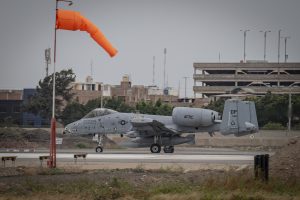
A U.S. Air Force A-10 Thunderbolt II from the 64th Air Expeditionary Wing, prepares for takeoff during exercise Resolute Sentinel, July 12, 2023, Chiclayo, Peru. U.S. Air Force photo by Master Sgt. Chris Hibben
Audio of this article is brought to you by the Air & Space Forces Association, honoring and supporting our Airmen, Guardians, and their families. Find out more at afa.org
An A-10 “Warthog” landed in South America for the first time ever recently, as Air Forces Southern leads one of the largest exercises under U.S. Southern Command.
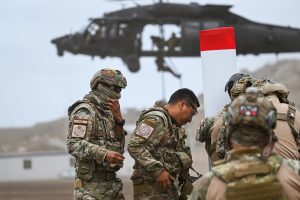
Resolute Sentinel 23, the third edition of the training exercise in SOUTHCOM, involves roughly 1,000 personnel from the Air Force, Space Force, Army, Marine Corps, Coast Guard, and eight partner nations: Peru, Ecuador, Colombia, Great Britain, Brazil, Chile, Panama, and Uruguay.
The 12th Air Force—Air Forces Southern—is leading the exercise, with 10 USAF aircraft involved, including the A-10, KC-135, C-130, C-17, and C-5, as well as 24 USAF units, spokesman Lt. Col. Mickey Kirschenbaum told Air & Space Forces Magazine.
Resolute Sentinel began in 2021, growing from previous humanitarian relief exercises like New Horizons and Beyond the Horizons. The first two editions took place in Central America, but this latest version, based mostly out of Peru, marks the biggest one yet.
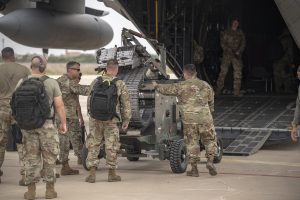
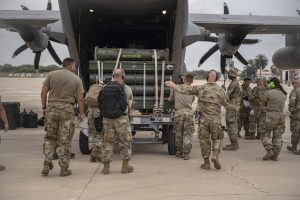
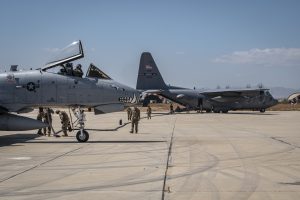
In addition to practicing humanitarian relief operations and aeromedical evacuations, Resolute Sentinel includes training for combat operations, interoperability, and Agile Combat Employment, requiring Airmen to rapidly relocate and operate from austere bases. In one scenario on July 12, Airmen set up a forward area refueling point (FARP), gassing up an A-10 from an HC-130 in a remote airfield. “The A-10s need additives for their fuel,” Kirschenbaum said. “We thought we had a contractor here that was going to provide that, and they weren’t able to. So we had to come up with a solution to ferry fuel from one location to the other and then put the additives in so the A-10s can fly with the proper fuel inside. … We’ve been doing a lot of events like that, overcoming obstacles that you would see in a deployed location.”
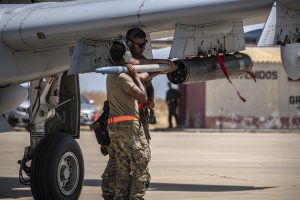
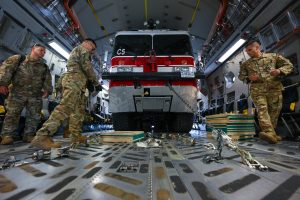
The A-10s in the exercise are from the Air Force Reserve’s 47th Fighter Squadron at Davis-Monthan Air Force Base, Ariz.—the Reserve portion of the exercise is going by the name Patriot Fury. Units from Texas, Georgia, Minnesota, Pennsylvania, and Ohio are all involved, even bringing their own fire truck and refueling trucks.
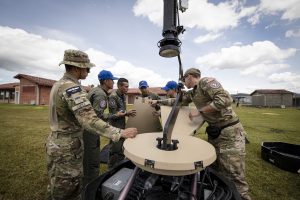
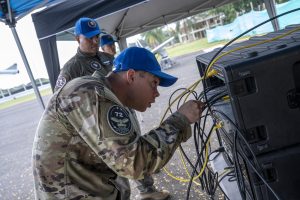
Meanwhile, the Space Force is also getting involved through Operation Thundergun Express, a 21-day Space Force deployment exercise nested under Resolute Sentinel. Members of the 16th Electromagnetic Warfare Squadron worked with compatriots from the Ecuadorian and Colombian air forces to build “mobile space detection systems” in Cali, Colombia, and Rionegro, Colombia, and based their command and control in Lima, Peru, according to an AFSOUTH release. It was “the first-ever defensive space control operation in U.S. Southern Command history.”
“During the exercise, the forward-deployed team rapidly detected and reported live-fire electromagnetic interference sent from an exercise input cell attempting to disrupt a commercial satellite on orbit over the Atlantic Ocean,” according to the release.
Resolute Sentinel began June 24 and will run through July 22.
Editor’s Note: This article was updated July 17 to correctly identify all of the units involved in the exercise.
Audio of this article is brought to you by the Air & Space Forces Association, honoring and supporting our Airmen, Guardians, and their families. Find out more at afa.org
The top Air Force commander on on the Japanese island of Okinawa has clamped down alcohol and issued a curfew for junior enlisted Airmen and Guardians at Kadena Air Base for the next month. The order came roughly two weeks after a U.S. Marine was arrested for allegedly robbing and…
The Air Force Office of Special Investigations is looking for a few good Airmen to swap jobs and become special agents. No, they won’t get the 007 James Bond code—but they could learn to conduct counterintelligence and investigate procurement fraud and major crimes.
The Air Force’s future strategy for fighting wars could include arming bombers with air-to-air strike capabilities, the service said in a new report to Congress.
The Pentagon has concluded a new agreement to buy laser-guidance kits that turn rockets into drone-killing weapons. BAE Systems and the Defense Department announced a framework deal of up to seven years for 25,000 Advanced Precision Kill Weapon System guidance kits annually for the U.S. military.
The Space Force has selected six commercial space domain awareness companies to support military operations with both steady-state and surge capacity, as part of the service’s new Commercial Augmentation Space Reserve.
The Pentagon and Lockheed Martin on Oct. 22 announced a framework agreement to buy F-35 Joint Strike Fighters for the next 10 years. But the deal, touted by the Pentagon as “landmark” and a first of its kind, depends on Congress granting the military authority to enter into such a…
Over a two-week period beginning in late September and culminating in mid-October, a Russian satellite maneuvered dangerously close to a commercial Finnish satellite currently providing intelligence to the Ukrainian military. The apparent provocation has experts wondering why Russia made the move—testing new capabilities, collecting intelligence, or trying to intimidate the…
At least two KC-135 Stratotankers that were seriously damaged during Operation Epic Fury are still undergoing extensive maintenance depot repairs, the head of Air Force Materiel Command said Oct. 21.
As the Air Force wrestles to solve the logistics of dispersed operations in the vast Indo-Pacific, it’s investing $3.5 million to help develop a new kind of aircraft: a blended-wing body freighter that’s smaller than a C-130 but larger than a Cessna for “sub-tactical” lift.
✓
Thank You!
Check your inbox to verify your email address and finish setting up your AFA account.
★
Welcome Back!
An account with this email already exists. Please log in to continue.
Subscribe to the Air & Space Forces Daily Report
The latest news from Air & Space Forces Magazine, as well as news from other leading publications, delivered right to your inbox every morning!
We’re sorry, there has been an error. Please review your input or try again later.