
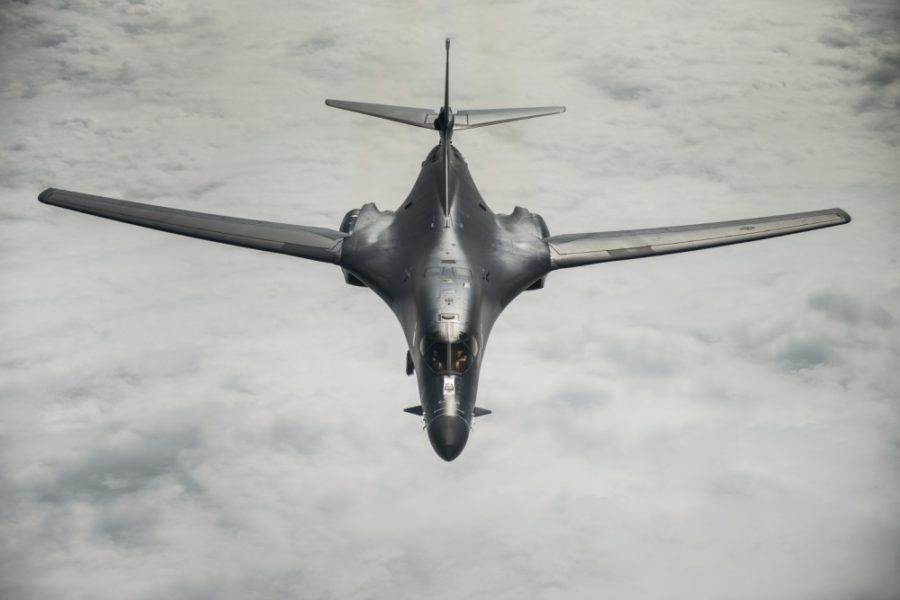
The B-1B is a conventional, long-range, supersonic, penetrating strike aircraft derived from the canceled B-1A. The B-1A first flew on Dec. 23, 1974, and four prototypes were developed and tested before program cancellation in 1977.
The Reagan administration revived the program as the B-1B in 1981, adding 74,000 lb. of usable payload, improved radar, and reduced radar cross section, but reducing speed to Mach 1.2. Its three internal weapons bays carry the largest payload of guided/unguided weapons in the Air Force inventory, and its blended wing/body and variable-geometry wing permit long-range/loiter time.
Offensive avionics include terrain-following SAR and a fully integrated Sniper ATP to track and target moving vehicles. B-1B made its combat debut over Iraq during Desert Fox in 1998. The B-1B is USAF’s sole Long-Range Anti-Ship Missile (LRASM) carrier and its range, speed, and payload make it a key power-projection asset in USAF’s Indo-Asia Pacific strategy.
The fleet completed its most comprehensive upgrade in 2020 including an all-digital glass cockpit, Fully Integrated Data Link (FIDL) to enhance targeting/LOS/ BLOS C2, and an internal test system to simplify troubleshooting. Ongoing upgrades include Load Adaptable Modular (LAM) pylons to carry long-range standoff, hypersonic, or 5,000- lb-class guided weapons externally. LAM expands capacity to 36 JASSM, LRASM, or developmental Hypersonic Attack Cruise Missiles (HACM).
The aircraft completed a successful weapon separation test in preparation to take over hypersonic weapons testing from the B-52. The B-1 finished developmental flight-testing of the next-gen MUOS secure, jam-resistant BLOS SATCOM, and is also undergoing radio crypto modernization. FY26 launches integration of the newest LRASM C3 variant as well as “hybrid” dispersed low-Earth orbit SATCOMS development for INDOPACOM requirements.
ACC deployed a third of the fleet for Operation Epic Fury, operating 15 B-1Bs alongside B-52s at RAF Fairford, U.K., in early 2026. USAF plans to spend $342 million on B-1 modernization from 2027 to 2031, which will keep the platform relevant until 2037, according to budget documents.
B-1B Lancer Technical Data
Contractor: Boeing (formerly Rockwell International).
First Flight: Oct. 18, 1984 (B1-B).
Delivered: June 1985-May 1988.
IOC: Oct. 1, 1986, Dyess AFB, Texas.
Production: 104.
Inventory: 45.
Operator: AFGSC, AFMC.
Aircraft Location: Dyess AFB, Texas; Edwards AFB, Calif.; Eglin AFB, Fla.; Ellsworth AFB, S.D.
Active Variant: B-1B. Upgraded production version of the B-1A.
Dimensions: Span 137 ft (forward sweep) to 79 ft (aft sweep), length 146 ft, height 34 ft.
Weight: Max T-O 477,000 lb.
Power Plant: Four GE Aviation F101-GE-102 turbofans, each 30,780 lb thrust.
Performance: Speed 900+ mph at S-L, range approx. 7,455 miles (further with air refueling).
Ceiling: More than 30,000 ft.
Armament: 84 Mk 82 (500-lb) or 24 Mk 84 (2,000-lb) general-purpose bombs; 84 Mk 62 (500-lb) or eight Mk 65 (2,000-lb) Quickstrike naval mines; 30 CBU-87/89 cluster bombs or 30 CBU-103/104/105 WCMDs; 24 GBU-31 or 15 GBU-38 JDAMs/GBU-54 JDAM; 24 AGM-158A JASSM, JASSM-ER, or LRASM.
Accommodation: Pilot, copilot, and two WSOs (offensive/defensive), on ACES II zero/zero ejection seats.