


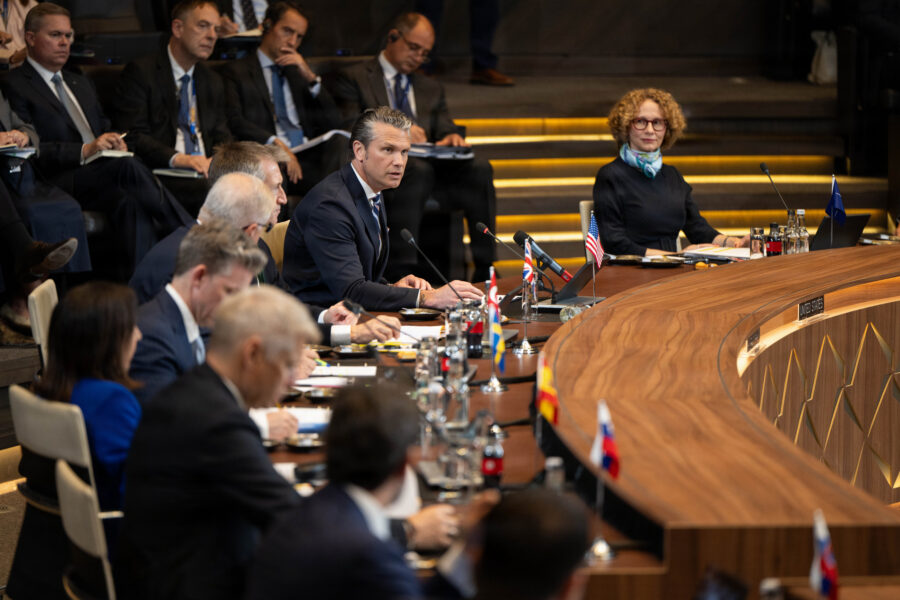
BRUSSELS—Secretary of Defense Pete Hegseth told NATO on June 18 that the U.S. is embarking on a sweeping review of the American military presence in Europe. He also warned that the U.S. would cut funds to the alliance’s operating budget if allies did not fulfill their commitment to boost military spending.
The assessment, which will take up to six months, would address “America’s core posture and basing in Europe,” Hegseth told allied defense ministers here.
The review will be led by Air Force Gen. Alexus Grynkewich, the head of U.S. European Command, and the assessment has no predetermined outcome, a U.S. official told Air & Space Forces Magazine. Grynkewich also serves as Supreme Allied Commander Europe, NATO’s top military officer.
“Make no mistake about it, this will be a real review,” Hegseth said. “It will be designed to ensure that NATO is moving fast and irreversibly toward Europe, stepping up to take primary responsibility for the defense of Europe, stepping up to ensure our forces are postured for America’s global needs, and stepping up to make sure our access, basing, and overflight are clearly delineated and assured. Any other country would do the same thing.”
The review comes amid a debate between the Pentagon and American lawmakers, including top-ranking Republicans, who support NATO and complain they were not consulted about previous U.S. troop cuts. The lawmakers have inserted provisions in the draft 2027 National Defense Authorization bill that are intended to stave off further troop reductions at a time when the Russian threat is showing no sign of diminishing. Some of those congressional provisions require a risk assessment by Grynkewich and Air Force Gen. Dan Caine, the Chairman of the Joint Chiefs of Staff, about the impact of any proposed U.S. troop reductions.
Striking a familiar theme, Hegseth asserted that many European countries had been “free-riding” on U.S. military spending. He also admonished European countries for not providing enough support for U.S. operations in Iran, which has also irked President Donald Trump.
Britain allowed U.S. bombers that attacked Iran to fly from one of its bases, but Spain balked at the use of its facilities. European nations were not consulted prior to the U.S. and Israeli attacks on Iran.
The Trump administration has dubbed its policy towards European security NATO 3.0, which seeks to give Europe the main responsibility for non-nuclear defense of the alliance’s 32 member countries. The U.S. would still retain the main responsibility for nuclear deterrence.
Last year, nearly all alliance members agreed to spend 5 percent of their gross domestic product on defense, and a number of key allies, including Poland and Germany, are stepping up their military spending.
Hegseth’s comments come a few weeks before the high-stakes session of NATO’s annual summit attended by the alliance’s top political leaders, which Trump is expected to attend. “NATO will be a two-way street. It’s only common sense,” Hegseth said. “America cannot care for or pay more for Europe’s defense than our allies.”
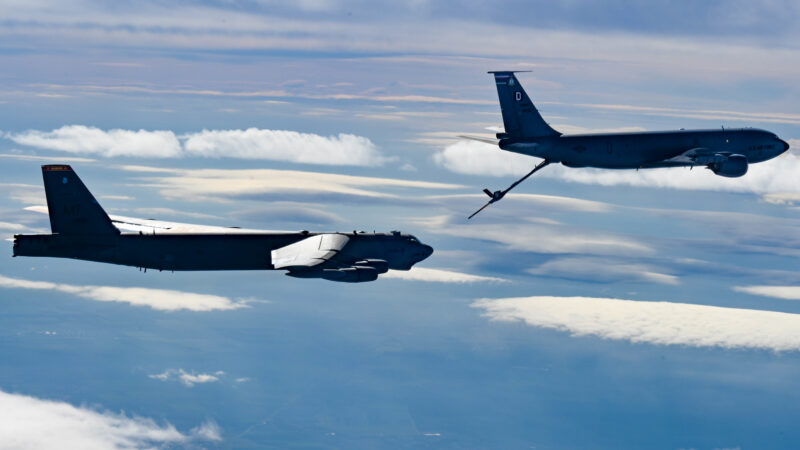
The Pentagon removed a brigade from Romania last year and recently halted the deployment of an armed brigade that was supposed to deploy to Poland. It has also reduced the assets the U.S. would commit to NATO in a conflict, including fewer aerial refueling planes, fighters, and strategic bombers—capabilities that Europe either lacks entirely or is in need of more, with future purchases of warplanes on order. The cuts to the so-called NATO Force Model were announced in recent weeks.
“It is immediate,” NATO Secretary General Rutte told reporters June 18. “The U.S. is lowering its contribution, still considerable, but somewhat lower than it was in the past. What you see there is that the Europeans are now backfilling it. Some of this is already done, some of this is in progress. We are working on that.”
U.S. officials have indicated that the shift is intended to devote more military resources to the Pacific.
Some allies say it would have been more productive to have a transitional phase.
“It is difficult and dangerous for the security of NATO’s European front when capabilities are withdrawn very quickly and before it is clear when these can be replaced,” said German Defense Minister Boris Pistorius.
“We know that they do more in the Indo-Pacific and we know that we have to do more for our conventional deterrence and defense,” he added. “But it takes some time, and it needs to acknowledge that we have in Europe, and even in the United States, a challenge when it comes to the capacity of production of the defense industry.”
But Rutte expressed confidence that the U.S. would “max out” its contributions in the event of a major war that prompted the alliance to invoke its Article 5 mutual defense clause.
There is “no effect” on America’s nuclear deterrence commitment to the alliance by the U.S. force reductions, a senior NATO official said. “It’s not in question,” the official added.
Hegseth warned that the U.S. could reduce its funding to NATO’s operating budget, which is separate from domestic defense spending. The U.S. currently contributes roughly 15 percent to NATO’s annual budget of around $5.75 billion.
“Going forward, our annual NATO dues will be contingent on other countries meeting their defense spending targets,” Hegseth said. “Where other allies do not spend with urgency, our dues contributions will go down.”
The Trump administration’s moves have drawn criticism from some U.S. lawmakers, including Republican leadership of the House and Senate armed services committees, who have expressed surprise that they weren’t consulted.
Both Republicans and Democrats appear united in attempting to cap U.S. troop cuts by including a provision in the draft NDAA that would maintain a congressional-mandated floor of 76,000 troops in Europe.
“There’s nothing wrong with reviewing our posture,” SASC Chairman Roger Wicker (R-Miss.) told reporters June 18. “There was some speculation that some specific announcement might be made. To the extent that no drawdowns were announced, it was a relief to some people.”
Hegseth said the U.S. would consult Congress and NATO allies during the U.S. review.
Hegseth’s fellow defense ministers, some with their arms crossed, watched with flat, resigned expressions in a cavernous conference room at the alliance’s glass-enclosed headquarters on the outskirts of Brussels.
Rutte praised U.S. efforts to spur more European defense spending as well as America’s deal with Iran that the U.S. says will reopen commercial traffic in the Strait of Hormuz.
NATO was established to defend Europe against a Soviet attack, and it sent troops to Afghanistan at Washington’s insistence. But alliance supporters have been reluctant to give the U.S. a blank check to use its facilities to carry out military operations well outside of Europe without advance consultations.
Hegseth, in contrast, said that any restrictions on U.S. aircraft basing and overflight permission to support strikes on Iran were unacceptable.
The U.K., after some consultation, allowed U.S. bombers to operate from its territory to attack Iran, and RAF Fairford in England now hosts around 20 B-1 Lancers and B-52 Stratofortresses, the largest overseas deployment of American bombers in recent history. Spain, which has routinely hosted bomber training deployments and aerial refueling tankers in the past, denied America the use of its facilities entirely. The Pentagon chief suggested some allies’ actions could have led to more American deaths in the conflict.