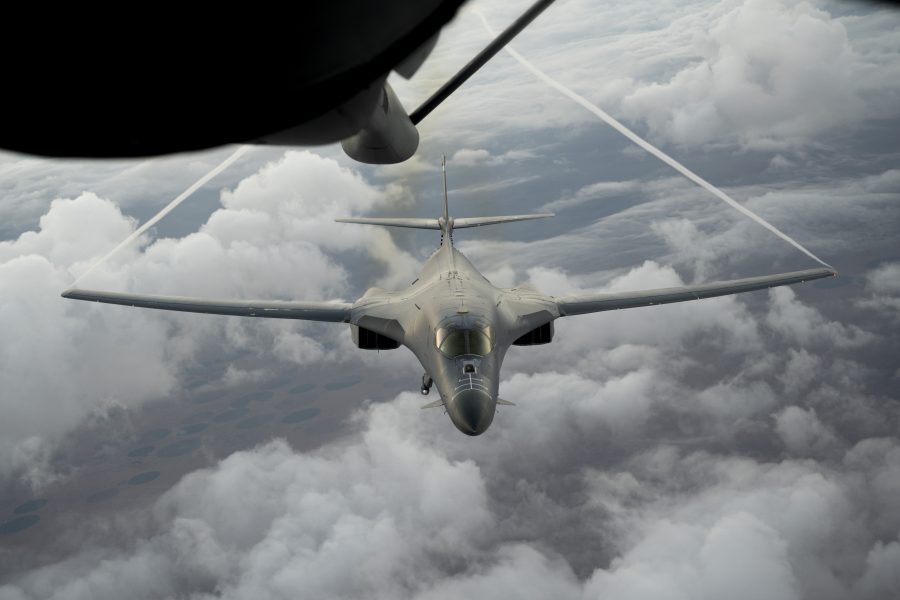
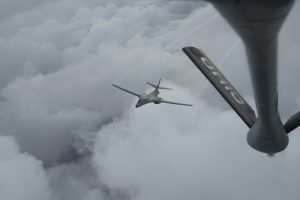
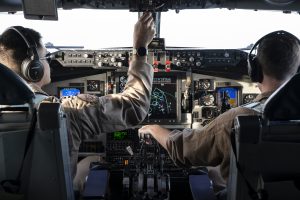
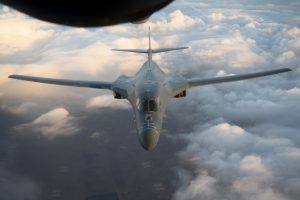
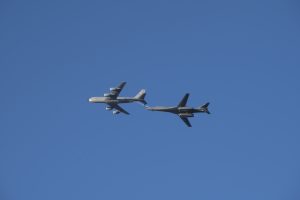
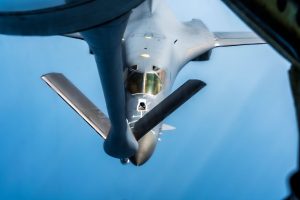
A U.S. Air Force B-1B Lancer approaches a KC-135 Stratotanker as part of a regularly-scheduled Bomber Task Force (BTF) mission in the U.S. Central Command area of responsibility Nov. 13, 2023. BTF missions actively enable bombers to operate with greater operational resilience from various overseas and continental U.S. locations, supporting the National Defense Strategy objectives of building enduring advantages and integrated deterrence in the USCENTCOM AOR. (U.S. Air Force photo by Senior Airman Jacob Cabanero)
Audio of this article is brought to you by the Air & Space Forces Association, honoring and supporting our Airmen, Guardians, and their families. Find out more at afa.org
U.S. Air Force B-1 bombers have flown missions over the Middle East three times in the last week and a half amid U.S. military activity and widespread unrest in the region.
When the first B-1 flight took place Nov. 5, Pentagon Press Secretary Air Force Brig. Gen. Patrick S. Ryder emphasized that it was a “long-planned Bomber Task Force mission” as part of the BTF rotation out of RAF Fairford, United Kingdom, which began Oct. 13.
“It’s important to differentiate the Bomber Task Force mission from the current situation in the Middle East,” Ryder said. at the time. U.S. troops have been attacked more than 50 times in the last month by Iranian-backed militias, as the entire region is on edge in the wake of the Israel-Hamas war.
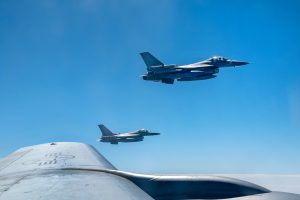
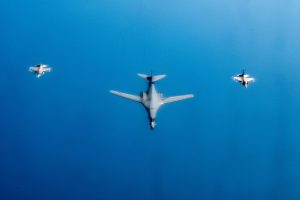
U.S. Central Command subsequently announced a second B-1 flight took place Nov. 8, with the bomber from Dyess Air Force Base, Texas, escorted by F-16 fighters. Released images showed the fighters as belonging to the 138th Fighter Wing of the Oklahoma Air National Guard. The Tulsa-based Vipers are one of three F-16 squadrons in the region.
On November 8, 2023, and for the second time in three days, a U.S. B-1 Lancer conducted a mission over the U.S. Central Command area of responsibility. U.S. F-16s escorted the bomber. pic.twitter.com/VsXYPyEWsZ
A third flight occurred Nov. 13, with the B-1 getting refueled by a KC-135 Stratotanker from the 121st Air Refueling Wing of the Ohio Air National Guard.
For the third time in eight days, B-1 Lancers conducted missions in the USCENTCOM area of responsibility demonstrating the ability to rapidly project combat power. pic.twitter.com/uRk5qRYVfC
CENTCOM offered few details on the flights, merely stating that the missions showed “the ability to rapidly project combat power” while noting their frequency. No locations were disclosed.
In a social media post, Air Forces Central called the Nov. 13 flight “a regularly scheduled Bomber Task Force mission.”
It is not unusual for bombers deployed to Europe as part of a Bomber Task Force rotation to conduct missions over the Middle East. In June, B-1s from a BTF deploying to Europe conducted live-fire exercises at ranges in Jordan and Saudi Arabia. In March, a B-52 flew alongside fighter escort aircraft from seven different nations during a flight over the region.
However, three announced flights in eight days marks the most by a bomber task force in CENTCOM’s area of responsibility in recent years.
The U.S. has also surged other assets to the region in recent weeks, including additional attack and fighter squadrons, two aircraft carriers—the USS Dwight D. Eisenhower in the Red Sea and the USS Gerald R. Ford in the eastern Mediterranean Sea—and an Ohio-class cruise missile submarine in the Suez Canel.
Audio of this article is brought to you by the Air & Space Forces Association, honoring and supporting our Airmen, Guardians, and their families. Find out more at afa.org
Northrop Grumman’s Talon Blue YFQ-48A Collaborative Combat Aircraft took its first flight Oct. 3, heightening the competition for the Air Force’s future combat fleet.
The Air Force’s plans to field 1,000 semi-autonomous fighter and intelligence, surveillance, and reconnaissance drones within just a few years made headlines at AFA’s Air, Space & Cyber conference last month. But beyond the service’s signature Collaborative Combat Aircraft and Massed Modular Aircraft programs, a half-dozen or so firms are pitching…
All 12 American bombers deployed in Britain rapidly returned to the U.S. on Oct. 4 following security concerns about a potential Iranian threat to their base in the U.K.
Air Force Global Strike Command has fielded a new prototype system for beyond-line-of-sight communications on the B-52H Stratofortress in a step forward for modernizing the Cold War-era heavy bomber.
After a two-year experiment that created F-16 “Super Squadrons” at Osan Air Base just 50 miles away from North Korea, the U.S. Air Force has returned some of the fighters to its other base on the peninsula.
The Air Force adjusted its fiscal 2026 recruiting goal down by a few hundred enlisted Airmen due to higher-than-expected retention and the number of available training slots—but it is aiming high in fiscal 2027 with its biggest goal for the Active-Duty Air Force in nearly 25 years, and the Space…
Seven F-22 Raptor pilots have recently been awarded one of the military’s highest decorations for their actions during operations in the Middle East. Six of the pilots were decorated with the Distinguished Flying Cross for their role in Operation Midnight Hammer, the June 2025 strikes against Iranian nuclear facilities.
Three T-7A Red Hawk trainer jets flew together at Joint Base San Antonio-Randolph, Texas, on Sept. 16—one physical aircraft in the air and two virtual ones controlled from simulators on the ground, all sharing one common operating picture.
The Air Force and Defense Innovation Unit have selected seven companies to move forward on a program meant to produce a low-cost, semi-autonomous drone to succeed the MQ-9A Reaper, multiple sources confirmed to Air & Space Forces Magazine.
✓
Thank You!
Check your inbox to verify your email address and finish setting up your AFA account.
★
Welcome Back!
An account with this email already exists. Please log in to continue.
Subscribe to the Air & Space Forces Daily Report
The latest news from Air & Space Forces Magazine, as well as news from other leading publications, delivered right to your inbox every morning!
We’re sorry, there has been an error. Please review your input or try again later.