
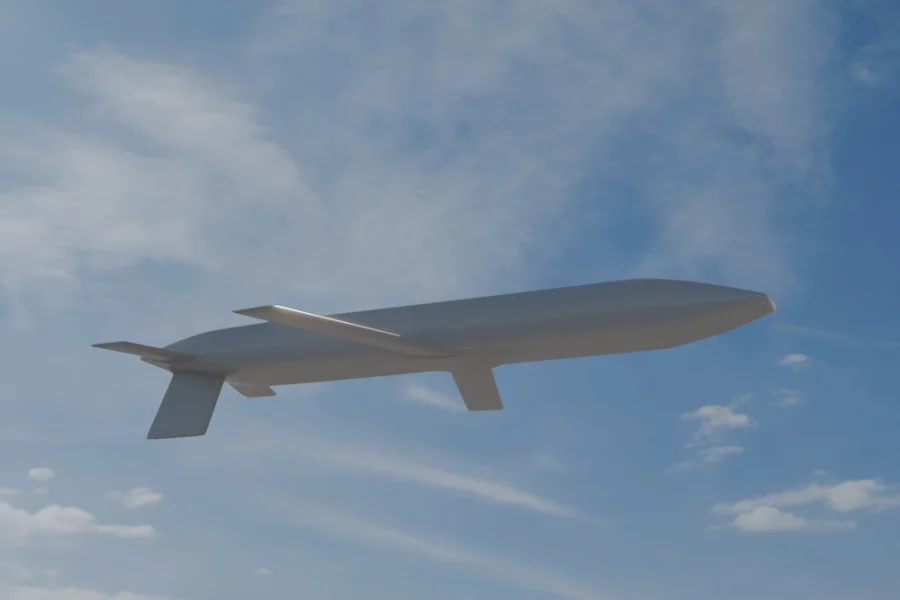
Air Force Secretary Troy Meink told lawmakers May 20 that the program to build a new long-range nuclear cruise missile is performing “very well” in both cost and schedule—but will require support as it enters a critical phase.
The AGM-181 Long Range Stand-off Weapon, or LRSO, is the service’s replacement for the aging AGM-86 Air-Launched Cruise Missile. The weapon, being developed by RTX, is expected to deliver a new nuclear strike capability by the end of the decade.
During a May 20 House Armed Services Committee hearing, Rep. Scott DesJarlais (R-Tenn.) asked Meink if the Air Force was continuing to prioritize the LRSO as it juggles a host of nuclear modernization priorities like the B-21 bomber, Sentinel intercontinental ballistic missile, and new nuclear command, control, and communications systems.
“Absolutely we will keep our eye on the ball on that,” Meink said. “I didn’t mention it, but it is one of those programs that is going very well. The program was properly structured from the beginning, and it is delivering actually at a very good cost point—not just from a schedule perspective, but from a cost perspective.”
For 2027, the Air Force is requesting $1.53 billion for LRSO—$565 million in research and development, $506 million for procurement, and $457 million in advance procurement.
That’s nearly double the 2026 budget, when Congress trimmed an already slimmed-down Air Force request all the way to $793 million for advanced and regular procurement, plus R&D. At the time, lawmakers justified some of their cuts as “unjustified growth” or “early to need.”
Now, though, DesJarlais called LRSO the “best performing” nuclear modernization program in the Air Force.
Meink, for his part, indicated the increase in resources comes at a “sensitive period” in LRSO’s development as it transitions from the research and development phase to production.
Indeed, budget documents show planned procurement spending growing year-over-year to reach more than $3 billion in 2031. Conversely, research, development, test, and evaluation funding is projected to decrease over the same period down to $23 million by 2031.
Officials have largely been secretive about the nuclear strike missile program. But its development feeds into the future of the Air Force bomber fleet—it is meant to be carried on the B-21 Raider and the B-52.
Need for a New Missile
The Boeing-built AGM-86, the current nuclear cruise missile, has been operational since 1982 and is currently carried by just the B-52. Around 1,715 missiles were produced, and the Air Force inventory as of 2024 was down to 536 units. It has a range of about 1,000 miles.
Mark Gunzinger, director of future concepts and capability assessments for the Mitchell Institute for Aerospace Studies, told Air & Space Forces Magazine that the AGM-86 is becoming hard to replace and its 1970s-era design was not built for today’s modern air defense systems.
The AGM-181 will transport the W80-4 warhead, which has a yield of up to 150 kilotons. It has a subsonic top speed, which is 530 to 690 mph.
“LRSOs will also give B-2s and B-21s the ability to strike targets without overflying defenses surrounding targets and it will expand the areas a bomber can hold at risk in a single sortie,” Gunzinger said.
The former B-52 pilot emphasized that bomber aircraft can, unlike other nuclear strike options, can be recalled or retargeted, making them both the most flexible and stabilizing elements of the nuclear triad.
The USAF first released its request for proposal for a nuclear air-launched cruise missile replacement in 2016.
In 2017, the Air Force awarded contracts of approximately $900 million each to Lockheed Martin and RTX to develop technologies and demonstrate the reliability and maintainability of the weapon, according to an Air Force Nuclear Weapons Center release.
RTX won the contract to produce the AGM-181 in 2020. The company received a $2 billion contract for the LRSO’s engineering, manufacturing, and development phase in 2021.
Wesley Kremer, former RTX president of Raytheon Missiles and Defense, told investors in an RTX investor day in 2021 that the LRSO had flown 6 million miles in a virtual environment.
Kremer used the LRSO as a key example of the company’s model-based systems engineering work.
“Right now, today, on LRSO, the Long-Range Stand-off Weapon, every single night, this code is compiled, the updates are made, the inputs from our vendors are made and we fly that missile 6 million miles in the highest threat environments in the world in a completely virtual environment,” Kremer said, according to a transcript of the event on the company’s website.
In 2023, the missile passed its critical design review.
Air & Space Forces Magazine reported in March on a photo of a B-52 flying with what appeared to be a pair of LRSO missiles. That was the first known public siting of the weapon, which was captured by Jarod Hamilton for CALLSIGN Magazine.
Before those photos, the weapon was only shown in an artist’s rendering released by the Air Force in 2025.
Details from the photo revealed that there had been progress made in testing the weapon, Gunzinger said in March.
