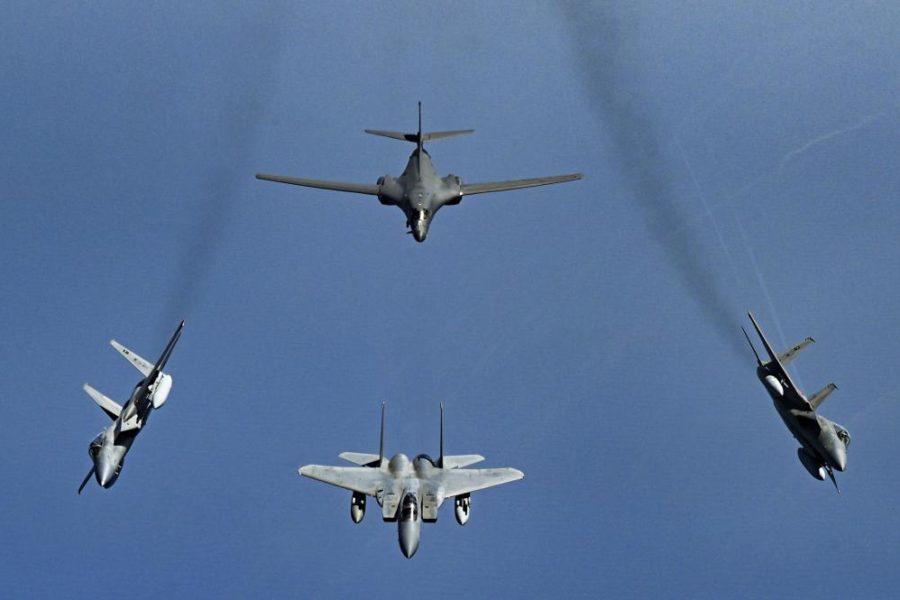
Royal Saudi Air Force F-15 Strike Eagles break away from a formation with a U.S. Air Force B-1B Lancer over the Red Sea as part of a presence patrol above U.S. Central Command’s area of responsibility Oct. 30, 2021. U.S. Air Force photo by Senior Airman Jerreht Harris.
Audio of this article is brought to you by the Air & Space Forces Association, honoring and supporting our Airmen, Guardians, and their families. Find out more at afa.org
A B-1 bomber flew with aircraft from four U.S. partner nations Oct. 30 as it circled the Arabian Peninsula during a bomber task force mission.
F-15s from Saudi Arabia and Israel and F-16s from Bahrain and Egypt escorted the bomber during a five-hour mission that “originated in the Indian Ocean, flew over the Gulf of Aden, Bab el-Mandeb Strait, Red Sea, Suez Canal, Arabian Gulf, Strait of Hormuz, and the Gulf of Oman,” according to a press release from U.S. Central Command. At least one American KC-10 also participated in the exercise.
“We are stronger together,” Gen. Kenneth F. McKenzie Jr., head of CENTCOM, said in a statement. “Military readiness for any contingency or mission—from crisis response to multilateral exercises to one-day presence patrols like this—depend on reliable partnerships.”
The Saudi Arabian and Israeli air forces also took to social media to feature images and videos from the mission.
Earlier today (Saturday), Israeli Air Force F-15 fighter jets escorted an American B-1B bomber over Israeli skies towards the surrounding bay.
The joint flight illustrates the continued strategic cooperation of the Israel Defense Forces with the United States in the area. pic.twitter.com/G6cPqRt8zK
While Central Command’s press release did not specify where the B-1 flew from in the Indian Ocean, B-1Bs and Airmen from the 28th Bomb Wing at Ellsworth Air Force Base, S.D., recently deployed to Naval Support Facility Diego Garcia in the Indian Ocean for the first time in 15 years as part of a bomber task force mission. Diego Garcia is located more than 2,000 miles from the Arabian Peninsula.
This marks the fifth “presence patrol” mission U.S. bombers have undertaken in the Central Command area of responsibility this year. It is the first since March and the first to involve a B-1. In January, B-52s flew over the Middle East on three occasions, followed by another mission in March.
The Air Force introduced bomber task forces in 2020 as an alternative to continuous bomber presences outside the continental U.S. In addition to the B-1Bs at Diego Garcia, B-1s from 9th Expeditionary Bomb Squadron of Dyess Air Force Base, Texas, deployed to RAF Fairford, England, in October as part of a bomber task force for U.S. Air Forces in Europe.
Audio of this article is brought to you by the Air & Space Forces Association, honoring and supporting our Airmen, Guardians, and their families. Find out more at afa.org
BAE Systems has received a contract from Lockheed Martin to install an upgraded Block 4 electronic warfare system into new F-35 Joint Strike Fighters, as well as to retrofit some older jets.
The Air Force has figured out a way for maintainers to inspect what had been a “blind spot” in F-16 engines, after problems in that area led to the catastrophic crashes of two jets in recent years.
The Air Force has begun evacuating stealth fighters, gunships, and special operations planes ahead of Hurricane Isaias expected landfall over the Gulf Coast this weekend.
The Air Force’s B-52 bomber may soon be able to carry up to 20 stealthy long-range anti-ship missiles to strike moving targets at sea, a key capability in a potential fight with China.
A reported surge of MQ-9 Reaper drones to Latin America could widen the scope of intelligence gathering and free up more strike options against cartels in the region, experts tell Air & Space Forces Magazine.
Northrop Grumman has broken ground on a major new production facility for the B-21 Raider, the company and the Air Force announced Oct. 6. The construction comes as a top service official said testing on the bomber is going well in the lead up to its planned introduction into the…
An OA-1K Skyraider II belonging to Air Force Special Operations Command went off the runway while landing at a small Oklahoma City airport Oct. 5 and is waiting to be moved, according to officials and flight tracking data.
More than two dozen F-35 Lightning II fighters are heading to Kingsley Field, Ore., after Air Force Secretary Troy Meink signed the official record of decision to base the jets there on Oct. 5, clearing the last bureaucratic hurdle for the Air National Guard base to host the service’s third…
✓
Thank You!
Check your inbox to verify your email address and finish setting up your AFA account.
★
Welcome Back!
An account with this email already exists. Please log in to continue.
Subscribe to the Air & Space Forces Daily Report
The latest news from Air & Space Forces Magazine, as well as news from other leading publications, delivered right to your inbox every morning!
We’re sorry, there has been an error. Please review your input or try again later.