


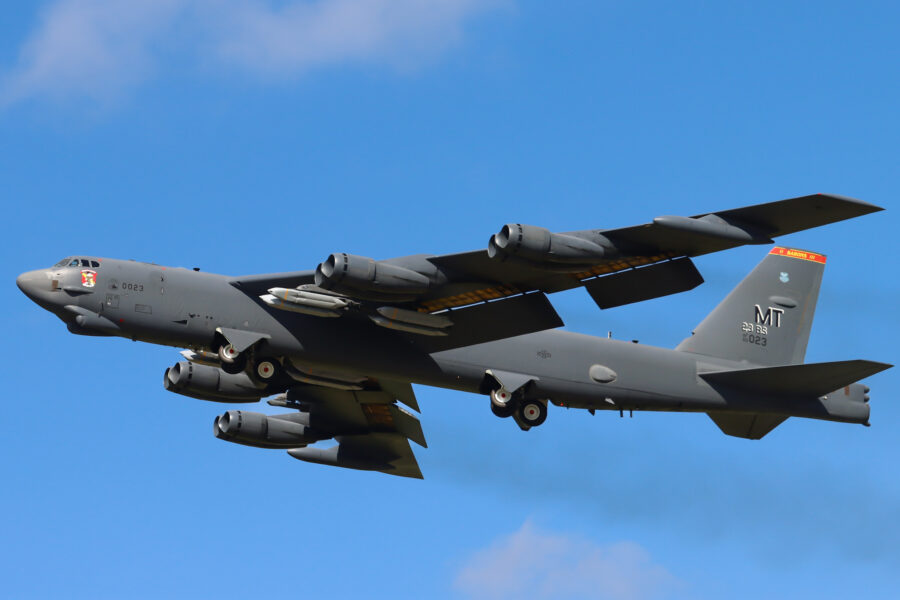
The Air Force’s plan to start fitting the B-52 Stratofortress with new engines before completing critical flight tests risks cost overruns and schedule delays, government auditors warn in a new report.
The Commercial Engine Replacement Program is now years behind schedule, the Government Accountability Office said in a report released July 31. Developmental flight testing is not expected to start until early in fiscal 2029—four years later than originally projected—and initial operational capability is not anticipated until 2033—five years behind schedule.
Current plans call for starting engine and subsystems production at the same time as developmental flight testing, 27 months behind schedule. The result is concurrent developmental testing and production, which GAO said could mean installing new engines on the B-52 and then having to modify those installs once testing is complete. If that happens, it could set back the upgrade even further behind schedule, raising costs, GAO said.
The Air Force has 75 B-52s, which average about 65 years old. The newest entered service in 1962. Yet those airframes are young in comparison to the wear and tear on their airframes, and the Air Force anticipates they will make up an enduring part of the bomber force for decades to come. While the B-1 and B-2 bombers are expected to retire in the late 2030s, the B-52 will remain as USAF’s stand-off bomber, complementing the stealthy B-21 penetrating bomber.
Such longevity is challenging. GAO respored that many B-52 relies are increasingly obsolete. Many parts’ original manufacturers are out of business, meaning alternative parts or suppliers must be found. In some cases, parts are still “cannibalized” from retired airframes.
GAO auditors said B-52 readiness has suffered, with its mission capable rate dropping below 54 percent in 2024, the last year for which the Air Force released that data. From fiscal 2011 to 2021, GAO said, the B-52 only met readiness goals four times.
The Air Force’s B-52 modernization project—at $21 billion effort, the most extensive in the B-52’s history—aims to extend its life into the 2050s. The program encompasses 13 upgrades, including engines, communications, software, weapons systems, and its radar. Once complete, the upgraded planes will be designated the B-52J.
The Commercial Engine Replacement Program, which will replace each B-52’s eight Pratt & Whitney TF33 engines with eight new Rolls-Royce F130 engines, is projected to cost more than $15.4 billion—about 74 percent of the modernization effort’s total cost, GAO said.
Those costs have risen more than 38 percent since 2018, GAO said. Had the program set a formal cost and schedule baseline, it might have resulted in a congressional notification known as a Nunn-McCurdy breach, but because the Milestone B declaration of a development process was delayed 32 months, that figure has not been set. GAO said the Air Force has begun an affordability study, but as of March 2026, it was not completed. The study is meant to assess alternatives and confirm cost estimates before development starts.
GAO said Air Force officials understand the risks of concurrent testing and development, but chose to accept the risk rather than further delay the program. Service officials told auditors they aim to mitigate risk with multiple decision points on the way to production, instead of one single production decision.
“While having multiple decision points might provide insights into the program’s progress, the initial production decision will turn the supply chain on and, once that begins, it is difficult and inefficient to stop production to address any issues identified at subsequent reviews,” the report said.
The Radar Modernization Program also is projected to cost about $2.9 billion, which represents a more than 30 percent cost growth. That cost growth led to a significant Nunn-McCurdy breach in May 2025. Program officials attributed the cost growth to significant design changes, contractor performance issues, and increased installation complexity.
The planned start of production for the new AN/APQ-188 radar has also been delayed more than two years, to the third quarter of fiscal 2026, and its initial operational capability is now expected to start in the third quarter of fiscal 2030, about three and a half years behind schedule. The B-52 program office also scaled back five of the new radar’s original performance requirements to keep future cost increases down. The new radar now has 20 performance requirements, program officials say establishes the “minimum viable product.”
“While cost saving and schedule control measures are prudent and may be warranted, in this case,” GAO reported, “the Air Force will receive less capability while paying more for the program.” Auditors said “leading practices … suggest making trade-off decisions and defining a minimum viable product before awarding a contract.”
The report was prepared before the June 15 crash of a B-52 at Edwards Air Force Base, Calif., on a test flight for the new radar. Program officials said during the Life Cycle Industry Days conference in Dayton, Ohio, July 27 that the loss of the test bomber likely would cause further delays. A second B-52 test jet is now being modified with the new radar.
Given the challenges, GAO recommended the Air Force delay its production decision on CERP until an analysis on cost growth and schedule delays is complete. The Air Force, in response, agreed that an analysis is valuable but disagreed about delaying the production decision. With that decision is still more than two years away, the Air Force should have enough time to complete the study.
The Air Force agreed with GAO’s other recommendations, including taking a closer look at the benefits of digital engineering on modernization programs and updating repair plans for the B-52.