
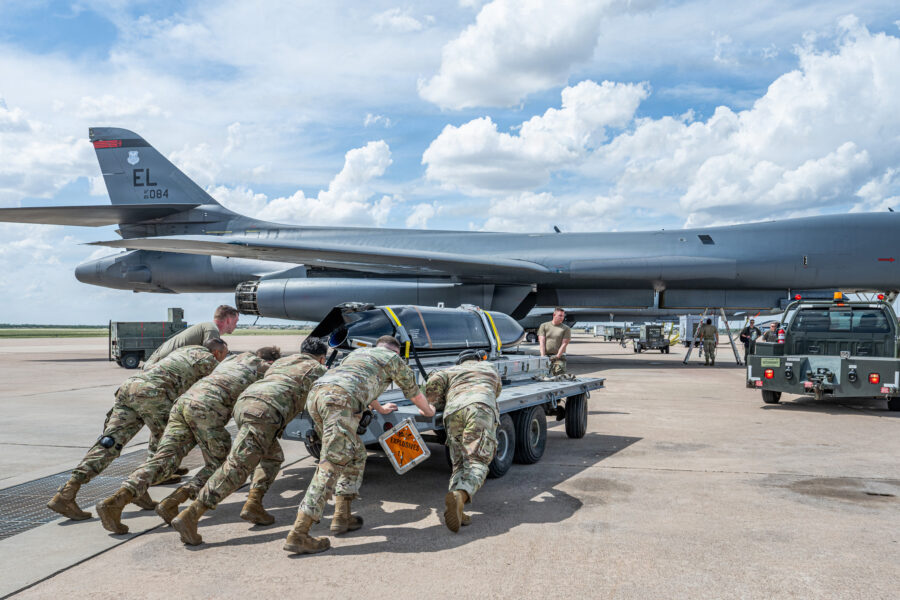
The Air Force recently tested the Long-Range Anti-Ship Missile on the B-1B Lancer, clearing a key milestone for integrating the weapon on its bombers.
The June 2 “event zero” validation test at Dyess Air Force Base, Texas, connects the AGM-158C LRASM to the Lancer, testing the missile’s ability to communicate with the bomber. For this test, engineers used a specially fabricated cable rather than fully loading the weapon onto the aircraft, according to an Air Force release.
The B-1 test came within weeks of a B-2 firing a LRASM during exercise Valiant Shield 26 near the Marianas Islands, the first time the service publicly acknowledged LRASM firing by a B-2.
LRASM is a sophisticated, multimillion-dollar long-range weapon and a joint development of the Air Force and Navy. The Air Force requested $738 million in its fistcal 2027 budget plan to buy 156 of the missiles from contractor Lockheed Martin. It is budgeted to buy 114 of the missiles missiles in fiscal 2026.
Retired Air Force Col. Mark Gunzinger, director of future concepts and capability assessments at AFA’s Mitchell Institute for Aerospace Studies, said the weapon adds a critical tool to the U.S. arsenal.
“The ability to strike moving targets at sea gives us a real advantage against adversaries who might, for instance, launch a cross-Taiwan Strait invasion,” Gunzinger told Air & Space Forces Magazine. Air Force bombers equipped with LRASMs can hold adversaries’ ships at risk from afar. By contrast, ship-based LRASMs would have to be fired from even further away, Gunzinger said.
“I think the vast majority of aim points initially would be allocated to the U.S. Air Force,” Gunzinger said. “That’s why we need modern counter-maritime, anti-ship weapons that our aircraft can launch.”
Homemade Testing Solutions
The 7th Bomb Wing tested and verified preflight procedures with the missile using software and updated hardware, according to the release. Dyess Airmen built the testing cable using Navy specifications.
“On the flightline and in our weapons shops, these professionals look past legacy blueprints to design and implement ideas that push weapon system capacity and capabilities far beyond original limits,” said Col. Robert Sturgill, 7th Bomb Wing commander, in the release.
An unnamed 7th Bomber Wing weapons officer said in the release that testing a live AGM-158C using the cable “verified rapid process integration” for both the aircraft and missile software. Testing and integration is a lengthy, detailed process necessary to ensure new weapons operate safely with existing systems on the aircraft.
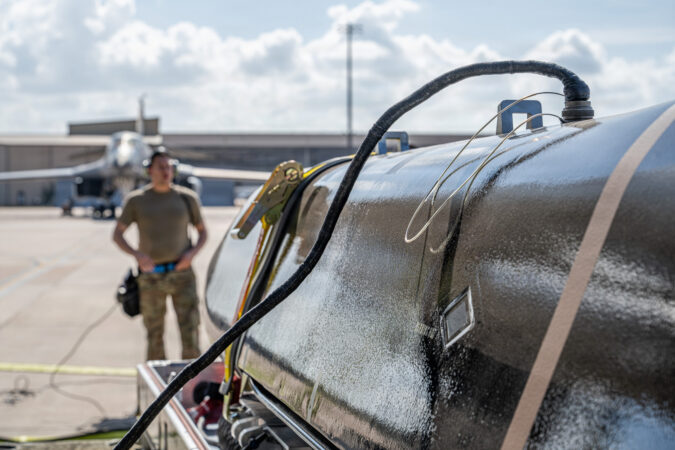
The B-1 was the first Air Force platform to reach early operational capability with the LRASM in 2018 and now supports joint maritime strike missions, according to the release. The LRASM has a 1,000-pound blast-fragmentation warhead and uses advanced, self-directed sensing and signature control to defeat maritime targets.
The LRASM has a range of more than 200 nautical miles, according to publicly available data. That’s sufficient for aircraft such as the B-1 to strike targets in contested areas, Gunzinger said.
A Lockheed spokesman, responding to a query, wrote: “LRASM brings additional, advanced long-range sea and land strike capabilities to the B-1B, F/A-18E/F and soon to the P-8 and F-15 with ongoing integration efforts.”
Adapted from the Joint Air-to-Surface Standoff Missile to attack moving targets, LRASM has a shorter comparable range to the standard JASSM but well short of the 1,200-mile range boasted by the JASSM-ER.
Gunzinger said he expects the LRASM and the entire JASSM family of munitions to continue to evolve.
“The JAASM and LRASM are also designed specifically to attack targets in contested and highly contested environments,” he said. “They have a degree of low observability—they’re stealthy weapons—and that is a key point: for fifth- and sixth-generation aircraft, we need fifth- and sixth-generation munitions.”