


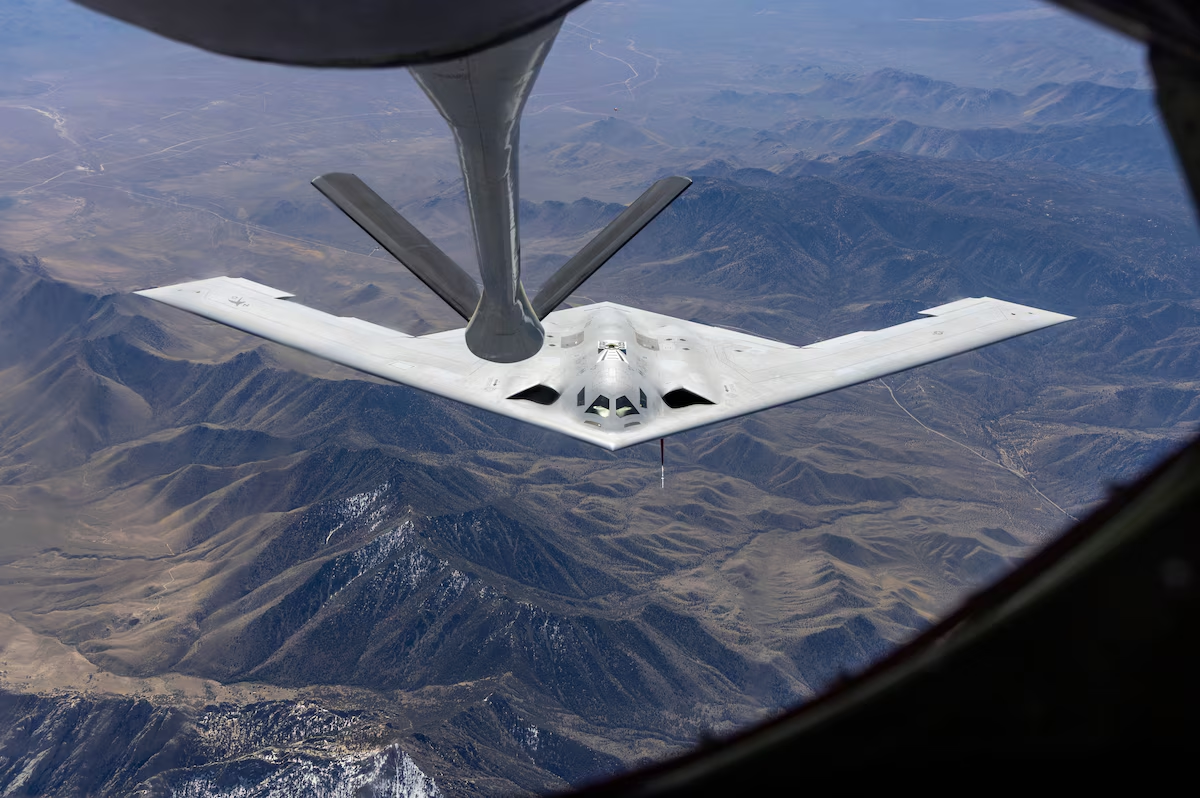
Operations Midnight Hammer and Epic Fury make this crystal clear: Bombers that can precisely deliver large payloads halfway around the world are crucial assets. Given the small size and advanced age of America’s current bomber inventory, it is time to boost investment in the B-21 Raider to ensure long range strike remains a viable option at scale for the foreseeable future.
Other nations have shorter range, smaller fighter and attack aircraft that deliver bombs, but no other Western military can generate the combat power of a bomber. Yet their success in recent operations also highlights a major concern: America has just 19 stealth B-2 bombers, the newest of which joined the force 26 years ago. The rest of the inventory is composed of 76 venerable B-52s, all built before the 1962 Cuban Missile Crisis, and 46 Reagan-era B-1Bs. This limited bomber force is effective in raids but too small to conduct sustained military campaigns. Global security demands that we modernize and grow the force.
As we look at this reset, stealth will remain a critical capability. The B-2 stealth bomber’s ability to evade enemy radar, execute their strikes, and return safely home during Operations Midnight Hammer and Epic Fury—what the U.S. Air Force calls survivability—was invaluable.
Range also matters, with B-2s operating with intercontinental reach that afforded surprise and protected bomber crews and their aircraft in between missions. Iranian missiles and drones could not reach the distant airfields from which American bombers were flying.
Despite those unmatched capabilities, 19 B-2s could only provide a fraction of the long-range strike sorties needed during Epic Fury. B-1s and B-52s helped carry the load, but they initially did so in a stand-off fashion, launching long-range missiles to stay safe from Iran’s air defenses. Only later, after U.S. and Israeli attacks degraded those defenses, did B-1s and B-52s strike from within Iran’s airspace.
The ability for the entire bomber force to operate over enemy territory was a crucial milestone, because expensive stand-off weapons are a finite resource, and it could take years to replenish stocks. It is always more sustainable to send stealth bombers armed with less expensive, easier to produce weapons than to launch multimillion-dollar cruise missiles from afar. It is simple math.
The true lessons of Midnight Hammer and Epic Fury are that the United States needs a bomber enterprise that is both larger and more modern than today’s force. In a potential conflict with China, the stresses on America’s long-range strike force will be far more pronounced than what we witnessed against Iran.
This, too, is simple math: The U.S. struck 13,000 targets during Epic Fury, only about one-tenth the number necessary in a China fight. Repeated expert analyses from the Mitchell Institute for Aerospace Studies and others call for a force with at least 200 next-generation B-21 bombers, double the “at least 100” for which the Air Force has previously planned.
Acquiring B-21s at a more ambitious rate is also important, since rebuilding the bomber force is a pressing requirement for deterring aggression globally. It is encouraging to see the Air Force move to grow B-21 production capacity by at least 25 percent in the last budget cycle.
It’s also important to see the Air Force extend its B-1s and B-2s life deeper into the 2030s, as it recently proposed, while it awaits those new B-21s. Failing to do this would risk a bomber inventory bathtub. Not only is that bad from an airframe capacity perspective, but it also takes its toll on pilots and maintainers.
The good news is that the B-21 program is doing well: On time and on cost, it will soon produce operational aircraft and begin to populate its first operational squadrons. One of the most encouraging signs came when the Air Force recently announced the B-21 has now successfully completed inflight air refueling—among the most demanding operations for a flying wing aircraft.
Taking all of this into perspective, now is the time to press harder. Commanders around the globe need more bomber capacity. They require B-21s at scale, along with modernized B-52s and and a ready fleet of B-1s and B-2s until there are enough B-21s to backfill those requirements.
Midnight Hammer and Epic Fury were incredible operations that spotlighted the value of airpower and the capability of Air Force bombers. But those attributes are not sustainable without continued investment, now and into the future. We need to make sure that tomorrow’s national leaders will have the options at hand that only bombers can provide.
Real-world operations are the best test of any weapon system, and bombers have aced that test over the past year. America must seize this once-in-a-generation opportunity to rebuild our nation’s premier long-range strike force. It’s time to commit to an objective of at least 200 B-21s.