
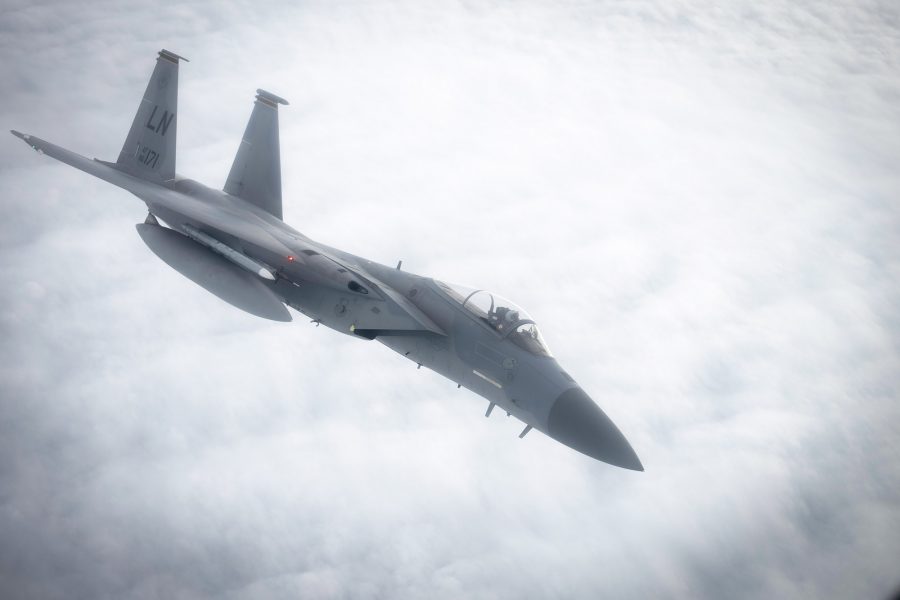
The F-15 Eagle was the world’s dominant, supersonic, all-weather, day/night air-superiority fighter for more than 40 years. The F-15A first flew on July 27, 1972, and F-15A/Bs were delivered between 1974 and 1979, attaining IOC in September 1975. F-15C/Ds began replacing F-15A/Bs in 1979, offering superior maneuverability, acceleration, range, weapons, and avionics. F-15s accounted for 34 of USAF’s 37 air-to-air kills during Desert Storm. The C/D added EW countermeasures and 2,000 lb of internal fuel and the final 43 production aircraft received the F-15E’s APG-70 radar and Multi-Stage Improvement Program (MSIP).
USAF received the first APG- 63(V)3 AESA-modified F-15 in 2010, but comprehensive modernization, including the Eagle Passive/Active Warning Survivability System (EPAWSS) was canceled with the decision to buy new-build F-15EX. USAF also reduced the number of MIDS/JTRS secure high-capacity comm and networking upgrades and limited SLEP to 63 airframes. The majority of F-15C/Ds suffer performance-limiting structural issues.
The ANG’s 104th Fighter Wing at Barnes flew its final F-15 sortie on Oct. 23, 2025, followed by the 173rd Fighter Wing at Kingsley Field on Dec. 22. Both units are transitioning to the F-35A. Congress added F-15EX funds to backfill the ANG but slowed divestiture of the F-15C/D. USAF now plans to delay F-15 retirement by four years to FY31. A total of 42 aircraft will continue flying homeland air defense through 2028, with the 21 most viable consolidating to Fresno, the final operating location, through 2030. USAF plans to cut 13 airframes in FY26.
F-15 Eagle Technical Data
Contractors: Boeing (previously McDonnell Douglas).
First Flight: Feb. 26, 1979 (F-15C).
Delivered: 1979-85 (F-15C/D).
IOC: 1979 (F-15C/D).
Production: 874.
Inventory: 108 (F-15C); 8 (F-15D)
Operator: ACC, ANG.
Aircraft Location: Fresno ANGB, Calif.; Jacksonville Arpt., Fla.; NAS JRB New Orleans, La.; Portland Arpt., Ore.
Active Variant: •F-15C. Upgraded version of the single-seat F-15A. •F-15D. Upgraded version of the two-seat F-15B.
Dimensions: Span 42.8 ft, length 63.8 ft, height 18.7 ft.
Weight: Max T-O 68,000 lb.
Power Plant: Two Pratt & Whitney F100-PW-220 augmented turbofans, each 23,450 lb thrust; or two P&W F100-PW-229 augmented turbofans, each 29,000 lb thrust.
Performance: Speed Mach 2.5, ferry range 2,878 miles (3,450 miles with CFTs and three external tanks; farther with air refueling).
Ceiling: 60,000 ft.
Armament: One internally mounted M61A1 20 mm six-barrel cannon (940 rd); four AIM-9 Sidewinders and four AIM-120 AMRAAMs, or eight AIM-120s as well as ECM pods; in a one-time test, an Eagle successfully launched an anti-satellite missile.
Accommodation: Pilot (C); two pilots (D), on ACES II zero/zero ejection seats.