
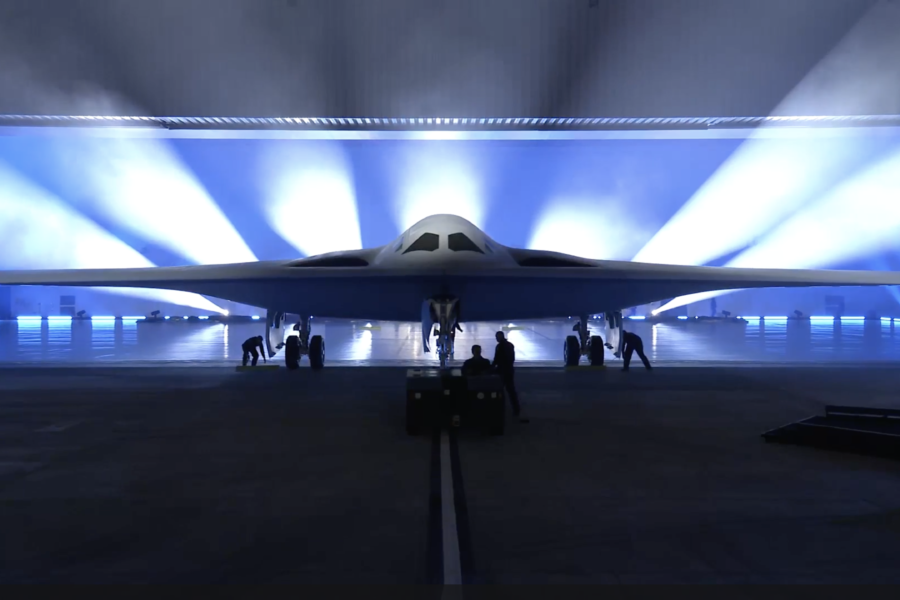
The B-21 Raider is a developmental, penetrating strike bomber planned to deliver both conventional and nuclear munitions. The low-observable flying-wing design was christened “Raider” in honor of the WWII Doolittle Raiders, who mounted the surprise attack on Japan in April 1942. Though similar in shape to the B-2, the B-21 features more deeply recessed engine inlets, dual-wheel main-landing gear, unique trapezoidal windscreens, and a more advanced low-observable design.
The Air Force awarded Northrop Grumman the Long-Range Strike Bomber contract in 2015, aimed at developing an affordable, next-generation stealth bomber utilizing modern systems and materials. The type is the Air Force’s first new bomber since the B-2 Spirit in 1988 and is planned to become the mainstay of the strategic fleet alongside the modernized B-52J. USAF is developing the B-21 as part of a “family of systems” encompassing complementary ISR, C2, and electronic warfare platforms designed for survivability in high-end threat environments. Northrop Grumman is using digital design techniques to quickly incorporate changes and speed fielding, as well as an open-system architecture to easily enable future upgrades.
Notional nuclear armament includes the planned Long-Range Standoff (LRSO) missile and B61-12 guided free-fall weapons, as well as a range of advanced conventional weapons. AFGSC plans to acquire a fleet of at least 100 B-21s for delivery starting in the mid-2020s. USSTRACOM is advocating for up to 145 aircraft to deter simultaneous threats from China and Russia. Concurrent development and low-rate initial production (LRIP) aim to accelerate fielding, starting with the first LRIP contract awarded in 2023. USAF awarded the second of five LRIP contracts in late 2024, totaling 21 aircraft prior to full-rate production. Congress allocated and the Air Force awarded Northrop an additional $4.5 billion to accelerate production by 25 percent in 2026, and at least six airframes are in production at Northrop Grumman’s Palmdale, Calif., facility.
Aircraft T-1, dubbed “Cerberus,” completed ground testing and taxi trials at Palmdale before beginning flight-testing at Edwards on Jan. 17, 2024, and recently underwent refueling test with a KC-135 in 2026. The initial aircraft is currently focused on handling flight envelope expansion trials, while a second aircraft delivered on Sept. 11, 2025, is now tasked with weapons integration and system tests.
The program continues to outperform projections, and multiple airframes are engaged in ground-based risk reduction and structural testing to assess durability and performance. Development encompasses LRSO missile and other advanced weapons integration, nuclear certification, and adaptation for future sensors and capabilities. Flyable test aircraft will be updated to operational specification once testing is complete.
The bomber program remains on time and within budget, and initial operational aircraft will be delivered to AFGSC’s formal training and operational units at Ellsworth in 2027, followed by Whiteman and Dyess.
B-21 Raider Technical Data
Contractor: Northrop Grumman (aircraft); Pratt & Whitney (engines); Collins Aerospace; GKN Aerospace; BAE Systems; Spirit Aerosystems; Janicki Industries (advanced structures).
First Flight: Nov. 10, 2023
Delivered: Nov. 10, 2023-present
IOC: N/A
Production: ≥100 (projected)
Inventory: Two (flyable test aircraft)
Operator: AFMC. Planned: AFGSC.
Aircraft Location: Edwards AFB, Calif. (test location); Planned: Ellsworth AFB, N.D.; Whiteman AFB, Mo.; Dyess AFB, Texas.
Active Variant: •B-21. Developmental Long-Range Strike Bomber.
Dimensions: Span 140 ft (estimated), length 55 ft (estimated), height 18 ft (estimated).
Weight: Max T-O unknown.
Power Plant: Undisclosed number of Pratt & Whitney engines.
Performance: Speed high-subsonic (estimated), range intercontinental.
Ceiling: Unknown.
Armament: Nuclear and conventional (planned).
Accommodation: Two pilots.