
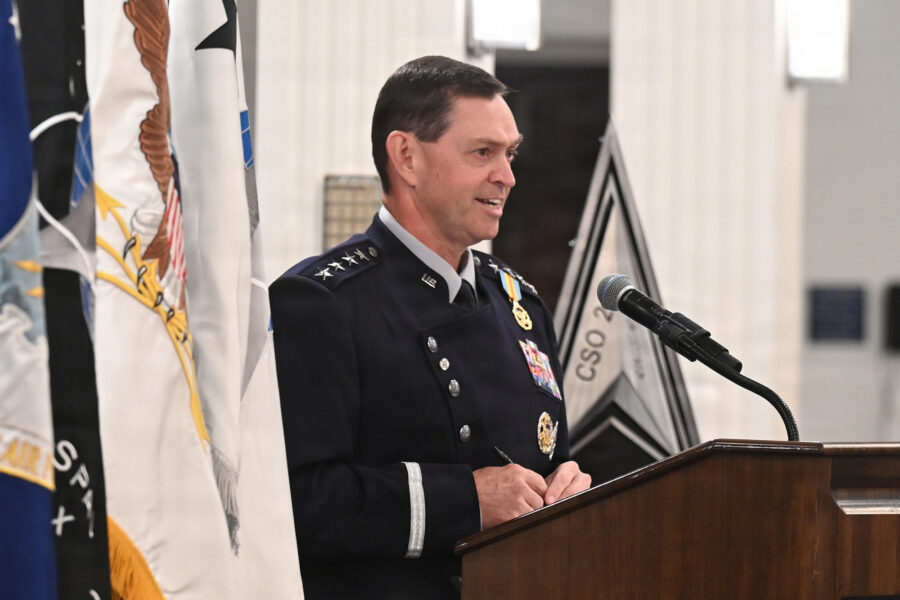
Chairman of the Joint Chiefs of Staff Gen. Dan Caine, Air Force Secretary Troy Meink, and Chief Master Sergeant of the Space Force John F. Bentivegna paid tribute to Gen. B. Chance Saltzman at the Chief of Space Operations’ retirement ceremony Aug. 13.
The tributes at Joint Base Anacostia-Bolling, in Washington, D.C., celebrated the Space Force’s second-ever CSO, whose 35-year military career carried him from junior missileer and to senior space operator.
Lt. Gen. Douglas A. Schiess will succeed Saltzman formally at a Sept. 3 ceremony, so Saltzman remains CSO through the end of the month.
The retirement event marks another stage in the Space Force’s growth. Meink underscored the outgoing CSO’s legacy saying, “there is nothing going in the Space Force today that Salty was not behind in one form or another.”
Saltzman, who was the Space Force’s first deputy chief of space operations for operations, played a key role during the tenure of the first CSO, Gen. John W. “Jay” Raymond before succeeding him on Nov. 2, 2022. Saltzman was the most junior of the candidates at the time but won the job in the interview, taking over when the Space Force was still less than three years old.
Over the next four years, he led the force’s growth, from about 8,000 uniformed Guardians and a budget of $26.1 billion then to today’s force of more than 10,000—on its way to 20,000—and a budget of $36.1 billion en route to nearly double next year.
Beyond adding people and budget, Saltzman was a force in driving a culture change among Guardians, as he pushed to emphasize their role as warfighters. Saltzman pressed Guardians to think as “warfighters,” with a central role in every conflict, not just as enablers who made it possible for other military branches to fight. He emphasized aggressive thinking, training for a high-end conflicts with advanced adversaries, broke taboos about discussing offensive operations in space, and instituted a new force generation model designed to rotate space operators between operational and training cycles to enhance readiness.
“You’ve laid out a clear and unambiguous vision for what your service needs to look like in the future: its culture, its purpose, its doctrine,” Caine told Saltzman. “And you’ve empowered leaders along the way.”
He also oversaw the establishment of eight different field components beneath unified commands, including every geographic combatant command, to ensure the Space Force was represented in operational plans everywhere.
“Just getting the billets, getting them in place, the details, and making that happen are extremely challenging,” Meink said.
To the public, Saltzman repeatedly made the case that space was no longer a benign environment and spoke openly about space superiority and becoming a more muscular warfighting service. He introduced the concept of “space control” as a new USSF mission, defining it as the ability “to contest and control the space domain, employing kinetic and non-kinetic means to affect adversary capabilities by disruptions and degradation—even destruction if necessary.”
Saltzman’s comments freed other Space Force and Pentagon leaders to speak more openly about counter-space operations and waging war in, from, and to space.
Indeed, while space operators have long stayed in the shadows, Saltzman led a growing chorus of leaders speaking more openly about how access to space both informs and enables the American way of war. Under his leadership, the Space Force shared details about how its missile warning capabilities helped defend Israel from Iranian attacks in 2024 and contributed to operations in Venezuela and Iran in 2026, performing missions like electronic warfare, missile warning and tracking, and position, timing, and navigation for U.S. forces.
Caine cited all those operations and more in touting how the Space Force has “secured the ultimate high ground, ensuring that we have options when the President or the nation needs them.”
Saltzman himself noted the transformation with pride. “In a few short years, we have transformed the Space Force from an organization that essentially served as a provider of operational support to other branches of the military into a combat-credible, battle-tested military service in its own right.”
Looking ahead, Saltzman offered a few simple pieces of advice from his military career:
- Be ready for criticism
- Be ready to adapt—not everything will go according to plan
- Don’t stress over things you can’t control
- Be nice
In July, Air & Space Forces Magazine sat down with Saltzman for a wide-ranging exclusive interview covering his career, resourcing the Space Force, developing USSF doctrine, and public perceptions. Read more here: