


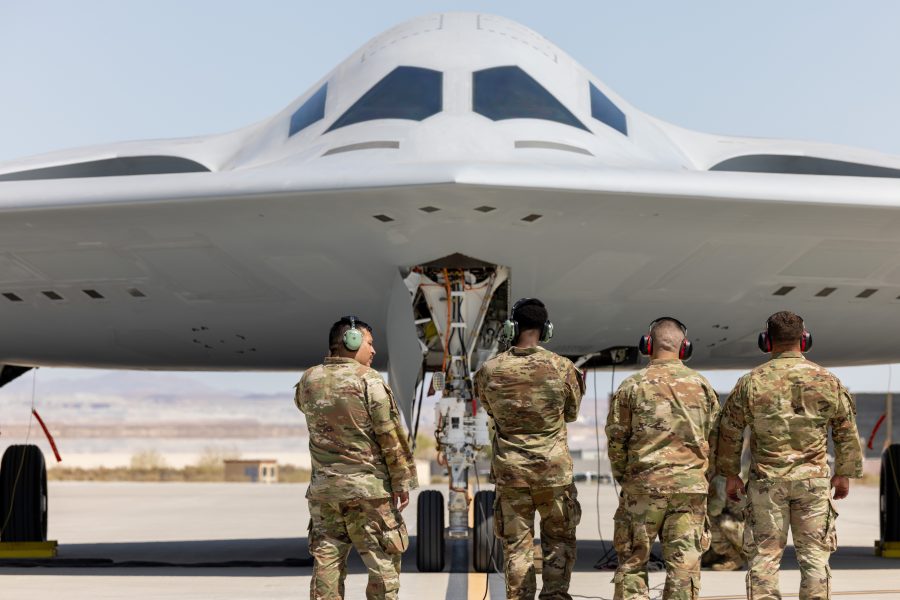
The Air Force has officially decided the B-21 Raider will fly with a two-pilot air crew—and some of those pilots will be former weapon system and combat systems officers.
The Air Force is establishing a transition program for WSOs and CSOs to become pilots and take follow-on assignments flying the new bomber.
Built by Northrop Grumman, the next-generation B-21 stealth bomber will enter service in 2027. Like the B-2, the B-21 features a flying wing design and will be capable of carrying both conventional and nuclear weapons. Official plans call for a fleet of at least 100 B-21s, but Pentagon leaders increasingly suggest that number will be higher, perhaps 145 or more.
There had been some speculation the B-21 would fly with only one pilot and one weapons system officer. Defense Daily and Aviation Week both reported last fall that Gen. Thomas A. Bussiere, then head of Air Force Global Strike Command, had recommended that configuration.
Such an arrangement, however, would have been a major challenge for the bomber’s long-range strike mission. During Operation Epic Fury, for example, B-1B Lancer and B-2A Spirit bombers that the B-21 will eventually replace flew 37-hour roundtrip missions from the U.S. to Iran and back. Both of those older types have two pilots per crew, who can rotate during long missions to get rest and sleep.
The first two “production-representative” B-21 bombers are now flying test missions at Edwards Air Force Base, Calif. At least one of those test articles will report Ellsworth Air Force Base, S.D., in early 2027 when the first operational B-21 unit stands up.
An Air Force spokesperson said the service is still working to determine how many B-21 pilots it will need. But at the end of 2025, there were 497 personnel with the bomber pilot Air Force Specialty Code and 141 bombers, a ratio of around 3.5 pilots per plane. All of the Air Force bomber types have two pilots per crew, and the spokesperson confirmed B-21 pilots will have the same “11B” AFSC as other bomber pilots.
Pilots maintain their Air Force Specialty Code even when not in flying billets, and the same code represents pilots at every stage of their career development. Assuming the same ratio of pilots to bombers, the Air Force will ultimately need at least 350 B-21 pilots.
Earlier plans to retire the B-1 and B-2 sooner would likely have led pilots trained for those planes to transition to the Raider. But with both now slated to remain for the next decade or so, tapping experienced WSOs and CSOs could be an effective way to build up a pilot force quickly—and to retain talent who might otherwise leave the service as F-15Es and other jets are retired.
“To maximize the lethality and survivability of the Raider, it is imperative to retain the deep tactical and combat experience currently residing within the WSO and CSO communities,” the Air Force said. “This deliberate talent management strategy secures the future of global strike capabilities, ensuring the Air Force remains postured to execute extended duration, long-range strike missions in highly contested environments.”
WSOs will be drawn from the B-1, B-52, and F-15E communities, where they operate the planes’ weapon systems and assist pilots with situational awareness and defensive operations. The Air Force plans to retire its B-1s by the late 2030s, and has sought to retire more than half the F-15E fleet, although Congress has blocked that so far. The F-15EX will ultimately supplant the F-15E, and it also has a two-seat cockpit. But as designed, that plane can be operated by a pilot alone, and that remains the Air Force’s plan so far.
CSOs also operate planes’ weapon systems, but they can serve as mission commanders for electronic warfare and navigation systems.
The Air Force said eligible WSOs and CSOs will be given further details on transitioning to fly the B-21 through their regular command channels.