
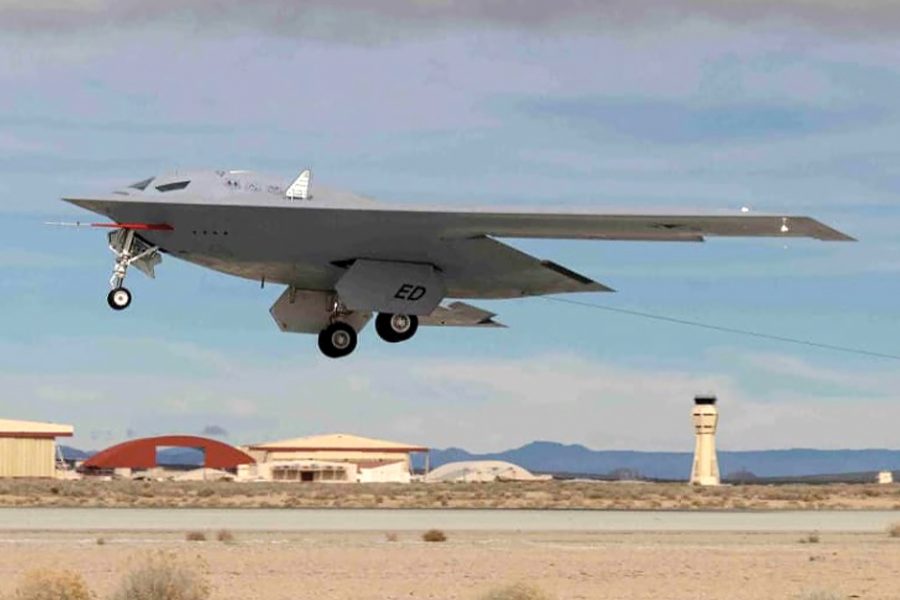
The first B-21 Raider bomber will bed down slightly ahead of the original schedule at Ellsworth Air Force Base, S.D., but still in 2027, and the first plane to arrive there is already flying test missions, said Air Force Secretary Troy Meink in an interview with Air & Space Forces Magazine.
One of the two B-21s now in flight testing at Edwards Air Force Base, Calif., will be the first Raider at Ellsworth. “The test aircraft will be going there,” Meink said during a wide-ranging interview at the Pentagon.
“We’re going to actually turn the test aircraft into operational aircraft at some point in time. They’ll be going there and starting to really do the things you need to do to prepare the base to get the long-term operational aircraft there.”
An Air Force spokesperson declined to say whether both test B-21s at Edwards will move to Ellsworth, or exactly when in 2027 the first plane will arrive. Flight testing typically continues even after planes arrive at operating bases.
When the first B-21 rolled out in December 2022, the Air Force and manufacturer Northrop Grumman touted the first plane as “production-representative,” meaning its stealth coating, mission systems, and other components were virtually identical to the final model. The Air Force decided early that the first test B-21 would be production representative, rather than an experimental aircraft. Northrop officials said in 2022 that opting for the production-representative plane was more complicated up front, but would accelerate testing.
Meink is eager to get the Raider—the Air Force’s first new bomber in more than three decades, and its first sixth-generation aircraft—out to the field where Airmen can start familiarizing themselves with it.
“We really pushed to accelerate a lot of this activity,” Meink said. “It’s going to get those aircraft into the hands of the actual units, so that they can start figuring out how they’re going to operate it. It’s pretty exciting.”
The Air Force plans to buy at least 100 B-21s, and top military officials are increasingly saying more will likely be needed. The new bombers will replace the 1980s-era B-1 Lancer and B-2 Spirit bomber designs.
The B-21’s range and next-generation stealth capabilities are intended to make the penetrating strike jet capable of slipping undetected into enemy territory and then operating deep inside rivals’ airspace. Northrop executives tout the bomber’s data-sharing capabilities and its digital open-systems architecture as key features of its “sixth-generation” description.
The first two B-21s are conducting test flights at Edwards now and steadily advancing.
In April, the Air Force confirmed the Raider is conducting aerial refueling tests. And in June, a service release said an operational pilot had flown the Raider for the first time, in tandem with a developmental test pilot, a feat they called the earliest an operational pilot has flown a new aircraft in modern history.
The Air Force is building new facilities at Ellsworth to prepare for the B-21’s arrival and is starting to turn its attention to construction at Whiteman Air Force Base, Mo. and Dyess Air Force Base, Texas, which will also host B-21s eventually.
Meink and Chief of Staff Gen. Kenneth S. Wilsbach have made improving aircraft readiness a defining theme of their tenures, and Meink said the service will have to make sure it has enough maintainers to keep B-21s flying.
“Do we have the right technicians with the right training, mechanics, on there?” Meink said when discussing readiness. “We’re looking at growing the force to provide more for that, particularly as we expand and start delivering some of these new weapon systems [such as the] B-21.”
As the interview closed, Meink threw cold water on the idea that the B-21 could make an appearance above Washington D.C. as part of the Fourth of July festivities for the United States’ 250th anniversary. Online speculation about a Raider flyover went into overdrive after a Northrop Grumman social media post June 25, featuring the silhouette of the B-21 and the caption, “Some things stay off the radar. America’s 250th isn’t one of them.”
But any aviation enthusiast who gathers on the National Mall hoping to catch a glimpse of the B-21 is likely to be disappointed.
“No, no, the program is going really, really well, but the planes are out at Edwards, and we just started doing refueling,” Meink said. “So to get a B-21 here [for the Fourth], not going to happen.”
