
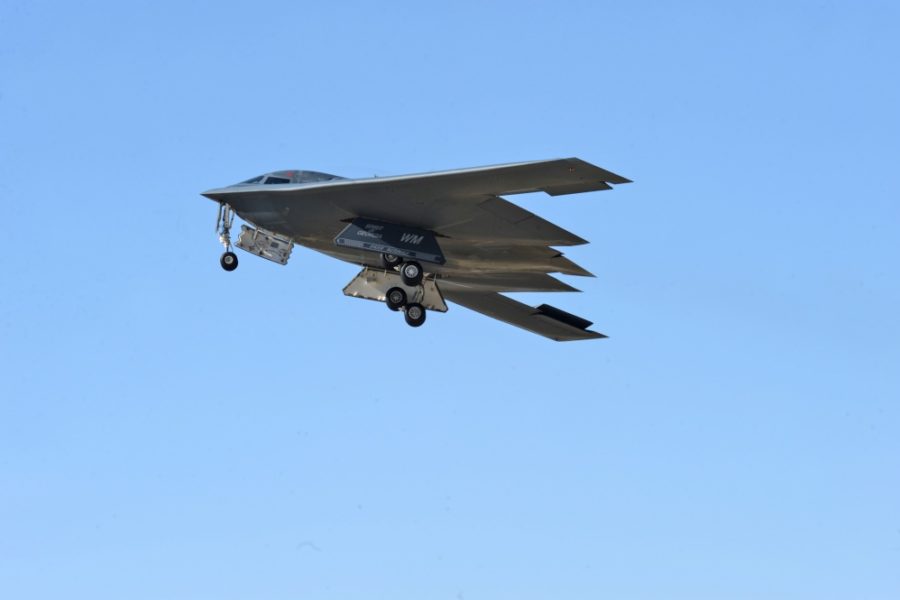
The B-2 is a stealthy, long-range, penetrating nuclear and conventional strike bomber. It is based on a flying wing design combining low observability (LO) with high aerodynamic efficiency. The aircraft’s blended fuselage/wing holds two weapons bays capable of carrying nearly 60,000 lb in various combinations.
Spirit entered combat during Allied Force on March 24, 1999, striking Serbian targets. Production was completed in three blocks, and all aircraft were upgraded to Block 30 standard with AESA radar. Construction was limited to 21 aircraft due to cost and political considerations, and a single B-2 was subsequently lost in a crash at Andersen on Feb. 23, 2008.
Modernization is focused on safeguarding the B-2A’s penetrating strike capability in high-end threat environments and integrating advanced weapons. Recent upgrades significantly enhance the B-2’s ability to deliver precision nuclear and conventional weapons under GPS-denied or degraded conditions. The aircraft is now capable of using radar targeting data and feeding coordinates to weapons pre-release to thwart jamming. Ongoing efforts include Advanced Communications upgrades to Mobile User Objective System (MUOS) secure, jam-resistant SATCOM and NATO-interoperable SATURN UHF/VHF as well as Link 16-based in-flight retasking. B-2s are also receiving updated primary cockpit display and advanced IFF and shifting to an easily upgradable opensystem architecture to keep pace with emerging threats.
USAF is enhancing the fleet’s maintainability with improvements to low-observable coatings and materials, and radar-absorptive structures such as the radome and engine inlets/exhausts. Seven B-2s employed the GBU-57 Massive Ordnance Penetrator (MOP) in combat for the first time, dropping 14 of the 30,000-lb weapons against Iran’s hardened nuclear weapons facilities during Operation Midnight Hammer on June 21, 2025. The service previously planned to retire the B-2 sometime in the early 2030s, but revealed plans in its 2027 budget request to spend $1.35 billion through 2031 modernizing the B-2, suggesting it intends to fly the bomber deeper into the next decade.
B-2 Spirit Technical Data
Contractors: Northrop Grumman; Boeing; Vought.
First Flight: July 17, 1989.
Delivered: December 1993-December 1997.
IOC: April 1997, Whiteman AFB, Mo.
Production: 21.
Inventory: 20.
Operator: AFGSC, AFMC, ANG (associate).
Aircraft Location: Edwards AFB, Calif.; Whiteman AFB, Mo.
Active Variant: •B-2A. Production aircraft upgraded to Block 30 standards.
Dimensions: Span 172 ft, length 69 ft, height 17 ft.
Weight: Max T-O 336,500 lb.
Power Plant: Four GE Aviation F118-GE-100 turbofans, each 17,300 lb thrust.
Performance: Speed high subsonic, range 6,900 miles (further with air refueling).
Ceiling: 50,000 ft.
Armament: Nuclear: 16 B61-7, B61-12, B83, or eight B61-11 bombs (on rotary launchers). Conventional: 80 Mk 62 (500-lb) sea mines, 80 Mk 82 (500-lb) bombs, 80 GBU-38 JDAMs, or 34 CBU-87/89 munitions (on rack assemblies); or 16 GBU-31 JDAMs, 16 Mk 84 (2,000-lb) bombs, 16 AGM-154 JSOWs, 16 AGM-158 JASSMs, or eight GBU-28 LGBs.
Accommodation: Two pilots on ACES II zero/zero ejection seats.