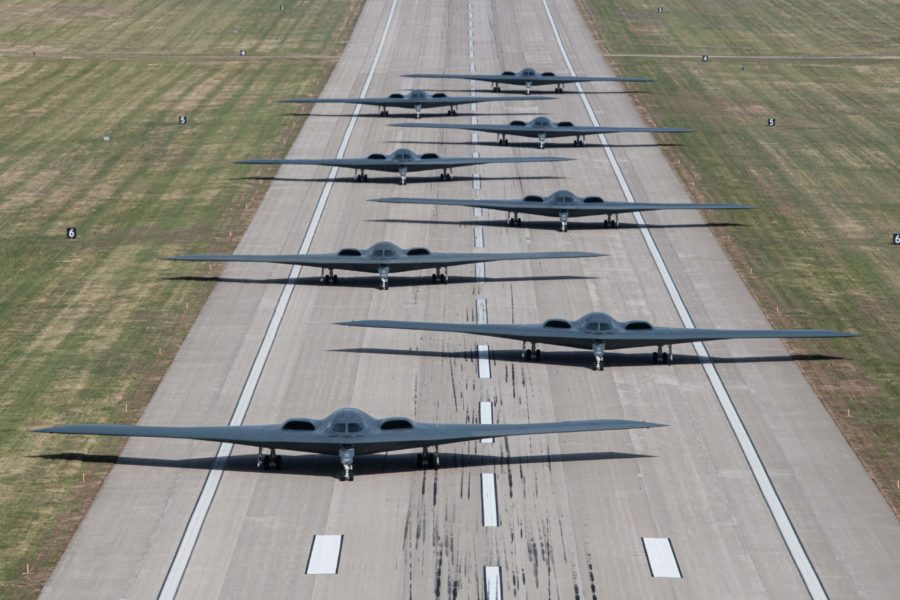
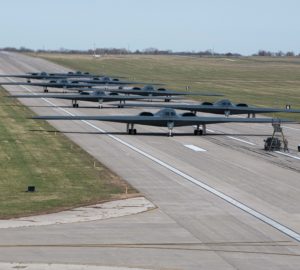
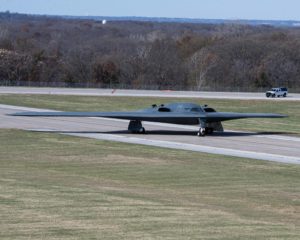
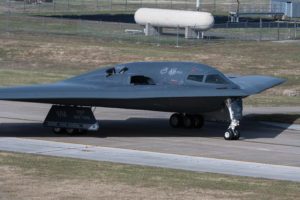
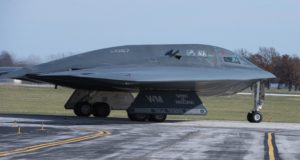
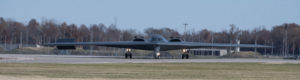
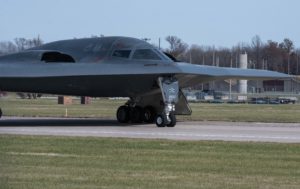
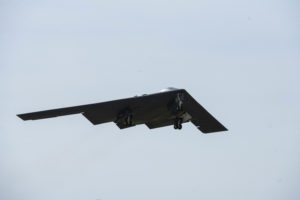
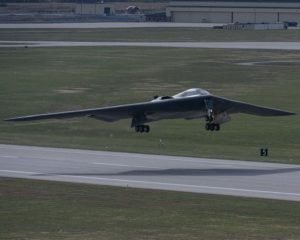
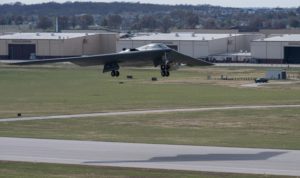
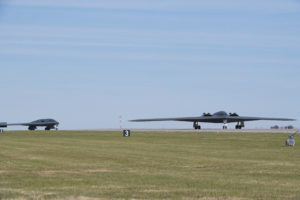
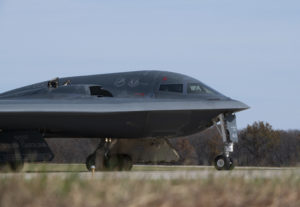
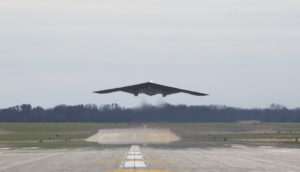
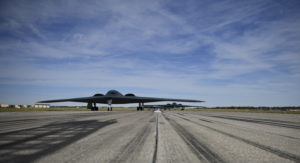
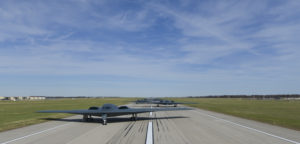
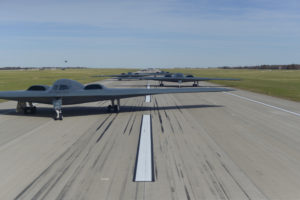
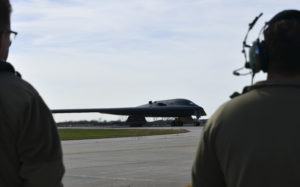
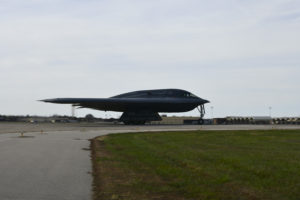
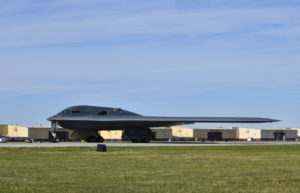
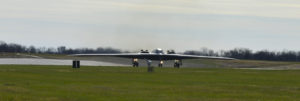
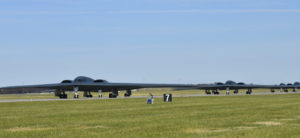
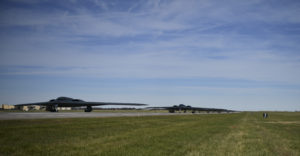
B-2 Spirit stealth bombers assigned to Whiteman Air Force Base, Mo., taxi and take off during exercise Spirit Vigilance, Nov. 7, 2022. Air Force photo by Airman 1st Class Bryson Britt.
Audio of this article is brought to you by the Air & Space Forces Association, honoring and supporting our Airmen, Guardians, and their families. Find out more at afa.org
Eight of the Air Force’s 20 B-2s assembled on one runway at Whiteman Air Force Base, Mo., on Nov. 7, for an extremely rare “elephant walk” of the service’s stealth bomber.
The gathering of B-2s from the 509th Bomb Wing, along with the Air National Guard’s 131st Bomb Wing, capped Exercise Spirit Vigilance, one of a series of “Vigilance” exercises that bomb wings across the Air Force perform throughout the year. “Elephant walks” involve aircraft taxiing in a close formation before rapidly taking off in a show of air power.
“Exercise Spirit Vigilance is a routine exercise that serves to develop and challenge the skills of the 509th Bomb Wing and ensure our combat mission readiness,” a 509th BW spokesperson told Air & Space Forces Magazine.
However, it is relatively uncommon for the Air Force to conduct bomber-only elephant walks. Eight B-52s from Barksdale Air Force Base, La., lined up for one in October 2020, and five B-52s participated in one in Guam in April 2020. But there have been no recent public reports of a B-2 elephant walk until now.
The occasion garnered extra attention, as members of the community around Whiteman were invited to watch from near the flight line, according to images shared by the 509th BW.
The B-2 entered service in the early 1990s as the Air Force’s first stealth bomber, and fewer than two dozen were produced. After a crash in 2008, the fleet was reduced to just 20 aircraft, meaning the elephant walk at Whiteman included 40 percent of the Air Force’s entire inventory of B-2s.
According to a 509th BW press release, Exercise Spirit Vigilance tested Airmen’s ability to rapidly prepare and deploy the B-2 “under greater scrutiny and time restraints than the normal day-to-day flying mission,” with the goal of promoting “resilience, innovation, competitiveness, and process improvement.”
“The B-2 bomber has never been more relevant than it is now. This plane was conceived at the height of the Cold War. Now we find ourselves 30 years later, and the B-2 is in the mission for which it was created: great power competition,” 509th Operations Group commander Col. Geoffrey Steeves said in a video explaining Spirit Vigilance. “An exercise like this is a reminder that the 509th Bomb Wing and the 131st Bomb Wing are ready and willing to execute its mission of nuclear operations and global strike, anytime, anywhere.”
Audio of this article is brought to you by the Air & Space Forces Association, honoring and supporting our Airmen, Guardians, and their families. Find out more at afa.org
The Marine Corps recently conducted its first-ever “ripple” release of eight Small Diameter Bomb IIs from an F-35B, a key early step in proving out the capability for all F-35 variants.
The Air Force will field operational prototypes for an autonomous drone to replace its MQ-9 Reaper in 2028, Secretary of the Air Force Troy Meink said Oct. 14.
One of the Air Force’s critical B-2 Spirit stealth bombers has returned to Whiteman Air Force Base, Mo., after an extensive course of maintenance to restore its stealth coating and preserve its structural integrity.
BAE Systems has received a contract from Lockheed Martin to install an upgraded Block 4 electronic warfare system into new F-35 Joint Strike Fighters, as well as to retrofit some older jets.
The Air Force has figured out a way for maintainers to inspect what had been a “blind spot” in F-16 engines, after problems in that area led to the catastrophic crashes of two jets in recent years.
The Air Force has begun evacuating stealth fighters, gunships, and special operations planes ahead of Hurricane Isaias expected landfall over the Gulf Coast this weekend.
The Air Force’s B-52 bomber may soon be able to carry up to 20 stealthy long-range anti-ship missiles to strike moving targets at sea, a key capability in a potential fight with China.
A reported surge of MQ-9 Reaper drones to Latin America could widen the scope of intelligence gathering and free up more strike options against cartels in the region, experts tell Air & Space Forces Magazine.
Northrop Grumman has broken ground on a major new production facility for the B-21 Raider, the company and the Air Force announced Oct. 6. The construction comes as a top service official said testing on the bomber is going well in the lead up to its planned introduction into the…
✓
Thank You!
Check your inbox to verify your email address and finish setting up your AFA account.
★
Welcome Back!
An account with this email already exists. Please log in to continue.
Subscribe to the Air & Space Forces Daily Report
The latest news from Air & Space Forces Magazine, as well as news from other leading publications, delivered right to your inbox every morning!
We’re sorry, there has been an error. Please review your input or try again later.