
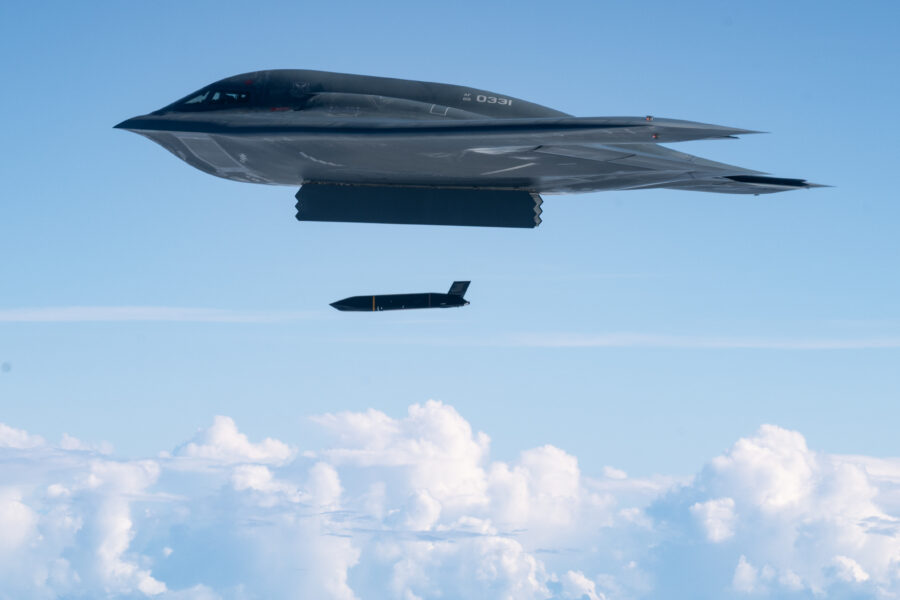
A B-2 Spirit on June 27 used a ship-killing missile to strike a decommissioned amphibious transport vessel during a Pacific exercise, marking a significant expansion of the stealth bomber’s maritime strike capabilities.
In a June 29 release, Pacific Air Forces revealed the B-2 employed an AGM-158C Long Range Anti-Ship Missile during exercise Valiant Shield 26 north of the Mariana Islands. Valiant Shield often involves U.S. Air Force and Navy assets hitting a decommissioned ship as part of a sinking exercise, or “SINKEX.” This year, however, represented the first time the U.S. military has acknowledged the B-2’s use of an AGM-158C.
The LRASM is an anti-ship cruise missile derived from the Joint Air-to-Surface Standoff Missile, designed to hit ships at long ranges.
It’s not the first time a B-2 has participated in a SINKEX. In 2024, one of the bombers employed an experimental bomb developed by the Air Force Research Laboratory called QUICKSINK. A modified GPS-guided Joint Directed Attack Munition, QUICKSINK is shaped to accurately hit a maritime vessel.
LRASM, in contrast, has a far greater range of 200-plus nautical miles. PACAF said the B-2 exercise represents “a major step forward in countering maritime threats.” As the entire U.S. military has turned more of its attention to the Pacific and competition with China, the Air Force has sought to increase its ability to strike enemy vessels at sea.
“The B-2’s impressive performance underscores the U.S. military’s commitment to adaptability and flexibility in the face of emerging security challenges,” PACAF Commander Gen. Kevin B. Schneider said. “By prioritizing counter-maritime strike operations, we can maintain a decisive edge over adversaries, protect our national interest, and ensure the free and open Pacific that underpin our global security.”
Air Force Global Strike Command confirmed to Air & Space Forces Magazine the B-2 fired its LRASM at the former USS Juneau, a decommissioned Austin-class amphibious transport dock that saw action in the Vietnam and Gulf wars before its 2008 retirement.
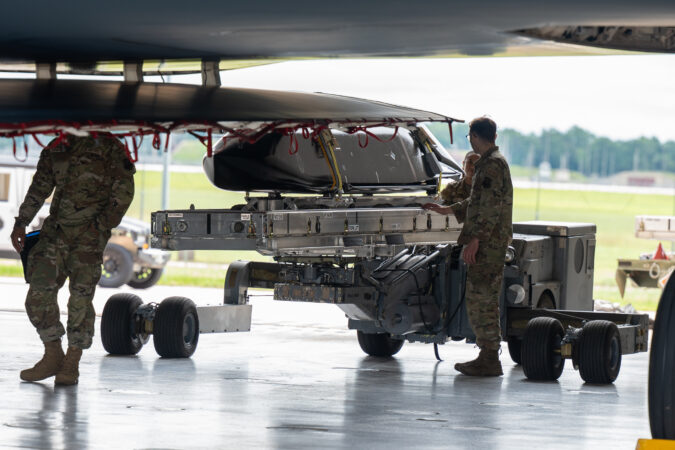
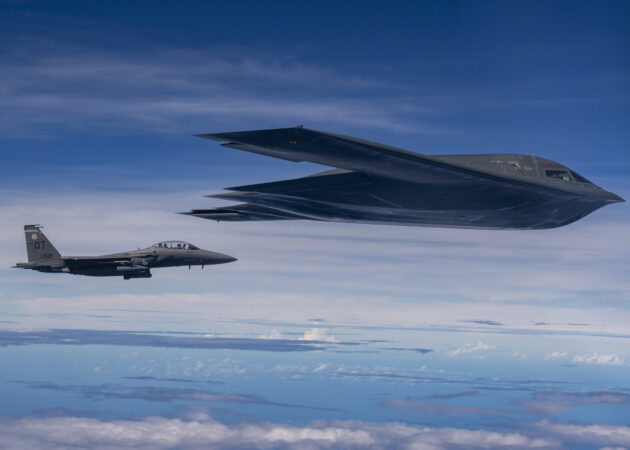
Photographs released by PACAF show the LRASM was loaded onto the B-2 at Whiteman Air Force Base, Mo., on June 22. The B-2, which is assigned to Whiteman’s 509th Bomb Wing, then flew to Andersen Air Force Base in Guam, where it took off for the June 27 exercise. An F-15E Strike Eagle from the 85th Test and Evaluation Squadron also took part in the exercise.
U.S. Pacific Command said in another June 29 statement that the live-fire sinking exercise brought together joint U.S. forces and allied forces in the air, on the surface and underwater to carry out coordinated strikes. This allowed crews to sharpen their abilities to engage target and employ weapons under realistic conditions, PACOM said.
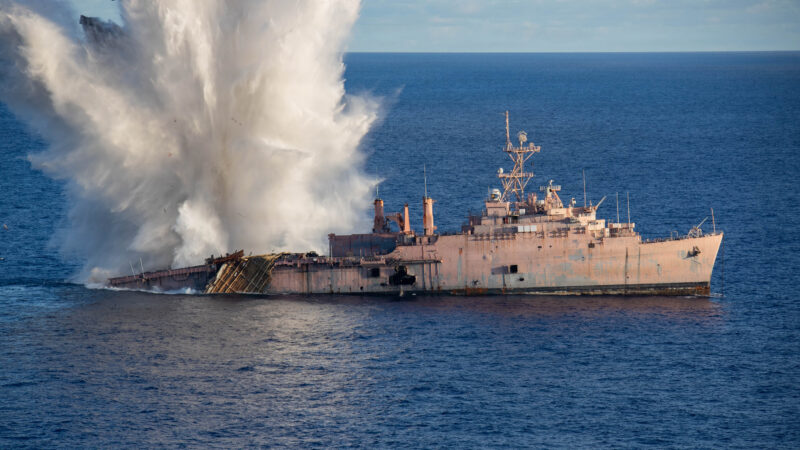
The Juneau was also targeted by a Japan Maritime Self-Defense Force submarine, which struck the vessel with a torpedo, PACOM said. U.S. Navy F-35Cs and F/A-18 Super Hornets from the aircraft carrier USS George Washington supported the sinking exercise as well. It was sunk more than 200 nautical miles off the coast of the Mariana Islands.
PACOM said the Juneau was extensively cleaned before it was sunk to remove hazardous materials such as petroleum residue and other pollutants.
