


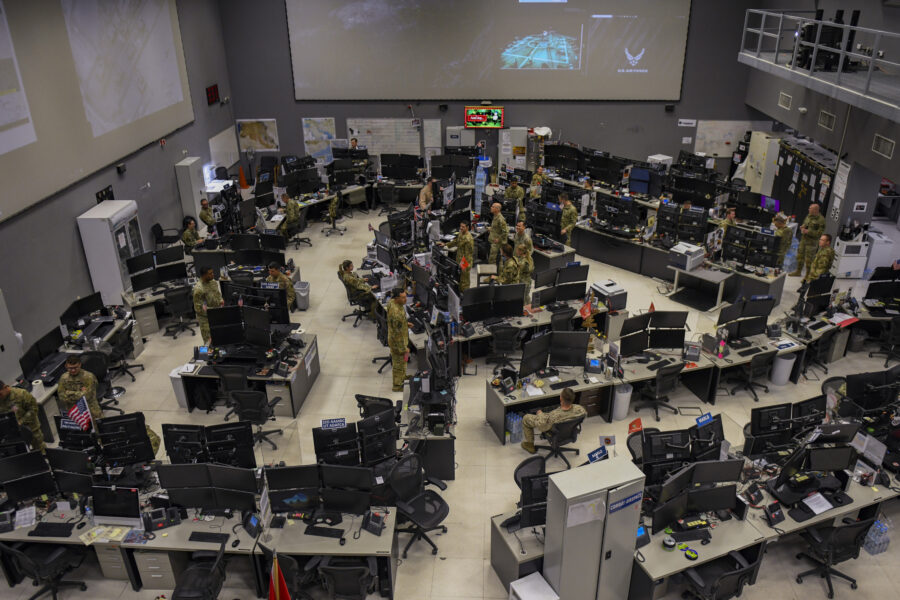
The command center that ran America’s air campaigns in the Middle East for over two decades took a direct hit during the U.S. war with Iran and was severely damaged, a senior U.S. official and other people informed about the attack told Air & Space Forces Magazine. The facility was not in use at the time and no injuries were reported.
Multiple Iranian missiles struck the Combined Air Operations Center at Al Udeid Air Base, Qatar during the early weeks of the war, rendering it inoperable. Yet the Iranian missile attacks didn’t interfere with Operation Epic Fury’s air campaign, which began on Feb. 28, or the more limited airstrikes conducted since the tenuous ceasefire reached in early April.
Anticipating that Iran would target the facility, the U.S. military directed the campaign from a facility at Shaw Air Force Base, S.C., from the start of the operation. Personnel were transferred away from Al Udeid before the conflict.
Damage to the CAOC at Al Udeid has not been previously reported.
The CAOC’s proximity to Iran and the damage to it have raised questions over whether or not it should be rebuilt. The CAOC falls under Air Forces Central, the air component of U.S. Central Command. A spokesperson for CENTCOM declined to comment.
The CAOC’s history goes back decades. The need for an air command post arose during Operation Desert Shield, ahead of the Desert Storm campaign, when the U.S. and its allies converged in the region in response to Saddam Hussein’s troops seizing Kuwait in August 1990. The first center was set up in a series of tents in a Riyadh parking lot, then moved to Prince Sultan Air Base. A new CAOC was completed just a few months before the Sept. 11, 2001 terrorist attacks, and ran continuously in support of the air war in Afghanistan and the 2003 invasion of Iraq, and operations that followed. The Air Force considers its AOCs a weapons system, which it has dubbed Falconer.
Shortly after Saddam Hussein was toppled in 2003, and as the Saudis became uneasy about the American military presence in the Kingdom, the CAOC was moved to Al Udeid.
A new bunker-like building was built, rising out of the desert like an upturned bathtub surrounded by razor wire—a $60 million facility, fed by 67 miles of high-capacity fiber-optic cable.
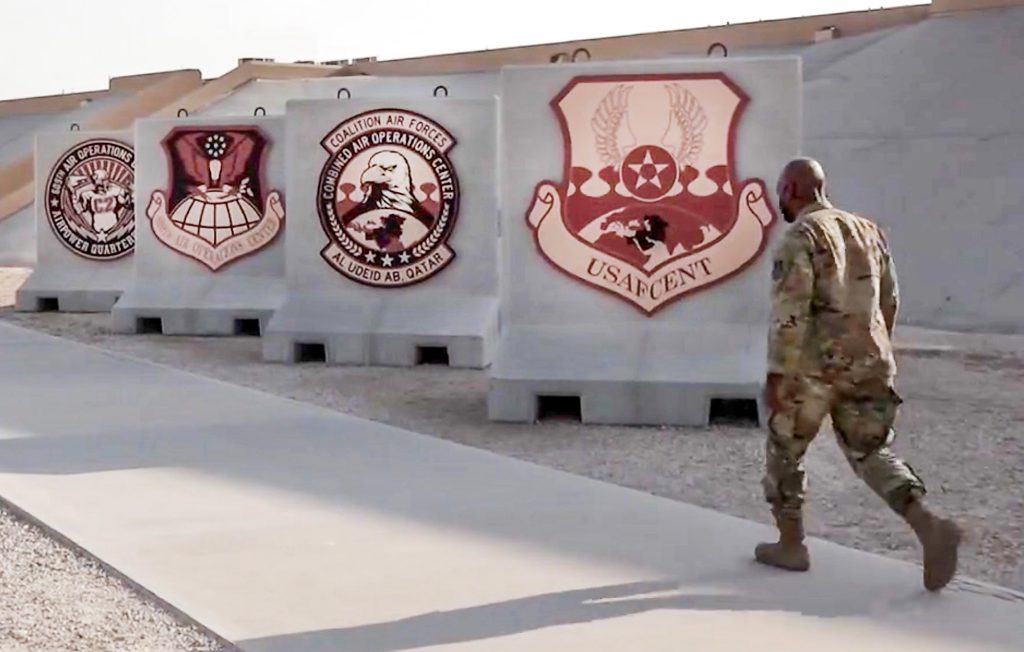
The Combined Forces Air Component Commander, or CFACC, is responsible for planning and executing air operations across the CENTCOM area of responsibility, and also leads Air Forces Central, or AFCENT. It is an immense theater that ranges from the Red Sea to the Turkish border and from Syria to Afghanistan.
AFCENT’s 609th Air Operations Center directs both the CAOC at Shaw and the one Al Udeid.
The CAOC at Al Udeid was used to direct the air campaigns for Operation Enduring Freedom in Afghanistan, Operation Iraqi Freedom, Operation Inherent Resolve against the Islamic State group in Iraq and Syria, and recent operations against the Houthis in Yemen.
But Iran, which is equipped with thousands of ballistic missiles and drones, posed a greater challenge.
The Iranians carried out a modest retaliatory attack after the June 2025 Midnight Hammer operation that struck three Iranian nuclear sites. They fired 14 missiles at Al Udeid, one for each of the GBU-57 Massive Ordinance Penetrator bombs that were dropped by B-2 Spirit stealth bombers. Only one of those missiles got through, damaging a radome.
In Operation Epic Fury, Israeli and U.S. forces took the fight to the Iranian leadership at the start, killing Ayatollah Ali Khamenei, the country’s supreme leader, along with other top officials. This time, the Iranians showed little restraint, attacking military bases throughout the Gulf.
“Any facility that’s above ground is vulnerable today, and so any critical nodes we build in the future need to be built underground, and be hardened,” said retired Lt. Gen. David A. Deptula, who was the director of the CAOC during the opening months of Operation Enduring Freedom and also played a key role in the air war command center during Operation Desert Storm.
Air Forces Central commander and CFACC Lt. Gen. Derek C. France and other CENTCOM bosses, and along with their predecessors, have anticipated for years that Al Udeid would be in the bullseye during any conflict and have also regularly operated from a command center at AFCENT’s U.S. headquarters at Shaw.
The effort to shift more operations to the CAOC at Shaw expanded under Gen. Kenneth F. McKenzie Jr., CENTCOM’s boss from 2019-2022. AFCENT has gradually moved more and more of its personnel, including foreign liaison officers, to South Carolina, while maintaining the CAOC in Qatar as a parallel effort, even as it continued to invest there with a $3 million upgrade completed in 2020.
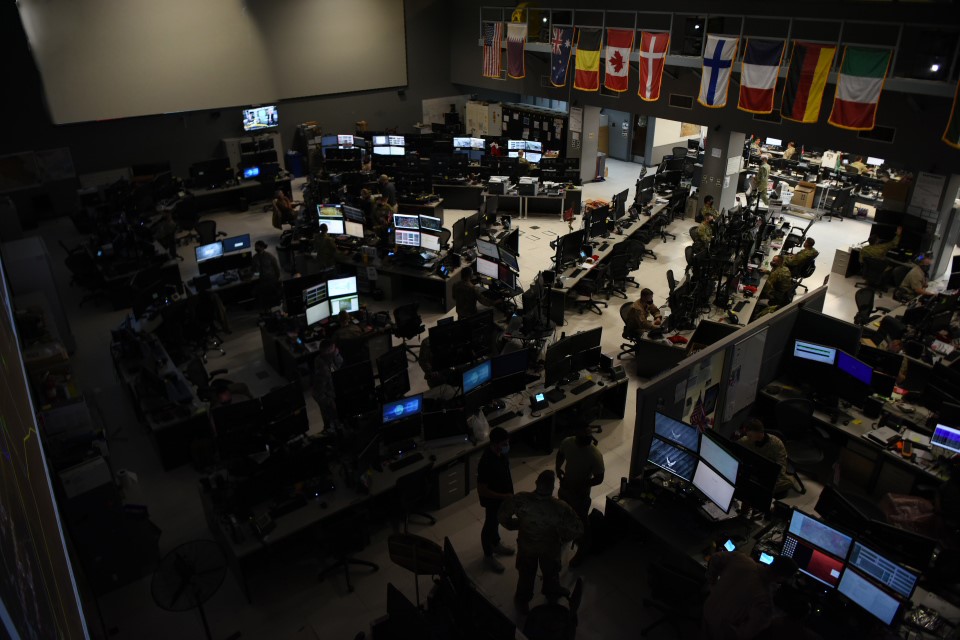
The CAOC at Shaw has been capable of coordinating high-end combat operations for years, according to current and former U.S. officials. In 2024, U.S. personnel staffing the CAOC were split roughly 50-50 between the two locations. At that time, between 300 and 400 personnel were assigned to each. Since then, the CAOC at Shaw has continued to expand, with an eye on taking over for all responsibilities if necessary.
In late February, as the U.S. began Operation Epic Fury against Iran, Al Udeid was almost immediately targeted by Iran, which is just across the Persian Gulf from Qatar.
“Nothing that has happened has not been expected,” said a former military official who served in the CAOC at Shaw and Al Udeid. “AFCENT was definitely very prepared. There’s not too much that has happened that we have not gone through. We exercised it, we talked about it, we wargamed it.”
But the Iranian attacks on Al Udeid have raised important questions.
“The acceleration of the reliability and bandwidth increase in modern telecommunications allows you to disperse your facilities. Epic Fury was run from the United States to a large degree,” said Deptula, dean of AFA’s Mitchell Institute for Aerospace Studies. “In the past, because of adversary limited reach, we assumed we had sanctuary and for efficiency we used what have now become highly vulnerable centralized nodes for command and planning. Today, if they’re going to be forward, they need to be dispersed, they need to be hardened, and they need to operate in a much more networked fashion.”
Iran has also attacked numerous American and partner facilities across the Middle East. Iranian aerial barrages have killed seven U.S. service members on the ground and destroyed pricey radars, aircraft, and other infrastructure. Thirteen service members have been killed in action during the conflict.
A 45-minute drive from downtown Doha, Al Udeid is a multibillion-dollar U.S.-Qatari base with numerous hardened structures and permanent facilities. The vast expanse of concrete in the desert has living quarters for over 10,000 service members and is the forward headquarters of CENTCOM and AFCENT. Prior to the conflict with Iran, it was America’s biggest base in the Middle East.
Before Epic Fury began, most personnel and aircraft were moved off the base, though some personnel remained, including U.S. Army Soldiers manning Patriot ballistic missile interception batteries.
“A massive effort was undertaken before this conflict to move as many humans off of targets to other places and maintain operational security about where they might be to minimize the space with which Iran could hit,” said Secretary of Defense Pete Hegseth in April testimony before the Senate Armed Services Committee.
Iran’s attacks have led Pentagon officials to suggest its footprint in the Middle East may look very different in the future.
“We don’t know what our future posture is going to be,” Jules “Jay” Hurst III, the Pentagon’s comptroller and chief financial officer, told the Senate Appropriations Subcommittee on Defense last month. “We don’t know how those bases would be reconstructed.”