
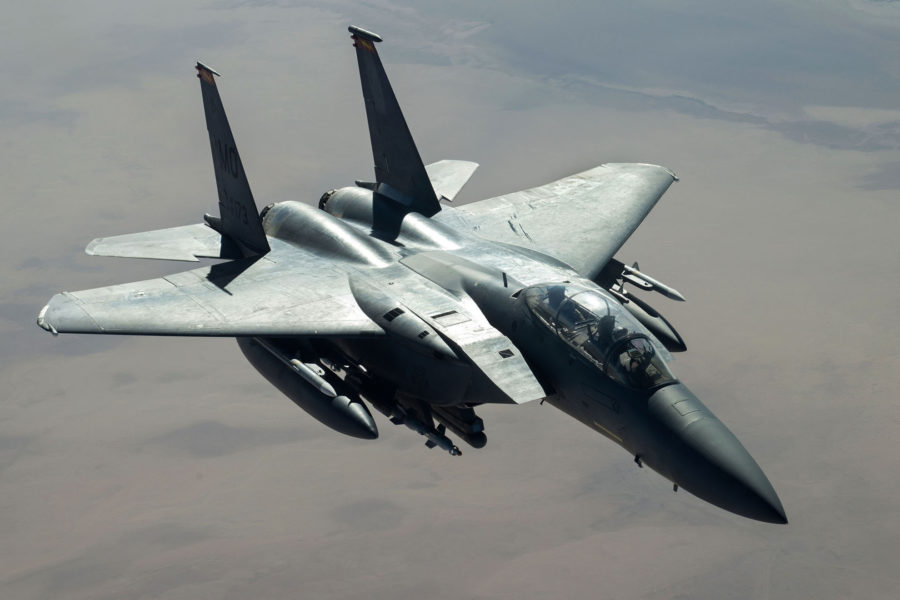
F-15E is an upgraded, two-seat, all-weather F-15 capable of deep interdiction/attack, tactical nuclear delivery, and air-to-air combat. The Strike Eagle can sustain 9 Gs throughout the flight envelope. It first saw combat in Desert Storm in 1991. F-15E’s large, varied load of precision weapons and 20 mm cannon make it a potent ground-attack platform, and radar-guided and IR-homing missiles give it an additional air-to-air capability. Its advanced cockpit includes a wide field-of-view HUD and helmet-mounted cockpit-cueing. The F-15E’s avionics permit all-weather day/night engagement and it carries LANTIRN, Sniper, and Litening ATPs on dedicated pylons. The “Dragon’s Eye” SAR pod fielded in 2009 provides all-weather surveillance/reconnaissance capability.
The Strike Eagle is undergoing major avionics modernization centered on the new APG-82(V)1 AESA radar, which will increase its lethality against more capable targets. The Eagle Passive/Active Warning Survivability System (EPAWSS) is simultaneously replacing the Strike Eagle’s obsolete self-defense suite to increase survivability in future high-threat environments. Supporting upgrades include color Large Area Digital (LAD) displays and updated removable data transfer modules. F-15Es recently began transition to Mobile User Objective System (MUOS) secure, jam-resistant SATCOM and NATO-interoperable SATURN UHF radios, with 43 slated for upgrade in FY26. Boeing completed EPAWSS installation on the first two F-15Es in 2022 and plans to upgrade 14 jets this year. Future enhancements include GPS hardening, updated EW protection and warning, and Legion Pod IRST to discreetly engage airborne targets starting in FY26.
USAF plans to retire roughly half the F-15E fleet through 2029, retaining and upgrading only 99 late-model PW-229-engined aircraft to fund other priorities. Congress blocked the retirement of 21 F-15Es in FY26 but signaled willingness to consider retiring approximately 50 jets through 2028. Three F-15s were shot down by Kuwaiti air defenses in a friendly fire incident during Operation Epic Fury on March 2, 2026.
F-15E Strike Eagle Technical Data
Contractors: Boeing (previously McDonnell Douglas); BAE Systems (EPAWSS); Raytheon (AESA).
First Flight: Dec. 11, 1986.
Delivered: April 1988-2004.
IOC: September 1989.
Production: 236.
Inventory: 217.
Operator: ACC, AFMC, USAFE.
Aircraft Location: Eglin AFB, Fla.; Mountain Home AFB, Idaho; Nellis AFB, Nev.; RAF Lakenheath, U.K.; Seymour-Johnson AFB, N.C.
Active Variant: •F-15E. All-weather strike aircraft derived from the F-15C/D.
Dimensions: Span 42.8 ft, length 63.8 ft, height 18.5 ft.
Weight: Max T-O 81,000 lb.
Power Plant: Two Pratt & Whitney F100-PW-220, each 23,450 lb thrust; or two F100-PW-229 turbofans with afterburners, each 29,000 lb thrust.
Performance: Speed Mach 2.5, range 2,762 miles with CFTs and three external tanks (further with air refueling).
Ceiling: 50,000 ft.
Armament: One internally mounted M61A1 20 mm six-barrel cannon (500 rd); four AIM-9 Sidewinders and four AIM-120 AMRAAMs or eight AIM-120s; most air-to-surface weapons in USAF inventory (nuclear and conventional) including GBU-53 Stormbreaker and B61-12 nuclear free-fall weapon, as well as ECM, SAR, and advanced targeting pods.
Accommodation: Pilot and WSO on ACES II zero/zero ejection seats.