


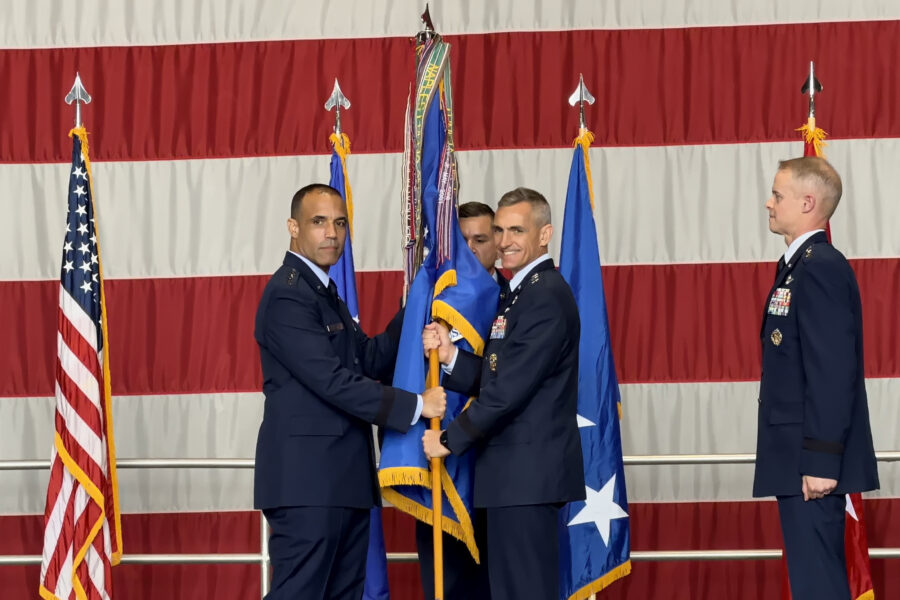
SHAW AIR FORCE BASE, S.C.—There is a new air component commander for U.S. forces in the Middle East: Lt. Gen. Daniel T. Lasica.
Lasica assumed command of Air Forces Central and took over as the Combined Forces Air Component Commander (CFACC) for U.S. Central Command from Lt. Gen Derek C. France in a ceremony here on Aug. 4. He takes over one of the most high-profile three-star commands in the U.S. military in the midst of an on-again-off-again air campaign against Iran.
Air Combat Command boss Gen. Adrian L. Spain presided over the ceremony. “In this command, the road you walk is a thin line between regional stability and global chaos,” Spain said. “This command has stood as our nation’s sentry” through the decades, including Operation Desert Storm, the enforcement of no-fly zones over Iraq, and more than 20 years of combat in Iraq and Afghanistan, and continues to be busy in combat with Iran.
“Today, Spain said, “that legacy of generating airpower under duress continues.”
Addressing Lasica directly, Spain added: “I know you will lead this team with the absolute focus and operational intensity that it constantly demands.”
U.S. forces were poised to resume major combat operations against Iran over the weekend, but President Donald Trump called off the planned bombing campaign, saying allies asked him to give peace talks more time.
The AFCENT change of command ceremony has traditionally taken place at Al Udeid Air Base, Qatar, the forward headquarters for both CENTCOM and AFCENT, and for years America’s largest base in the Middle East. But Al Udeid sits roughly 170 miles from Iran and has come under persistent missile attack, so the ceremony was moved to Shaw Air Force Base, in the swampy Midlands region of South Carolina.
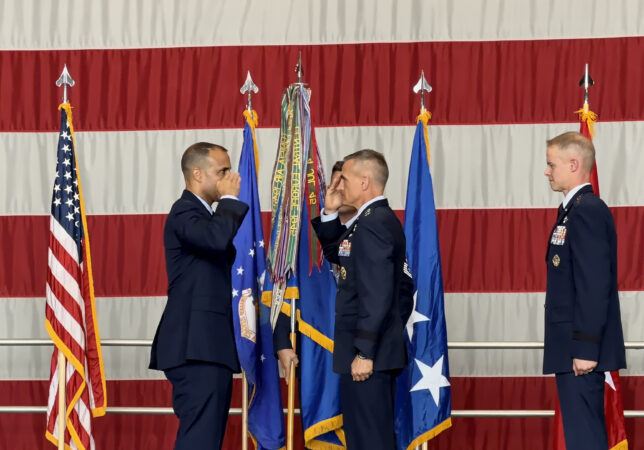
France, who will retire, directed the air campaign against Iran from Shaw, AFCENT’s U.S. headquarters. AFCENT built a duplicate command center, the Combined Air Operations Center, there in recent years and transferred operations there from the command’s longtime CAOC at Al Udeid before hostilities broke out earlier this year.
France referred to CAOC at Shaw as “the machine that makes airpower happen day in and day out.”
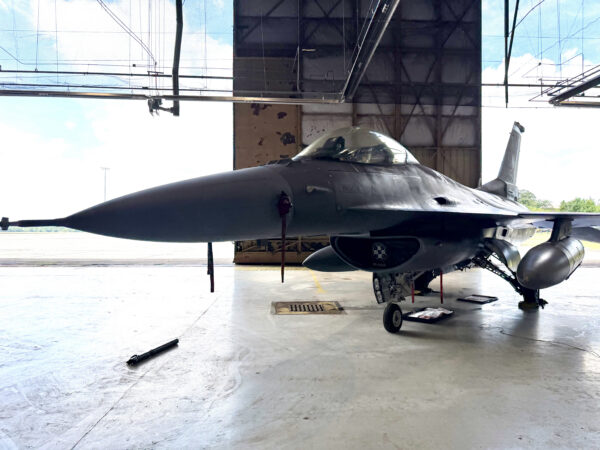
Two of Shaw’s flying units, the 20th Fighter Wing of F-16C Fighting Falcons, which are known as “Wild Weasels” for their mission specializing in the suppression of enemy air defenses, and the 25th Attack Wing of MQ-9 Reaper drones, have been engaged in combat against Iran. One of each of those platforms was displayed during the ceremony, which took place in the 20th Fighter Wing’s hangar overlooking Shaw’s runway, which was active with F-16 flights throughout the day.
“We had a couple of change of commands where we had airpower overhead,” CENTCOM deputy commander Army Lt. Gen. Patrick D. Frank said during the ceremony, referring to his time as commander of U.S. Army Central from 2022 until earlier this year. Frank said staff asked if they should “call AFCENT and ask them to not fly during those ceremonies.” Frank recalled. “I said, ‘Are you kidding me? That is the sound of freedom right there. We want them flying during our ceremonies.’”
CENTCOM commander Navy Adm. Brad Cooper would typically preside over this ceremony, but with Iran operations possibly looming, Cooper turned the job over to Spain, with Frank attending in place of Cooper. It is the first time in eight years that AFCENT’s change of command was held in South Carolina instead of Qatar, and it has been at least half a decade since the ACC boss attended, officials said.
Lasica assured those assembled that he would not let down his superiors.
“We will continue to meet your and Adm. Cooper’s intent in service to our national strategic objectives,” Lasica said. “We will continue our legacy and aggressively focus on defend, defeat, develop, and win. We will defend our nation’s interests, our Airmen, our joint warriors, our allies, our partners, so that we can defeat adversary aggression. … We will develop our Airmen and take our lessons learned to improve the combat capabilities of our Air Force, our joint force, as well as our allies and our partners—all of this in order to win.”
An F-16 pilot by trade, Lasica’s prior post was director of operations for U.S. European Command, where he served under former AFCENT commander Gen. Alexus G. Gynkewich. Before that, Lasica was director of policy, plans, strategy, and capabilities at EUCOM. In both jobs, he helped support Ukraine in its war with Russia, during which EUCOM has provided logistical support to Ukraine and maintained greater presence on Europe’s Eastern Flank to deter further Russian aggression. Among other earlier jobs, Lasica is the former commander of Shaw’s 20th Fighter Wing.
France departs after overseeing an intense period of combat operations, including Operation Epic Fury against Iran, the most intense air war since 1991’s Gulf War. AFCENT also executed Operation Midnight Hammer against Iranian nuclear facilities and Operation Rough Rider against the Houthis in Yemen, both in 2025, and it played a central role in the defense of Israel against Iranian drone and missile attacks in 2024, strikes against ISIS in Iraq and Syria, and humanitarian aid air drops into Gaza.
“For the past two years, you stood at the center of one of the most consequential periods in the history of CENTCOM,” Frank said of France. “We saw this command sustain relentless operations against Houthis in Operation Rough Rider, defend thousands of civilians against Iran’s unprecedented drone and ballistic missile attacks in the 12-day war, and execute Operation Midnight Hammer, demonstrating the capability and the reach that only American airpower can do.”
Frank called this recent stretch “one of the most demanding periods of any of your predecessors,” senior leaders who have included former Air Force Chiefs of Staff Gen. John P. Jumper, Gen. David L. Goldfein, and Gen. Charles Q. Brown Jr., and current combatant commanders Grynkewich and Gen. Gregory M. Guillot, the head of U.S. Northern Command. “During Iranian missile attacks, intense air campaigns, and combat stories, your calm judgment and expertise in all things airpower allowed this command to thrive.”
France took over from Grynkewich, now NATO Supreme Allied Commander and the head of U.S. European Command, just days after a mass Iranian drone and missile attack in April 2024. The U.S. and allied forces helped defend against that attack, knocking down some 80 drones. Iran later directly attacked Israel with ballistic missiles in October 2024.
“The day I took command is the day that the [Israeli Air Force] did a response, and that was a long day because we set up defense and I got to bed about seven in the morning,” France recalled. “I thought, ‘What in the world have I gotten myself into?’”
During his time in command, France himself flew around 30 combat missions, including over the Strait of Hormuz.
France said he led “one of the most potent joint forces that we’ve seen in a long time.”
He cited the operational success of Midnight Hammer and the rescue by combat search and rescue of the crew of Dude 44, an F-15E Strike Eagle shot down by Iran in April, as among his proudest moments. He also reflected on losses during his tenure, including when two KC-135 Stratotankers had a midair collision while supporting Operation Epic Fury. One of those tankers, callsign Zeus 95, crashed in western Iraq, killing all six Airmen aboard.
“There are times of great victory, like those B-2s exiting hostile airspace after Operation Midnight Hammer or the rescue of Dude 44, where an entire nation came to the aid of two downed Airmen,” he said. “It also has low points: the tragedy of Zeus 95 and several other casualties that we’ve had across this theater.”
One thing ties all these events together, he said: “At the core of all of this is airpower. Airpower’s ISR provides an unblinking eye on the enemy. It is the power of fighter and bomber strike. It is the refueling that services both of those. It is combat search and rescue that picks up Americans out of harm’s way, and it is airlift that feeds the fight, whether it’s weapons, fuel, or aeromedical evacuation.
“And if airpower is the common thread that makes a difference in the fight, our Airmen are the secret weapon,” France said. “Our Airmen standing watch today are our nation’s sword and shield, its sentry and avenger.”