
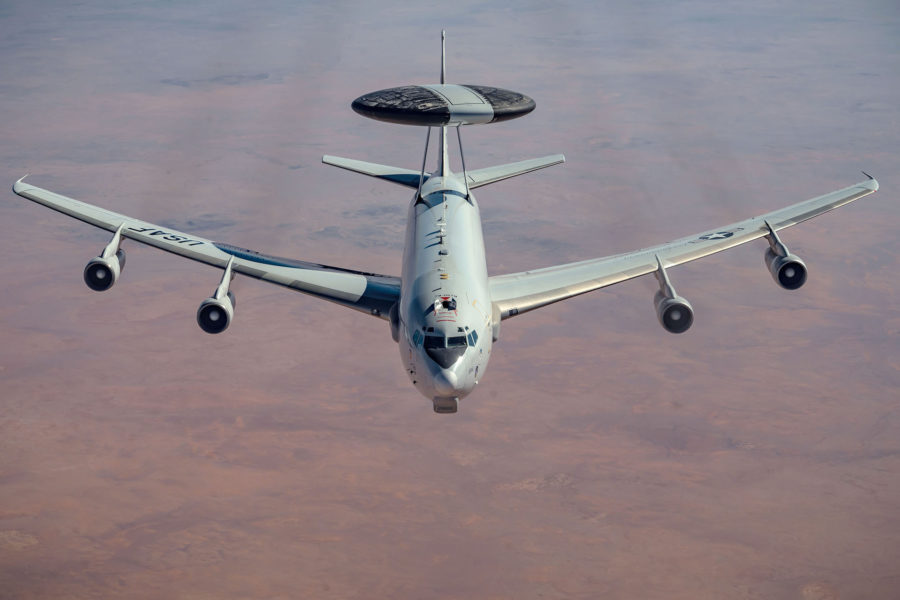
The E-3 Airborne Warning and Control System (AWACS) is a heavily modified Boeing 707-320B tasked with all-weather air and maritime surveillance; command and control; battle management; target, threat, and emitter detection; classification; and tracking. The aircraft can surveil airspace in excess of a 250-mile radius from surface to stratosphere.
AWACS coordinates theater air operations in direct subordination to joint/combined air and space operations centers. It can simultaneously conduct C2, BM, and target detection/tracking.
E-3Bs were upgraded to Block 30/35 standards in 2001 and current Block 40/45 aircraft are redesignated E-3G. Block 40/45 comprehensively modernized tracking/identification, system reliability, and sustainability, paired with separate flight deck modernization which added a digital cockpit and next-generation CNS/GATM.
The E-3 is increasingly unable to counter current and emerging threats and suffers a 55 percent mission capable rate due to obsolescence. USAF sharply curtailed modernization and retired roughly half the fleet, opting instead to award a $1.2 billion contract to adapt the Boeing E-7A Wedgetail operated by several allies. Anticipated cost increased and delivery of the first of 26 planned E-7As slipped to 2028, leading USAF to attempt to cancel the program in FY26.
Two “production representative” development prototypes were already on order and Congress intervened to restore FY26 funding to continue development. Future E-3 upgrades will be limited to sensors, comms, networking, and computing improvements to maintain capability until retirement. Upgrades are focused on the AWACS Communications Integration Program (ACIP), which will include BLOS SATCOM/second-generation NATO UHF, and anti-jam GPS.
USAF reduced the E-3 fleet to 16 aircraft in FY23 to improve sustainment through targeted phaseout in FY29. One of the remaining aircraft was destroyed by an Iranian attack on Prince Sultan Air Base, Saudi Arabia, on March 27, 2026.
E-3 Sentry Technical Data
Contractors: Boeing, Northrop Grumman (radar); Lockheed Martin (computer); Collins Aerospace (DRAGON cockpit upgrade).
First Flight: Oct. 31, 1975 (full mission equipment).
Delivered: March 1977-1984.
IOC: 1977; July 28, 2014 (Block 40/45).
Production: 31.
Inventory: 16 (E-3G).
Operator: ACC, AFRC (associate).
Aircraft Location: JB Elmendorf-Richardson, Alaska; Kadena AB, Japan; Tinker AFB, Okla.
Active Variants: •E-3B. Block 30/35 upgraded aircraft. •E-3G. Block 40/45 upgraded aircraft.
Dimensions: Span 145.8 ft, length 152.9 ft, height 41.8 ft.
Weight: Max T-O 335,000 lb.
Power Plant: Four Pratt & Whitney TF33-PW-100A turbofans, each 21,000 lb thrust.
Performance: Speed 360 mph, range 5,000+ miles (air refuelable).
Ceiling: Above 35,000 ft.
Accommodation: Two pilots, navigator, flight engineer, 13 to 19 mission specialists.