
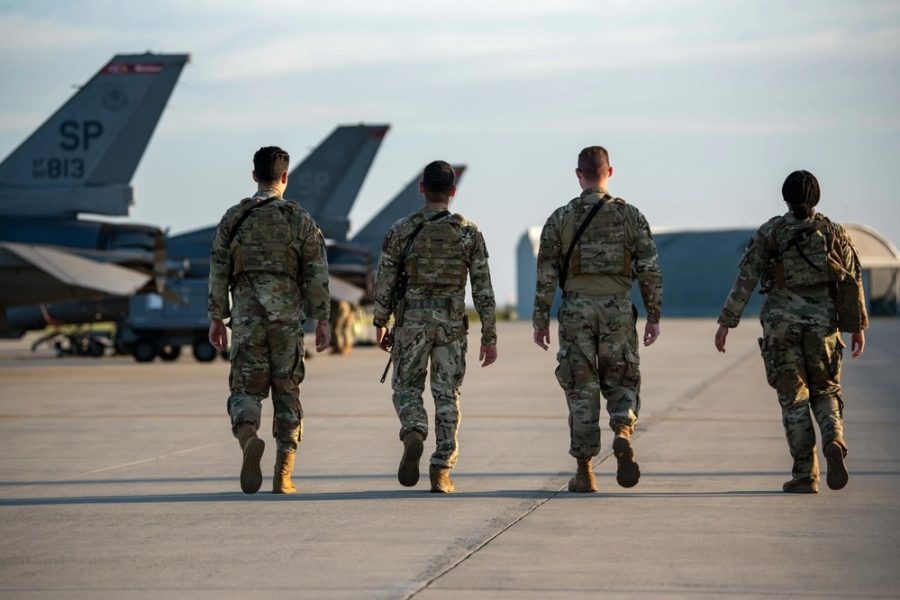
The Air Force is developing a new enlisted job specialty to defend bases against missile and drone attacks. Alarming damage to air bases across the Middle East during Operation Epic Fury focused leaders’ attention on the requirement.
Air Force leaders convened for the semiannual “Corona” meeting at Wright-Patterson Air Force Base, Ohio, earlier this month were briefed on “the evolving threat” and the need for a “dedicated new Air Force Specialty Code” to ensure personnel are trained and equipped to defend bases from aerial attack, according to a June 26 release.
Air Force leaders will also establish new “Point Defense Flights” at “select Air Force installations” to train for air defense responsibilities, the release said. The units will draw from multiple career fields.
The increasing availability of low-cost quadcopter and jet-powered drones like Iran’s Shahed have increased the threat of attacks on air bases and other military installations, not only those forward based but those closer to home, as well. The Air Force came under congressional scrutiny after unidentified drones hovered unchecked over Langley Air Force Base, Va., in December 2023, and more drone incursions followed at bases in Ohio, Utah, and the United Kingdom.
Ukraine’s 2025 “Operation Spiderweb” impressed but also concerned U.S. commanders, who watched with surprise as video surfaced of remotely piloted drones crashing into and disabling Russian bombers parked on base runways. Pentagon officials launched a review of U.S. military base defense systems and former commanders called for developing robust new defenses for a critical mission too long ignored.
New Pentagon initiatives, such as the Replicator 2 counter-drone initiative and the Joint Interagency Task Force 401, established to quickly develop counter-drone technologies for all the military services, are part of the solution. But new systems and weapons require new specialists to operate them and doctrine and standards for employing them. Today, responsibility for protecting bases is left to local commanders to figure out for themselves.
The Air Force’s Point Defense Battle Lab stood up last October to develop tactics, techniques, and procedures for Airmen defending domestic bases with commercial counter-drone technologies. Domestic bases and others in built-up civilian areas overseas are more limited in how they can react due to concerns about collateral damage to those living just beyond base boundaries.
In other overseas areas, such as air bases spread across the Middle East, most bases are in remote locations, though some, such as the Navy’s 5th Fleet headquarters in Manama, Bahrain, border on built-up urban complexes.
Iranian forces’ numerous drone and missile attacks during Operation Epic Fury killed an American Soldier at Prince Sultan Air Base, Saudi Arabia, and destroyed an E-3 Sentry Airborne Warning and Control aircraft, one of several aircraft damaged on the ground during the war. U.S. Central Command’s forward Combined Air Operations Center at Al Udeid Air Base, in Qatar, was severely damaged, Air and Space Forces Magazine has reported, and the Wall Street Journal reported severe damage to the Navy’s 5th Fleet Headquarters in Bahrain.
Air base defense in the Pacific, where bases in Japan are well within reach of China’s long-range weapons, continues to vex Air Force planners. The military’s primary missile interceptor systems, such as Patriot, belong to the Army, and while the Army ostensibly is responsible for protecting Air Force bases from attack, there aren’t enough systems to go around. The Air Force’s fiscal 2027 budget request seeks about $1.4 billion for a missile defense variant of the Air Base Air Defense Systems (ABADS), but it will take time for such a system to become operational.
“Nuclear deterrence and cyber are some of the biggest threats that we face, but defending our air bases, not only overseas but in the homeland, has become an increasingly high priority,” said Air Force Secretary Troy E. Meink, in May 20 congressional testimony. “I think we agree 100 percent that Airmen and Guardians have a responsibility to defend our air bases and defend our forces, regardless of where they are. We are focusing on electronic warfare to directed energy to kinetic capabilities to defend our Airmen and Guardians.”
How soon the Air Force will roll out the new air base defense specialty code is unclear. Creating a new AFSC requires a training curriculum and career field management plan, and will take time to develop. Requests for more information were not answered in time for this article. Some Security Forces personnel at high-security installations, such as nuclear bases and airfields, already train to counter drone threats. It is not clear how the new role will fit into Security Forces operations.
