
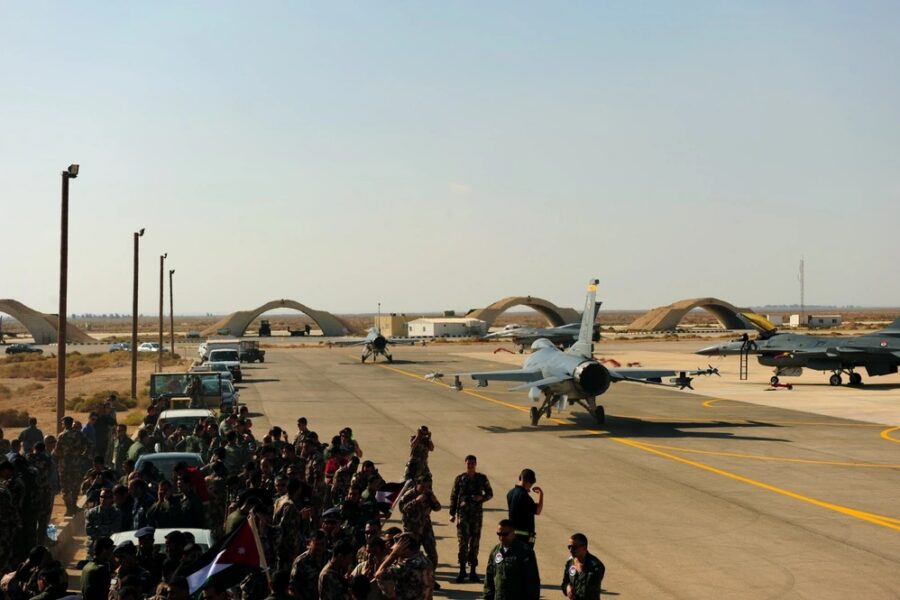
The Air Force is searching for a new “ground-based launcher” as it ramps up its efforts to defend its air bases from aerial enemy attacks.
The Command, Control, Communications, and Battle Management Directorate under the Air Force Life Cycle Management Center at Wright-Patterson Air Force Base, Ohio, wants defense firms to present ideas for a launcher that can “engage both cruise missiles and unmanned aircraft systems,” according to a July 17 request for information.
The RFI was first reported on by Air Force Times.
The Air Force and its sister services have been under increasing pressure to develop capabilities to repulse drone attacks in particular. Airmen and combat aircraft based in the Middle East have faced persistent air attacks during the conflict between the U.S. and Iran. Nine of the 16 U.S. service members killed during the hostilities have died as a result of Iranian drone and missile attacks on bases like Muwaffaq Salti Air Base, Jordan. And a March 27 Iranian missile and drone attack on Prince Sultan Air Base, Saudi Arabia, severely damaged an E-3 Sentry Airborne Warning and Control System, or AWACS, along with aerial refueling aircraft.
Proposed ground-based launcher systems should be designed to include onboard sensors, a laser illuminator, command and control tech, and a kinetic weapon, the request for info states. The system should be capable of defending against unmanned systems ranging all the way in size from small Group 1 drones weighing up to 20 pounds to large, Group 5 threats that are comparable to the MQ-9 Reaper in size and weigh more than 1,320 pounds.
Defense firms have until Aug. 7 to send responses, which should include the type of munition their system fires. Responses must also outline operational performance metrics, “specifically the firing rate across all magazines and the total magazine depth, while demonstrating seamless command and control (C2) system integration for rapid sensor data dissemination and weapons cueing,” the RFI states.
Firms should also describe the logistical parameters for transporting their systems, the manpower required to sustain it, and how rapidly it can be deployed, according to the document.
Air base defense has traditionally fallen to the Army, but Air Force Secretary Troy E. Meink told lawmakers May 20 that it has become “an increasingly high priority” for the service.
“We are focusing on electronic warfare to directed energy to kinetic capabilities to defend our Airmen and Guardians,” Meink said.
In its fiscal 2027 budget request, the Air Force is seeking about $1.4 billion for a missile defense variant of the Air Base Air Defense Systems (ABADS). Meanwhile, the Air Force received $51.8 million in procurement funds for its Small Unmanned Air Defense Systems, or SUADS, in fiscal 2026, according to budget documents. It’s available in two variants, one for fixed air bases and one that can be rapidly deployed on an aircraft pallet.
Aside from developing and procuring new equipment, the Air Force is also building new units, specifically trained to defend air bases from aerial attack. The service has established its first point defense flights of Airmen that can be rapidly deployed to support future agile combat employment missions in the Pacific where air bases are well within reach of China’s long-range weapons. For the long term, the service is developing a new job specialty code for a base defense career path.
The Air Force also stood up its Point Defense Battle Lab last October to develop tactics, techniques, and procedures for Airmen defending domestic bases with commercial counter-drone technologies.
