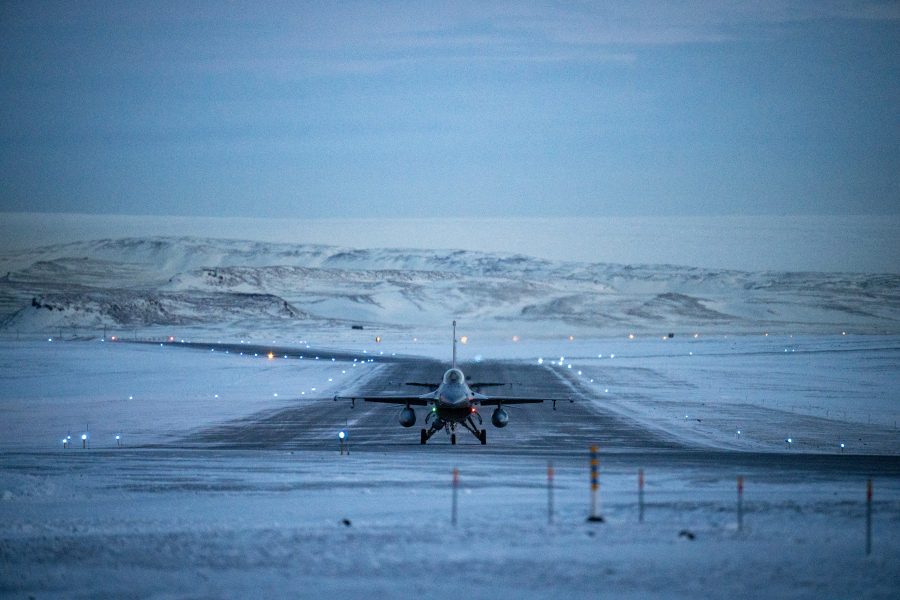
Maj. Dylan Flynn and Capt. Jeff Weingast, F-16 Fighting Falcon pilots assigned to the 18th Fighter Interceptor Squadron from Eielson Air Force Base, Alaska, taxi their aircraft on the flightline during Operation NOBLE DEFENDER at Pittufik Space Base, Greenland, Jan. 31, 2025. Operation NOBLE DEFENDER is an air defense operation under the direction of the North American Aerospace Defense Command designed to demonstrate the command’s ability to defend the approaches of North America from current and future threats while integrating across domains with partners and allies. NORAD routinely conducts sustained, dispersed operations in defense of North America through one or all three NORAD regions, include Alaska, Canada and the continental U.S. (U.S. Air Force photo by Tech. Sgt. Christopher Ruano)
Audio of this article is brought to you by the Air & Space Forces Association, honoring and supporting our Airmen, Guardians, and their families. Find out more at afa.org
Airmen from across North American Aerospace Defense Command deployed with fighters, tankers, and more to Pituffik Space Base in Greenland in recent weeks for a bitterly cold exercise.
From Jan. 28 to Feb. 11, more than 125 personnel participated in Operation Noble Defender, braving subfreezing temperatures that got as low as -29 degrees Fahrenheit with a wind chill of -56 degrees, according to a release.
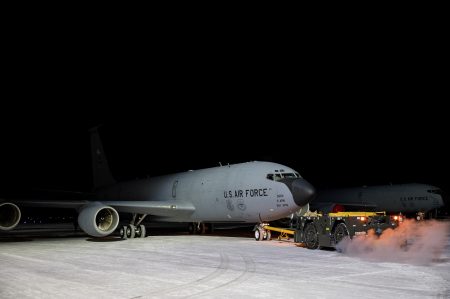
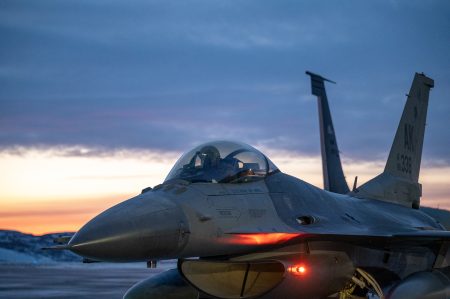
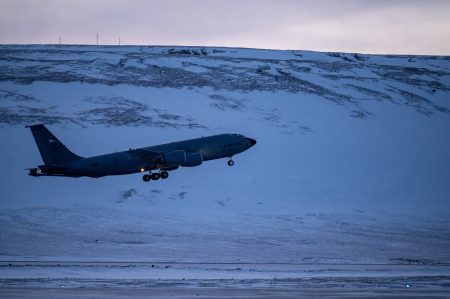
NORAD noted in its release that the exercise brought together personnel and aircraft from all three of its regions: Alaska, Canada, and the continental U.S. Participating aircraft included F-16s, KC-135s, and E-3s from the U.S. Air Force, as well as CF-18s, C-150s and CH-149s from the Royal Canadian Air Force.
“Over the last three weeks, our integrated American and Canadian NORAD teams have demonstrated the ability to operate at the highest level in one of the most austere environments in the world,” said Lt. Col. Matthew Shemo, commander of the 41st Air Expeditionary Group. “I am immensely proud of them and their dedication to this mission and appreciate the close cooperation from the Kingdom of Denmark as we train for the defense of Canada and the United States across all domains.”
According to released images, the F-16s came from the 18th Fighter Interceptor Squadron out of Eielson Air Force Base, Alaska, and the KC-135s from the 50th Air Refueling Squadron at MacDill Air Force Base, Fla.
The point of the exercise is to demonstrate and work on NORAD’s “ability to defend the approaches of North America from current and future threats, maintain mission readiness in diverse and challenging environments, and to preserve capacity for follow-on operations,” the command release stated.
NORAD previously announced the F-16s had deployed to Greenland the same day as U.S. Air Force F-35s and Royal Canadian Air Force CF-18s conducted combat air patrols in response to Russian military aircraft operating in the Arctic. F-35s also deployed to Greenland for the 2023 edition of Noble Defender.
The exercise comes as experts and U.S. military officials have warned that Russia remains interested in the so-called GIUK gap—the region including Greenland, Iceland, and the United Kingdom. NORAD boss Gen. Gregory M. Guillot said in March 2024 that Russian bombers flew through the region for the first time in years. President Donald Trump has also emphasized the strategic importance of Greenland, saying he would like to acquire the self-governing territory from Denmark.
Audio of this article is brought to you by the Air & Space Forces Association, honoring and supporting our Airmen, Guardians, and their families. Find out more at afa.org
The Air Force’s future strategy for fighting wars could include arming bombers with air-to-air strike capabilities, the service said in a new report to Congress.
The Pentagon has concluded a new agreement to buy laser-guidance kits that turn rockets into drone-killing weapons. BAE Systems and the Defense Department announced a framework deal of up to seven years for 25,000 Advanced Precision Kill Weapon System guidance kits annually for the U.S. military.
The Pentagon and Lockheed Martin on Oct. 22 announced a framework agreement to buy F-35 Joint Strike Fighters for the next 10 years. But the deal, touted by the Pentagon as “landmark” and a first of its kind, depends on Congress granting the military authority to enter into such a…
At least two KC-135 Stratotankers that were seriously damaged during Operation Epic Fury are still undergoing extensive maintenance depot repairs, the head of Air Force Materiel Command said Oct. 21.
As the Air Force wrestles to solve the logistics of dispersed operations in the vast Indo-Pacific, it’s investing $3.5 million to help develop a new kind of aircraft: a blended-wing body freighter that’s smaller than a C-130 but larger than a Cessna for “sub-tactical” lift.
Roughly two of every five fighters in the Air Force fleet could be F-35As by 2035, according to a new fighter force structure report the service submitted to Congress on Oct. 16. Lt. Gen. David Tabor, deputy chief of staff for plans and programs, revealed the new estimate during an…
The Air Force Life Cycle Management Center is moving forward with a program to upgrade a quarter-century-old computing system for some F-16 fighter jets.
The U.S. Navy on Oct. 15 accepted a C-130J-30 Super Hercules plane that it will modify to become the first of its new nuclear command, control, and communications aircraft—a route the Air Force is considering for a similar NC3 mission under congressional direction.
More than 40 years after the original YF-117 operational prototype flew test runs from a Lockheed Martin Skunk Works facility, an F-117 returned for a $1 million refurbishment to look its best when it assumes its place in history alongside other iconic aircraft on permanent exhibit at the National Air…
✓
Thank You!
Check your inbox to verify your email address and finish setting up your AFA account.
★
Welcome Back!
An account with this email already exists. Please log in to continue.
Subscribe to the Air & Space Forces Daily Report
The latest news from Air & Space Forces Magazine, as well as news from other leading publications, delivered right to your inbox every morning!
We’re sorry, there has been an error. Please review your input or try again later.