
Editor’s Note: This story was updated April 23 with a statement from the Air Force.
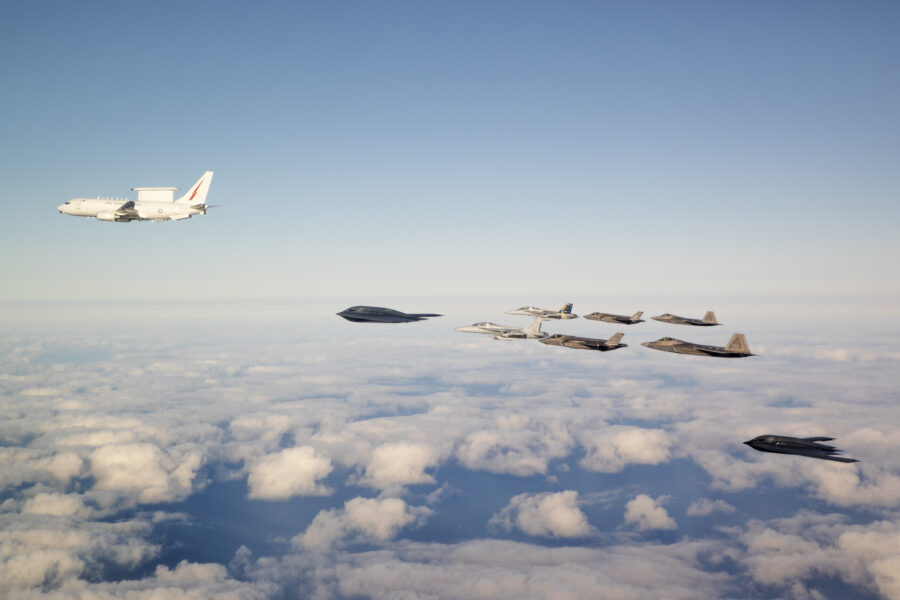
The Pentagon did not include any funding for the the E-7A Wedgetail in its 2027 budget request, potentially setting up another round in its fight with Congress over the future of the Boeing-built successor to the E-3 Sentry Airborne Early Warning and Control jet.
The Air Force is building E-7 prototypes as directed by Congress in the fiscal 2026 budget, and Air Force Secretary Troy Meink has promised a “discussion” with lawmakers about the long-term future of the program.
In a statement, an Air Force spokesperson acknowledged that there is no funding for the Wedgetail in the budget but said the service is “evaluating options to resource the E-7 program in FY 2027 to deliver Rapid Prototyping aircraft and continue Engineering and Manufacturing Development activities.”
Yet retired Lt. Gen. S. Clinton Hinote, former head of Air Force Futures, suggested the service may have waited too long in procuring the Wedgetail to realize its full value during a panel focused on airborne battle managament at the Center for a New American Security on April 22.
“The big discussion that we were having as we were preparing for the future Air Force was, did we miss the window—meaning, did we miss the window of replacing the E-3 with another aircraft, knowing that we would eventually distribute the sensors?” Hinote said. “Frankly, I think that discussion is still valid today.”
The retired three-star later added that he didn’t think the Air Force would buy as many E-7s as it needs and may need to rely on those in the Australian and British military to help quarterback an air fight in the future.
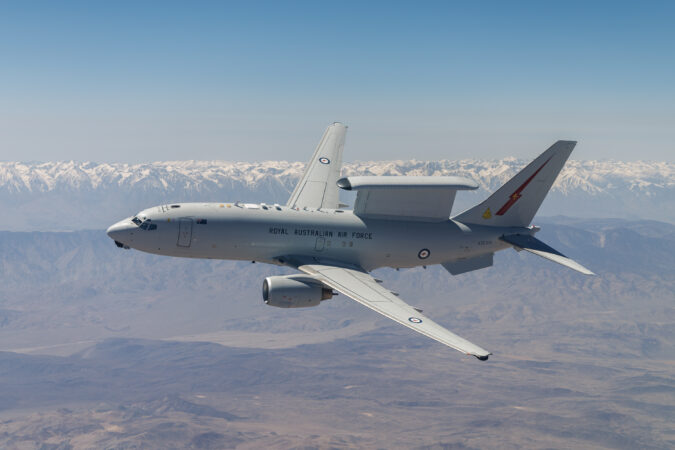
Australia deployed an E-7 to the Middle East to help the United Arab Emirates defeat Iranian missiles and drones in early March during Operation Epic Fury.
The lack of funds for the E-7 in 2027 was hardly a surprise, given Meink’s comments at AFA’s Warfare Symposium in February. The secretary declined then to commit to a long-term E-7 program and told reporters that the service would build the prototypes and “deliver a plan” as required by Congress.
“By the way, ‘deliver a plan’ does not mean we’re going to put it in the budget,” Meink said in February. “We’ll deliver a plan of what it takes to do, and then we’ll have a discussion.”
An Aging Fleet
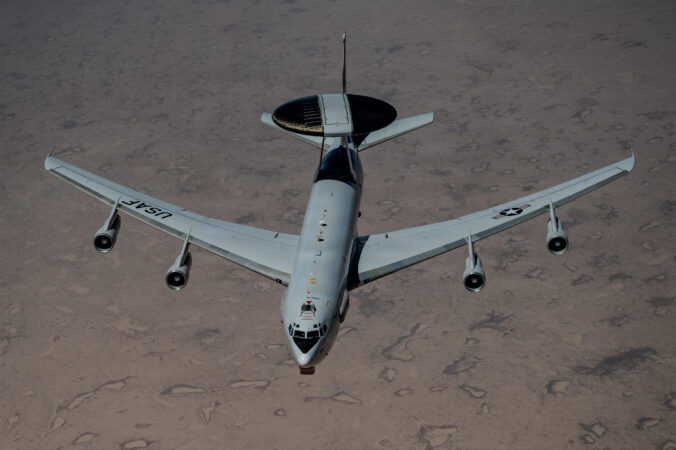
The Air Force’s E-3 AWACS jets are based on Boeing’s 707 and are increasingly challenging to maintain. Only 16 jets remained in the fleet at the start of this fiscal year, and they averaged 45 years old. In 2024, the last year for which Air Force figures are available, their mission-capable rate was just 56 percent.
Six of those AWACS birds deployed for Operation Epic Fury and one was destroyed March 27 while parked at Prince Sultan Air Base, Saudi Arabia, when it was struck with a volley of missiles and drones.
“Those are old aircraft, they are very old aircraft,” said Hinote, who retired in 2023 after 35 years of service. “The tail number on that aircraft is 810005. What that means is that the airplane was contracted by the Air Force to build in 1981. I was 11.”
Mitigating Risk
A March CNAS report on the future of air battle management made the case for retaining an aerial battle management platform in the Air Force inventory, despite concerns that the E-7 is both expensive and vulnerable to threats.
Philip Sheers, who authored the report, said any air battle management aircraft is an inevitable target for an adversary. China’s anti-access weaponry, which includes a host of maritime and ground-based air defenses as well as fighter aircraft, will focus on them. But Sheers argues that providing a “middle tier” of command and control between ground bases and space sensors is too important to neglect. Combining an aircraft’s mobility with the data processing and coordinating capabilities of an operations center, these planes fill a vital gap, he says.
The E-7’s sensing is superior to ground-based sensors for detecting and handling low-altitude drone and cruise missile threats, he wrote, and its 19-person crew provides on-board specialists to analyze and direct vast amounts of sensor data from various sources.
Sheers called for the Air Force to use airborne battle management aircraft in conjunction with uncrewed autonomous aircraft as escorts that could both protect and sense for the platform.
Budget Battles
In 2024, the Air Force awarded Boeing a $2.5 billion contract to build two E-7 prototypes, with plans to expand the fleet to 26 E-7s to replace the AWACS. But last year, with the arrival of a new administration, the Pentagon reversed course, seeking to cancel the program. That caused an outcry: Six former Air Force Chiefs of Staff and nine other retired 4-star generals joined the Air & Space Forces Association in urging Congress to reinstate funding.
Congress agreed, directing the Pentagon to follow through on the prototypes and report back on the program. Congress appropriated $1.1 billion to keep the program going and mandated that the Air Force provide a plan for “ongoing actions to streamline requirements and control costs on future production of the E-7 aircraft.”
That report is due in early May, after which the debates will begin in earnest.