
The Space Force announced $615 million in contracts to three vendors to mature space-based sensing and targeting capabilities in an effort to diversify its contractor base and accelerate technology development.
The Space-Based Air Moving Targeting Indicator awards, announced Aug. 4, went to Rocket Lab, Systems & Technology Research, and a third firm whose name the service withheld “due to operational security.” Space Systems Command declined to provide financial information or discuss the technology in detail, but Rocket Lab confirmed it received $397 million—the bulk of the total contract value. STR could not immediately be reached for details on its award.
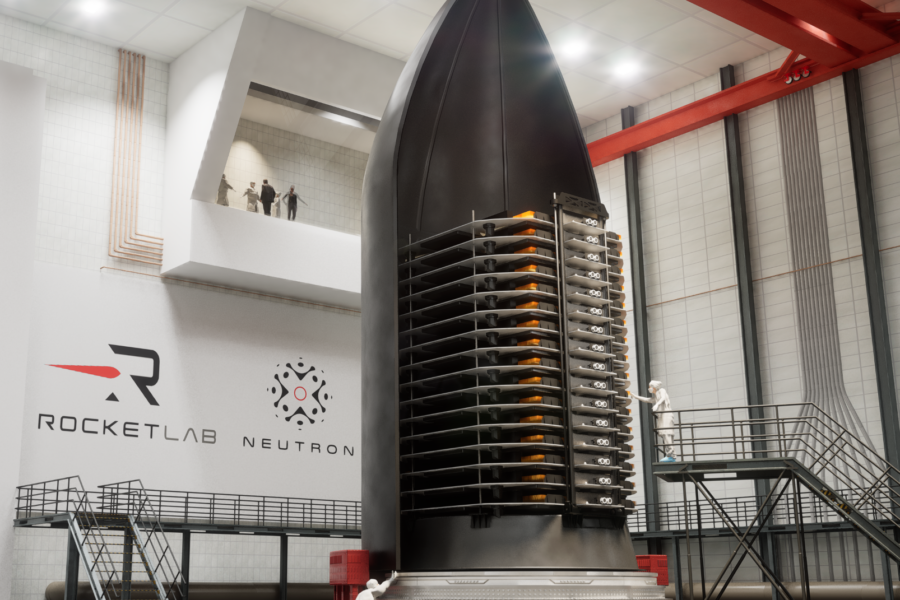
Rocket Lab said in a press release that its contract covers the development and launch of a next-generation flat satellite, which it calls a “Flatellite.” The spacecraft are designed for large constellations and will feature space-based sensors and low latency, high bandwidth communication links. Under the deal, Rocket Lab will launch the Flatellites on its Neutron rocket, a next-generation launch vehicle that the company expects will take flight for the first time this year.
“The Flatellite spacecraft and Neutron launch service will enable vendor diversity in the SB-AMTI program and increased capabilities for deploying the SB-AMTI architecture, which integrates cutting-edge sensors, secure communications, and robust ground processing systems to provide the U.S. military with persistent, real-time battlespace awareness in contested environments,” Rocket Lab said.
The U.S. military has long relied on ground-based radars and aircraft like the Air Force’s E-3 Sentry to track airborne targets like missiles, aircraft, and drones. Now, the Space Force and the National Reconnaissance Office are working to add satellites to the equation, an approach leaders expect will make the mission more resilient against adversaries’ anti-access/aerial-denial systems.
The Space Force’s fiscal 2027 budget request includes $7 billion to procure Space-Based AMTI satellites and $1 billion for a separate effort to conduct ground-moving target indication from orbit.
The new awards follow a massive $4.2 billion contract to SpaceX in May to provide an undisclosed number of AMTI satellites. Col. Ryan Frazier, portfolio acquisition executive for space-based targeting and sensing, told Air & Space Forces Magazine in a recent interview that he expects initial capability delivery over the next six to 12 months and “usable” capability in orbit by 2028.
Though SpaceX’s contract is significant, Frazier emphasized that competition and vendor diversity is important to the program and the service intends to maintain competition for additional sensors and satellites as well as ground and communications systems. In April, SSC selected nine vendors to compete for future AMTI task orders.
“We’ll compete for different space sensors, different types of sensors,” Frazier said. “We’ll go buy and populate part of the space layer, and then we will do another competition and continue to build out the space layer and then add some complementary phenomenologies to it.”
SpaceX leaders, meanwhile, told investors Aug. 4 they expect more contracts for the Space-Based AMTI program—as well as a second program called the Space Data Network— later this year.
“You can look at those as initial tranches and beginnings of additional capability that we will bring online, some of which we’ll have to compete,” SpaceX President and Chief Operating Officer Gwynne Shotwell said during the company’s second quarter earnings call. “Fundamentally, we have contracts in place to fulfill many phenomenologies, both the ones we’ve recently announced as well as additional ones that we’ll be working on going forward.”
