
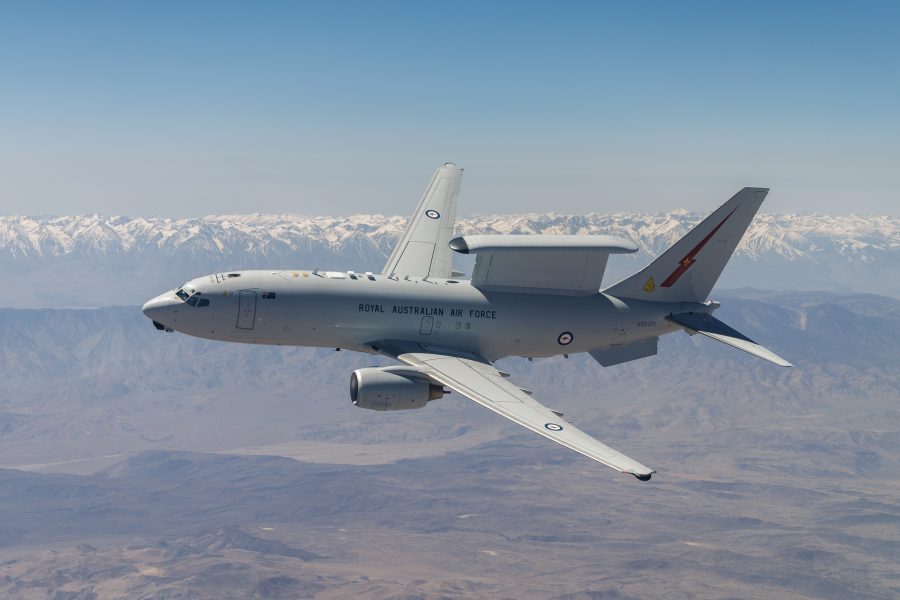
In a switch, the Pentagon is revising its budget to fund the E-7A Wedgetail, a replacement for the E-3 AWACS, in its 2027 budget request. The president’s initial budget request zeroed out E-7 acqusition.
Secretary of Defense Pete Hegseth told the House Appropriations Committee that the department had submitted a budget amendment to the White House seeking funds to fund systems that remain critical to current capabilities, including the Boeing 737-based early warning and battle management aircraft.
“There are gaps that still need to be filled, and there are systems that still need to be funded that are used on the battlefield right now—say MQ-9s, A-10s, you name it. The E-7 is one of those,” Hegseth told the committee, in response to a question from Rep. Tom Cole (R-Okla). “So we’ve actually sent a budget amendment to OMB to add that, and I think it has a future. It has a place on the battlefield, and we’ll get more information for you on that as well.”
OMB is the White House Office of Management and Budget.
Cole asked Hegseth about the potential gap in capability if the airborne early warning and control mission performed by the aging E-3 AWACS jets are not replaced.
Later in the day, during a Senate Armed Services subcommittee on airland hearing, Lt. Gen. David Tabor, the Air Force’s deputy chief of staff for plans and programs, confirmed the Air Force has recently been working with the Office of the Secretary of Defense to submit a budget amendment restoring funding for the E-7.
The U.S. deployed six E-3 Sentry aircraft for Operation Epic Fury against Iran, and one was destroyed on the ground in a March 27 missile attack on Prince Sultan Air Base, Saudi Arabia. In addition, Australia deployed an E-7 to assist the allied effort, helping the United Arab Emirates to detect and defeat Iranian missiles and drones targeting UAE territory.
Whether or not to buy the E-7 has become a contentious issue, pitting Congress against the Pentagon. Cole’s district includes Tinker Air Force Base, where most of the Air Force’s AWACS jets are based.
The long-term goal is to replace the need for aircraft to perform the airborne targeting and management missions envisioned for the E-7 with space-based systems. But satellites cannot yet fulfill the Airborne Moving Target Indicator (AMTI) mission, leaving a near-term need for an E-3 replacement.
Secretary of the Air Force Troy Meink said April 15 that the Space Force had selected vendors to build a constellation of sensors and satellites to perform the AMTI mission. He told reporters at the Space Symposium in Colorado Springs, Colo., that space-based AMTI technology works, but providing it affordably remains a hurdle.
In 2024, Boeing won a $2.5 billion Air Force contract to manufacture two E-7 prototypes, the first of a planned fleet of 26. But following President Donald Trump’s inauguration, the Pentagon sought to cancel the program. That prompted an outcry from six former Air Force Chiefs of Staff and nine retired 4-star generals, who joined the Air & Space Forces Association in calling on Congress to reverse the decision.
Congress responded, requiring the Pentagon to invest $1.1 billion to complete the two prototypes and ordering a report on the program’s status by early May.
In April, Meink indicated funding was in place for a total of seven Wedgetail aircraft. The Air Force is adding five more E-7s to the program’s contract this year, the military deputy for the Air Force’s assistant secretary for acquisition, technology, and logistics, Lt. Gen. Luke Cropsey confirmed, and the service expects to have a budget baseline by the end of this summer.
What led Defense Department leaders to reconsider their decision remains unclear. Australia’s public TV network, the Australian Broadcasting Corporation, reported May 10 that a Royal Australian Air Force E-7 had contributed “critical” capability to NATO’s defenses last year when Russian fighter jets crossed into Estonian airspace. Australia owns six of the aircraft.
Cropsey said the E-7 program, with its initial two rapid prototypes, is currently a middle-tier acquisition program, but that it will soon advance.
Once the baseline cost estimate is in hand, he said, the Air Force plans to convert the package of seven Wedgetails into a major capability acquisition program and formally enter the program into its engineering and manufacturing development phase.
Staff Writer Stephen Losey contributed reporting.