
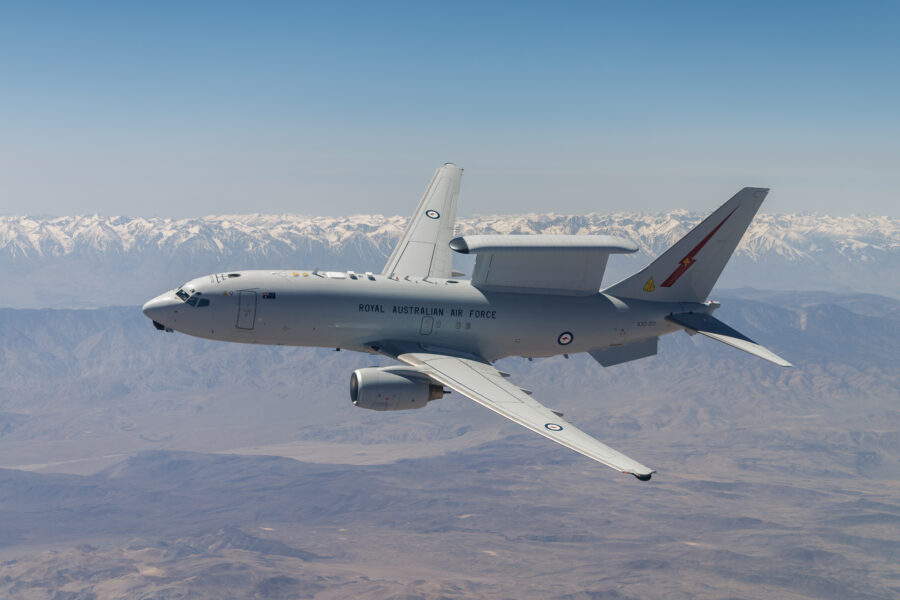
The Air Force has contracts in place for five additional E-7A Wedgetail airborne battle management aircraft, Secretary Troy Meink told lawmakers April 30.
Meink also said the Department of the Air Force wants to work with Congress to find ways to continue to fund the E-7 next year and beyond, even though the department did not include any money for the program in its fiscal 2027 budget request.
Meink, who was testifying to the House Appropriations defense subcommittee about the Department of the Air Force’s budget request, said those contracts to build five more engineering and manufacturing development E-7s are in addition to the two rapid prototype Wedgetails that were already under contract, bringing the number of contracted planes to seven.
The Air Force announced in March that it had reached a $2.4 billion deal with Boeing to buy an unspecified number of EMD E-7s. Meink’s comments are the first confirmation on the number of aircraft bought.
The E-7 is a Boeing-made modernized battlefield management aircraft that the Air Force planned to buy as a replacement for its aging E-3 Sentry Airborne Warning and Control System, or AWACS, aircraft. The E-3 fleet has been flying since the 1970s, and its sensor capabilities are growing increasingly outdated as adversaries such as China advance technologically.
The Air Force selected the E-7, which was originally built for the Royal Australian Air Force, in 2023, and the following year awarded Boeing a contract for two prototype aircraft worth $2.56 billion. At that time, the Air Force said it eventually planned to field a fleet of 26 E-7s to replace the AWACS.
But over the last year, the fate of the E-7 has whipsawed back and forth. In a June 2025 hearing, Defense Secretary Pete Hegseth cast the E-7’s future in doubt when he said it was an example of a system the department had to “make tough calls” on. Hegseth told the House Appropriations subcommittee that space-based assets represent the future of intelligence, surveillance, and reconnaissance.
Later that month, the Pentagon proposed canceling the E-7 program in its 2026 budget request and instead adding more Northrop E-2D Hawkeye planes and targeting satellites. Lawmakers pushed back and prevented the Air Force from canceling the E-7 in its 2026 defense appropriations and policy bills, and even added $1.1 billion to the budget to keep the program going.
At the Air & Space Forces Association’s Warfare Symposium in February 2026, Meink still sounded noncommittal about the future of the E-7 program beyond the pair of rapid prototype planes.
In the 2027 budget request released earlier this month, the Air Force once again zeroed out E-7 funding for this year—though it did include a nominal amount of money starting again in fiscal 2029 as part of its five-year projection.
Rep. Jake Ellzey (R-Texas), the vice chairman of the subcommittee and a former Navy fighter pilot, said he’s concerned that the Air Force’s budget request doesn’t include the E-7.
Ellzey acknowledged that the Air Force has to make some tough budgetary choices. But he questioned whether slashing the E-7 program and counting on the E-2D Hawkeye to fill its role is the right move.
“The E-2 really doesn’t cut it,” said. “It’s like comparing a King Air [turboprop executive jet] to a 777, with respect to capabilities.”
Ellzey also expressed concern that the Air Force lost one of its few remaining E-3s to an Iranian strike as part of Operation Epic Fury.
Meink acknowledged that the E-2, while a great aircraft in its own right, is “not in the same class” as the E-7. And he signaled an openness to revising the Air Force’s budget to further pay for the E-7.
“The department is committing to work with you to figure out how to adjust the [20]27 budget submission to fund the E-7, and then work the [20]28 [budget] going forward,” Meink said.
Congress frequently modifies the Pentagon’s budget request as it crafts the annual defense appropriations bill. That can mean adding extra funding on top of the request, or deducting money from some accounts to pay for plus-ups to others. The Air Force also is required to submit an unfunded priorities list to lawmakers, often referred to as a “wishlist” of programs that didn’t make the cut. It remains to be seen whether the E-7 will be on that list.