
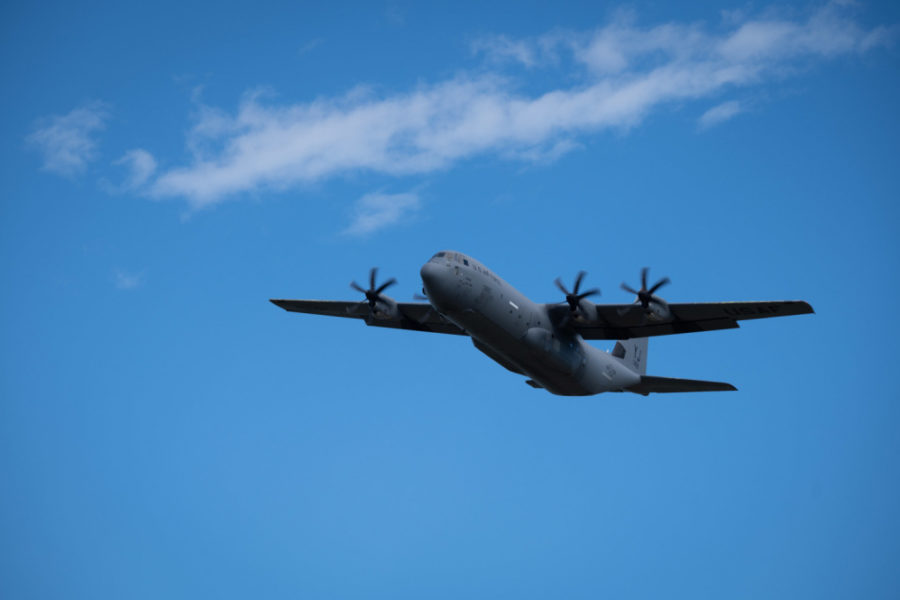
The C-130J is the redesigned, current production version of the C-130 all-purpose theater transport. Missions include tactical and intertheater airlift; airdrop, AE, and wildfire suppression using the Modular Airborne Fire Fighting System (MAFFS); and humanitarian relief. The aircraft first deployed to combat in Southwest Asia in 2004.
The Super Hercules features three-crew flight operations, more powerful engines, composite six-blade propellers, and digital avionics and mission computers. The C-130J can fly faster, higher, and farther than the C-130H. The C-130J-30 variant features a 15-foot-longer “stretched” fuselage. The combined fleet is sustained via block upgrades.
USAF combined Block 7/8.1 upgrades to reduce modification downtime. Block 7 includes Link 16, new flight management systems, civil GPS, and a special mission processor. Ongoing Block 8.1 upgrades add improved LOS data link and BLOS comms, improved precision navigational aids, and enhanced covert lighting; replace UHF comms with SATCOMS; and update mission planning systems. Block 8.1’s Mode 5 IFF and air traffic management upgrades were fielded ahead of cycle to meet airspace requirements, the first full 7/8.1 aircraft was redelivered in late 2020, and the first production-equipped aircraft was delivered in 2024.
C-130Js continue to receive Large Aircraft IR Countermeasures (LAIRCM) upgrades and enhanced service-life center wings to bring pre-2009 aircraft in line with current standards. Major development is focused on Comm Modernization to provide jam-resistant HF/UHF/ SATCOM voice and data (MUOS and NATO Saturn), as well as crypto and data links to keep pace with newer satellites and networking starting in FY27.
AMC recently tested external fuel tanks to enhance the J-model’s range and endurance for USINDOPACOM. An AFRC C-130J also trialed the Electronic Modular Aerial Spray System (EMASS) in preparation for taking over the aerial spray mission from the C-130H. FY26 funds six C-130Js, though Lockheed Martin has paused deliveries due to a comm system integration problem. ANG units in Connecticut, Montana, Minnesota, and Illinois also plan to upgrade to the Super Hercules.
C-130J Super Hercules Technical Data
Contractor: Lockheed Martin.
First Flight: April 5, 1996.
Delivered: February 1999-present.
IOC: October 2006.
Production: 545+ worldwide (J), 202 (USAF).
Inventory: 165.
Operator: AETC, AFMC , AMC, PACAF, USAFE, ANG, AFRC.
Aircraft Location: Dyess AFB, Texas; Keesler AFB, Miss.; Little Rock AFB, Ark.; Ramstein AB, Germany; Yokota AB, Japan; and ANG in California (EMASS), Georgia, Kentucky, Rhode Island, Texas, and West Virginia. Planned: Youngstown ARS, Ohio; ANG in Arkansas, Connecticut, Montana, Minnesota, and Illinois.
Active Variants: •C-130J Super Hercules. Short-fuselage current production version. •C-130J-30 Super Hercules. Stretched version capable of accommodating larger loads.
Dimensions: Span 132.6 ft, length 97.8 ft, height 38.8 ft.; (J-30 length) 112.8 ft.
Weight: Max T-O 155,000 lb (J), 164,000 lb (J-30); max payload 42,000 lb (J), 44,000 lb (J-30).
Power Plant: Four Rolls-Royce AE2100D3 turboprops, each 4,700 shp.
Performance: Speed 417 mph (J), 410 mph (J-30); range with 35,000 lb payload 1,841 miles (J), 2,417 miles (J-30).
Ceiling: With max payload, 26,000 ft (J), 28,000 ft (J-30).
Accommodation: Two pilots, loadmaster.
Load: Up to 92 combat troops or 64 paratroopers or 74 litters or six cargo pallets or 16 Container Delivery System (CDS) bundles or any combination of these up to max weight (J); 128 combat troops or 92 paratroopers or 97 litters or eight pallets or 24 CDS bundles or any combination of these up to max weight (J-30).