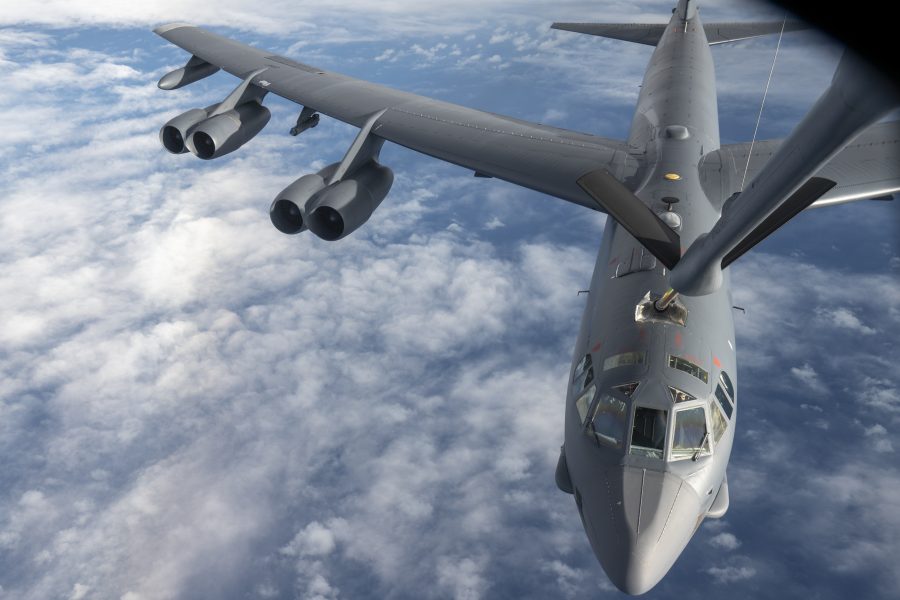
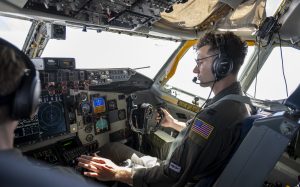
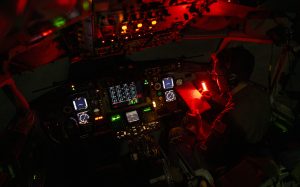
A B-52 Stratofortress assigned to the 2nd Bomb Wing, Barksdale Air Force Base, Louisiana, is refueled by a KC-135 Stratotanker assigned to the 6th Air Refueling Wing, MacDill AFB, Florida, within the U.S. Southern Command (SOUTHCOM) area of responsibility, June 18, 2024. The B-52 Stratofortress is a long-range, heavy bomber that can perform a variety of missions. As part of the Air Force Global Strike Command, the B-52 enables combat-ready forces to conduct strategic nuclear deterrence and global strike operations in support of combatant commanders. (U.S. Air Force photo by Senior Airman Lauren Cobin)
Audio of this article is brought to you by the Air & Space Forces Association, honoring and supporting our Airmen, Guardians, and their families. Find out more at afa.org
Two B-52 bombers from Barksdale Air Force Base flew a mission in the U.S. Southern Command area of responsibility last week, a relatively rare trip below the equator.
The Air Force released photos of the long-range bombers from the 2nd Bomb Wing in flight, as well as a KC-135 from the 6th Air Refueling Wing at MacDill Air Force Base, Fla., refueling them during the June 19 sortie. A spokesperson for the 12th Air Force—Air Forces Southern—told Air & Space Forces Magazine that six KC-135s from multiple locations participated in the training.
The spokesperson declined to identify what countries and areas the B-52s flew over as part of the mission, but did say the exercise took place in compliance with “all international requirements and protocols in the Gulf of Mexico, Caribbean and Northern part of South America.”
Open-source flight tracking data showed a KC-135 from MacDill flying over the Gulf of Mexico, Caribbean, and Central America, before approaching Ecuador and Peru from the east before returning home along a similar route.
“This mission was authorized by STRATCOM and closely planned with SOUTHCOM, the U.S. Embassies, and the appropriate partner nation government agencies to ensure maximum training and integration,” the spokesperson said. “STRATCOM Bomber Task Force missions help maintain global stability and security by demonstrating the ability to operate in different environments and locations while building ally and partner military capabilities.”
In a statement, Air Forces Southern said missions like this help “units to become familiar with operations in different regions” and show a commitment “to shared defense in Latin America.”
Unlike the Indo-Pacific, Europe, or even the Middle East, bomber deployments in the SOUTHCOM region are relatively rare. It has been a year since a B-52 last flew a mission over Latin America, and B-1s last participated in a SOUTHCOM mission in 2022.
This latest sortie comes on the heels of SOUTHCOM’s three-week multilateral exercise, Resolute Sentinel, which wrapped up June 14.
The exercise involved more than 1,500 personnel from all branches of the military participating, along with representatives from Peru, Colombia, Ecuador, Chile, Brazil, and France, according to a 12th Air Force release. In air operations, over 326 flight hours were logged across 299 air tasking order sorties.
“Resolute Sentinel 2024, as part of Large-Scale Global Exercise 24, is a demonstration of our ability to seamlessly operate together to maintain global freedom and stability,” Maj. Gen. Evan Pettus, 12th Air Force commander, said in a statement.
The exercise primarily took place in Peru, with emphasis on improving medical readiness through field hospital drills and community healthcare to strengthen regional disaster response capabilities, particularly for earthquakes, hurricanes, and floods.
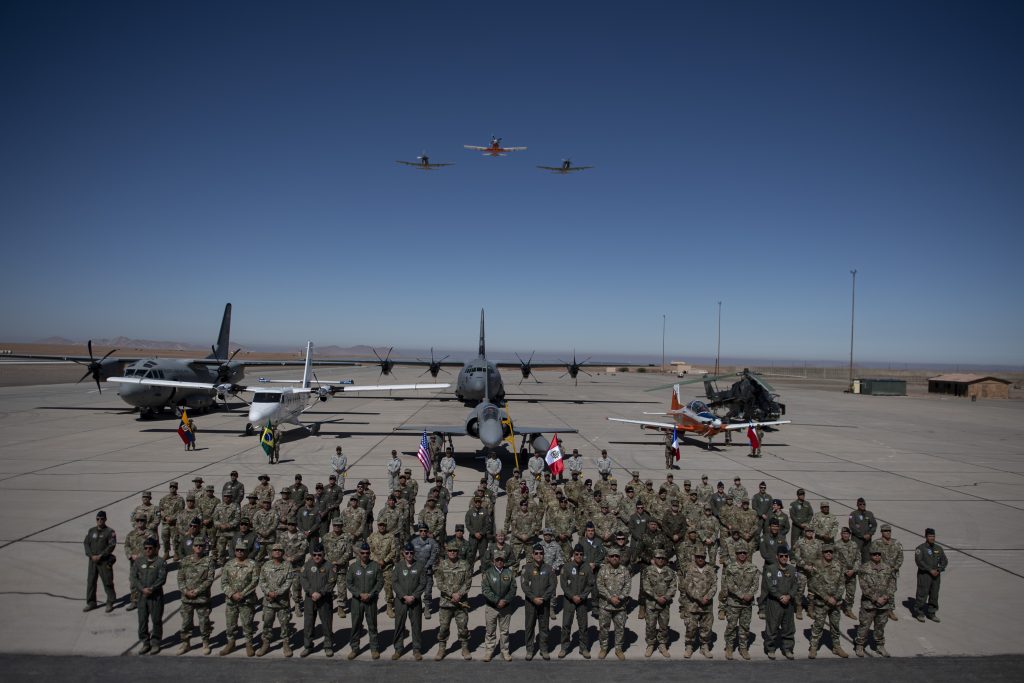
Representatives from the militaries of Peru, Colombia, Chile, Ecuador, Brazil, France and the United States pose for a group photo during the opening ceremony for Resolute Sentinel 2024 at Grupo 4 in La Joya, Peru, May 27, 2024. U.S. Air Force photo by Master Sgt. Daryl Knee
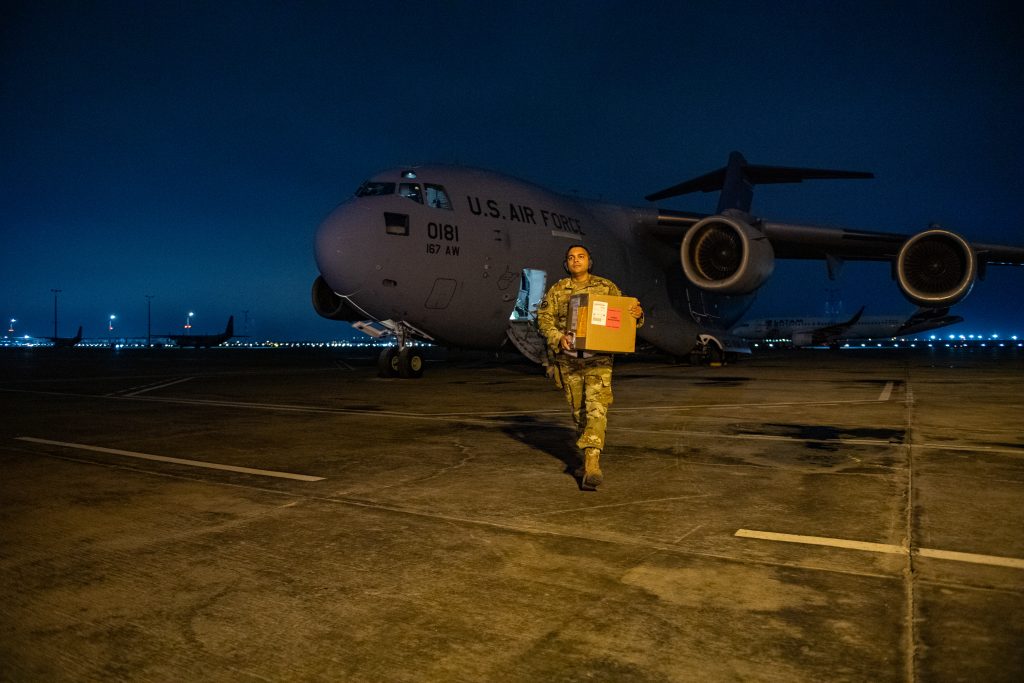
The exercise featured the first blood delivery to Peru in its three-year history, from Joint Base Charleston, S.C., to Lima, using a C-17 Globemaster III from the 167th Airlift Wing of Shepherd Field Air National Guard, W.V.
“Resolute Sentinel tests the full spectrum of medic interoperability across the Americas, ensuring we can work with our allies to rescue wounded warriors.” said Col. Brian Gavitt, 346th Expeditionary Operational Medical Readiness Squadron commander, in a release.
U.S. Air Force Staff Sgt. Thiago Goes, 70th Aerial Port Squadron special handler/joint inspector, carries a box of donated blood from a C-17 Globemaster III during Resolute Sentinel 2024 in Lima, Peru, May 30, 2024. U.S. Air Force photo by Senior Airman Courtney Sebastianelli
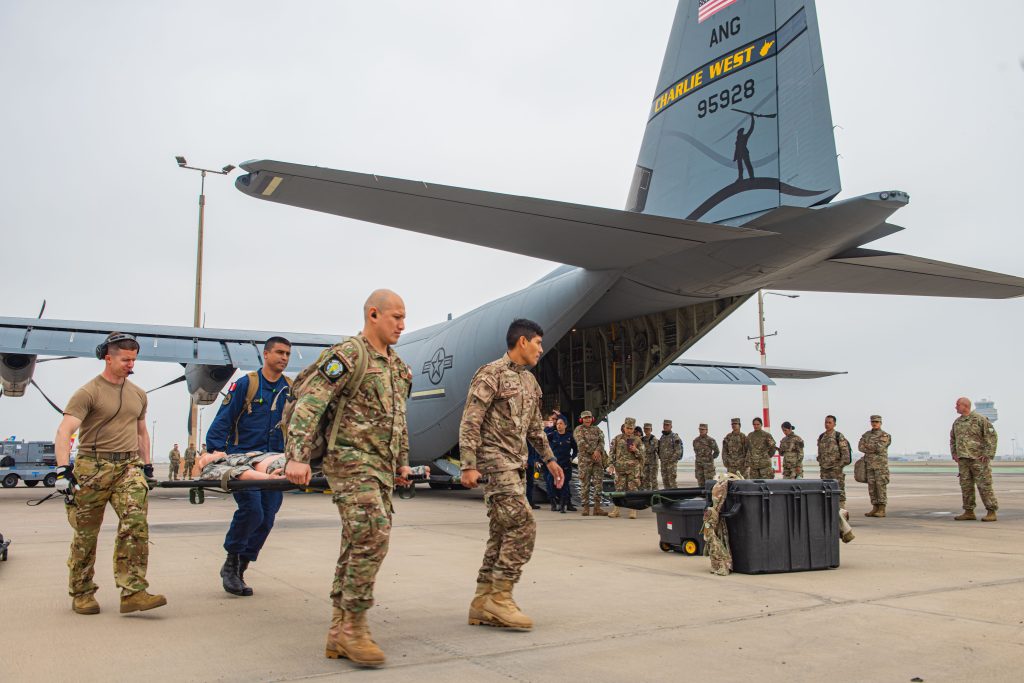
Airmen from the U.S. and Peru, alongside Peruvian Coast Guardsmen, also participated in joint aeromedical evacuation training in Lima. They focused on practicing critical care procedures, such as IV administrations and mid-air blood transfusions aboard a C-130J Super Hercules.
Airmen from the U.S. Air Force, Peruvian Air Force and Coast Guard, transport a simulated aeromedical evacuation patient during Resolute Sentinel 2024 in Lima, Peru, May 30, 2024. U.S. Air force photo by Airman 1st Class Sir Wyrick
Audio of this article is brought to you by the Air & Space Forces Association, honoring and supporting our Airmen, Guardians, and their families. Find out more at afa.org
At least two KC-135 Stratotankers that were seriously damaged during Operation Epic Fury are still undergoing extensive maintenance depot repairs, the head of Air Force Materiel Command said Oct. 21.
As the Air Force wrestles to solve the logistics of dispersed operations in the vast Indo-Pacific, it’s investing $3.5 million to help develop a new kind of aircraft: a blended-wing body freighter that’s smaller than a C-130 but larger than a Cessna for “sub-tactical” lift.
Roughly two of every five fighters in the Air Force fleet could be F-35As by 2035, according to a new fighter force structure report the service submitted to Congress on Oct. 16. Lt. Gen. David Tabor, deputy chief of staff for plans and programs, revealed the new estimate during an…
The Air Force Life Cycle Management Center is moving forward with a program to upgrade a quarter-century-old computing system for some F-16 fighter jets.
The U.S. Navy on Oct. 15 accepted a C-130J-30 Super Hercules plane that it will modify to become the first of its new nuclear command, control, and communications aircraft—a route the Air Force is considering for a similar NC3 mission under congressional direction.
More than 40 years after the original YF-117 operational prototype flew test runs from a Lockheed Martin Skunk Works facility, an F-117 returned for a $1 million refurbishment to look its best when it assumes its place in history alongside other iconic aircraft on permanent exhibit at the National Air…
A U.S. Air Force F-22 pilot controlled a YFQ-44A Fury Collaborative Combat Aircraft this month while both aircraft were in flight, according to an Oct. 16 release, another milestone in the service’s ambitious CCA efforts.
The Marine Corps recently conducted its first-ever “ripple” release of eight Small Diameter Bomb IIs from an F-35B, a key early step in proving out the capability for all F-35 variants.
The Air Force will field operational prototypes for an autonomous drone to replace its MQ-9 Reaper in 2028, Secretary of the Air Force Troy Meink said Oct. 14.
✓
Thank You!
Check your inbox to verify your email address and finish setting up your AFA account.
★
Welcome Back!
An account with this email already exists. Please log in to continue.
Subscribe to the Air & Space Forces Daily Report
The latest news from Air & Space Forces Magazine, as well as news from other leading publications, delivered right to your inbox every morning!
We’re sorry, there has been an error. Please review your input or try again later.