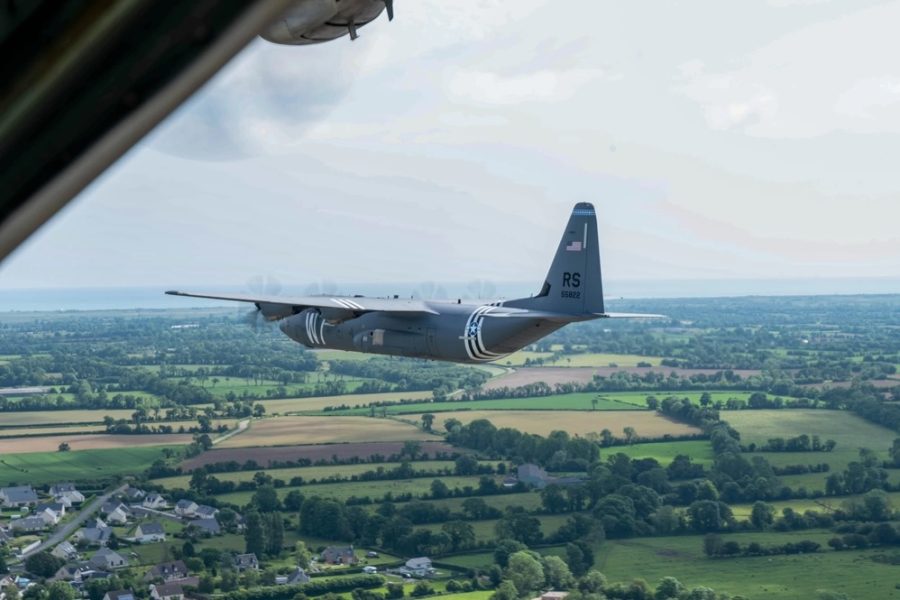
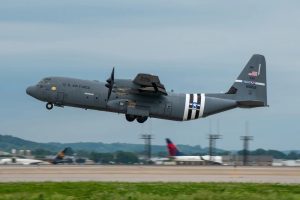
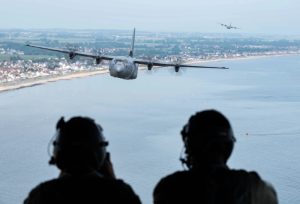
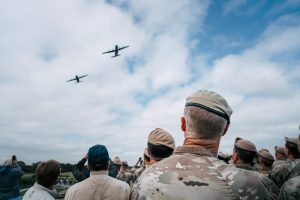
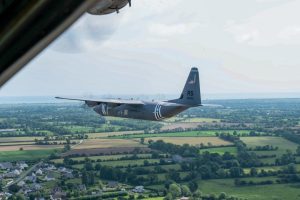
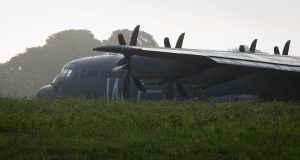
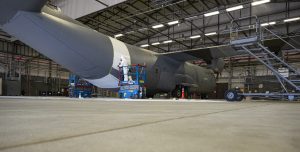
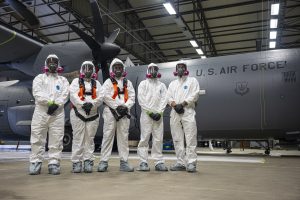
A U.S. Air Force C-130J Super Hercules assigned to the 37th Airlift Squadron, Ramstein Air Base, Germany, gets ready to fly over a commemorative ceremony for the 80th anniversary of D-Day at Sainte-Mere-Eglise, France, June 3, 2024. (U.S. Air Force photo by Senior Airman Jordan Lazaro)
Audio of this article is brought to you by the Air & Space Forces Association, honoring and supporting our Airmen, Guardians, and their families. Find out more at afa.org
Air Force crews flew over France this week in C-130 transport planes decked out in black-and-white “invasion stripes” for the 80th anniversary of D-Day, the June 6, 1944 battle where U.S. and allied troops began the liberation of Nazi-occupied France during World War II.
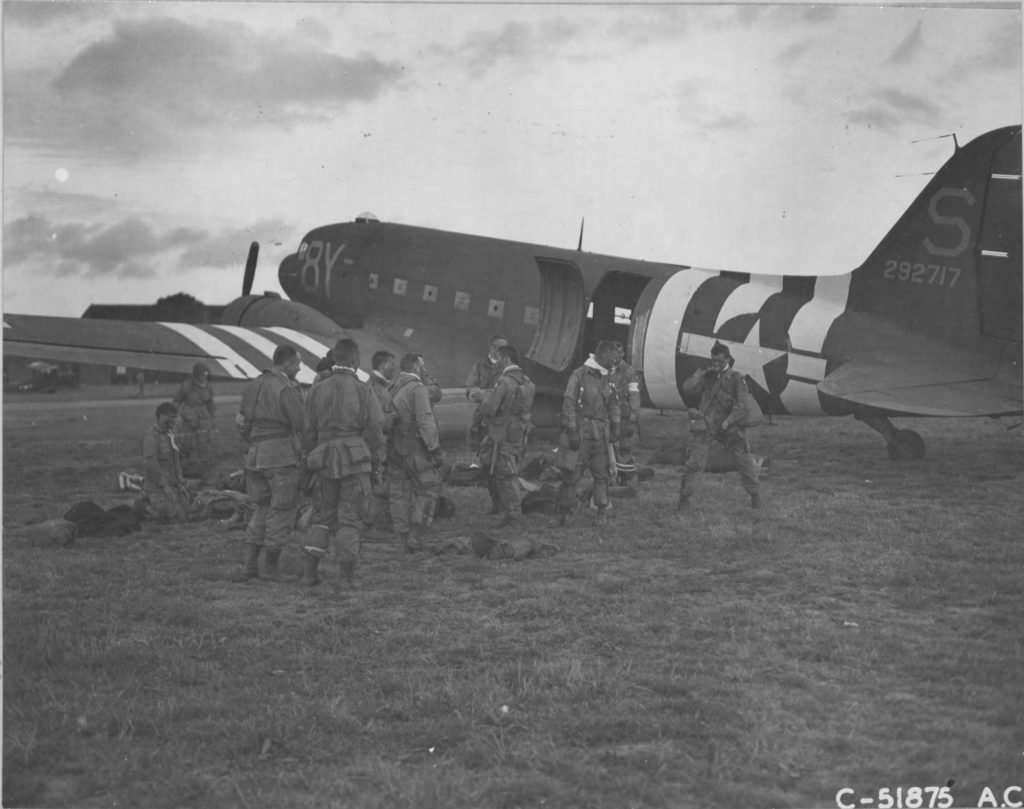
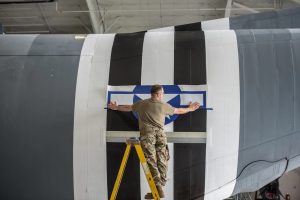
The stripes commemorate the patterns painted on allied aircraft during the invasion so that ground troops could quickly identify them as friendly forces. A year earlier, during the 1943 invasion of Sicily, Allied naval gunners mistakenly shot down 23 C-47 transports and heavily damaged another 37, killing dozens of paratroopers and air crew members.
“The incident would lead to better coordination between units and the black and white recognition stripes used on aircraft at Normandy,” according to the National World War II Museum.
Many of the stripes were hastily painted on June 3 for troop transports and June 4 for fighter and bomber squadrons—the short notice was part of an effort to keep the plan a secret, according to the National Air and Space Museum.
American paratroopers prepare to board their C-47 for their jump into Normandy. (U.S. Air Force photo / National Archives and Records Administration)
Over the years, many U.S. and allied air forces have sported the invasion stripes in honor of D-Day, including A-10 and F-15 fighter jets; C-17 and C-130 transport planes; and the United Kingdom’s Typhoon fighter jet.
For the 80th anniversary celebration, which will include dozens of events across France over several weeks, multiple USAF aircraft are sporting invasions stripes.
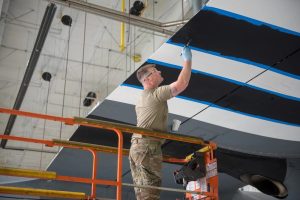
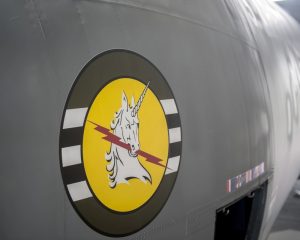
One is a C-130J assigned to the Kentucky Air National Guard. Besides the stripes, the Super Hercules also featured nose art based on the squadron patch of the WWII-era 368th Fighter Squadron which eventually became one of the first units of the Kentucky Air National Guard.
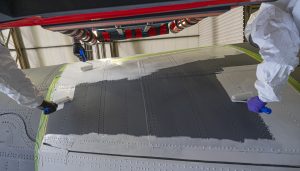
“I feel honored to be part of this 80th anniversary—to pay tribute to the men who gave so much so we could secure our freedom,” Master Sgt. Lee Stanley, aircraft structural shop chief for Kentucky’s 123rd Maintenance Squadron, said in a press release. Stanley led the paint effort, which started in late May.
“Designing the nose art is something I took a lot of pride in, and something I didn’t take lightly,” he added. “I wanted to make sure we got all the details historically accurate.”
Multiple C-130s from Ramstein Air Base, Germany, also got the stripes, with maintainers painting them on months ago.
Also included in the celebration was the legendary C-47 “That’s All, Brother” that led more than 800 C-47 Skytrain transports that ferried troops and cargo on D-Day.
“A steady and proven aircraft, the C-47 earned for itself a reputation hardly eclipsed even by the more glamorous of combat airplanes,” wrote Air Mobility Command Museum in a tribute to the C-47, which was widely known as the “Gooney Bird.”
The C-47 also evacuated wounded troops, dropped flares for bombing attacks at night, flew reconnaissance and psychological warfare missions, and served as a gunship during the Vietnam War, the museum wrote
All told, more than a dozen U.S. Air Force aircraft are participating in the 80th anniversary events, mostly C-130s. The 93rd Air Ground Operations Wing from Moody Air Force Base, Ga., also sent 30 Airmen to parachute in a June 9 display.
Several dozen D-Day veterans attended the 80th anniversary, which may be the last time many of them see invasion stripes flying overhead.
“For a lot of those guys who fought at D-Day, this might be the last chance they get to see this,” Stanley said. “So we really took a lot of care to make sure we got everything right.”
Audio of this article is brought to you by the Air & Space Forces Association, honoring and supporting our Airmen, Guardians, and their families. Find out more at afa.org
A U.S. Air Force F-22 pilot controlled a YFQ-44A Fury Collaborative Combat Aircraft this month while both aircraft were in flight, according to an Oct. 16 release, another milestone in the service’s ambitious CCA efforts.
The Marine Corps recently conducted its first-ever “ripple” release of eight Small Diameter Bomb IIs from an F-35B, a key early step in proving out the capability for all F-35 variants.
The Air Force will field operational prototypes for an autonomous drone to replace its MQ-9 Reaper in 2028, Secretary of the Air Force Troy Meink said Oct. 14.
One of the Air Force’s critical B-2 Spirit stealth bombers has returned to Whiteman Air Force Base, Mo., after an extensive course of maintenance to restore its stealth coating and preserve its structural integrity.
BAE Systems has received a contract from Lockheed Martin to install an upgraded Block 4 electronic warfare system into new F-35 Joint Strike Fighters, as well as to retrofit some older jets.
The Air Force has figured out a way for maintainers to inspect what had been a “blind spot” in F-16 engines, after problems in that area led to the catastrophic crashes of two jets in recent years.
The Air Force has begun evacuating stealth fighters, gunships, and special operations planes ahead of Hurricane Isaias expected landfall over the Gulf Coast this weekend.
The Air Force’s B-52 bomber may soon be able to carry up to 20 stealthy long-range anti-ship missiles to strike moving targets at sea, a key capability in a potential fight with China.
A reported surge of MQ-9 Reaper drones to Latin America could widen the scope of intelligence gathering and free up more strike options against cartels in the region, experts tell Air & Space Forces Magazine.
✓
Thank You!
Check your inbox to verify your email address and finish setting up your AFA account.
★
Welcome Back!
An account with this email already exists. Please log in to continue.
Subscribe to the Air & Space Forces Daily Report
The latest news from Air & Space Forces Magazine, as well as news from other leading publications, delivered right to your inbox every morning!
We’re sorry, there has been an error. Please review your input or try again later.