


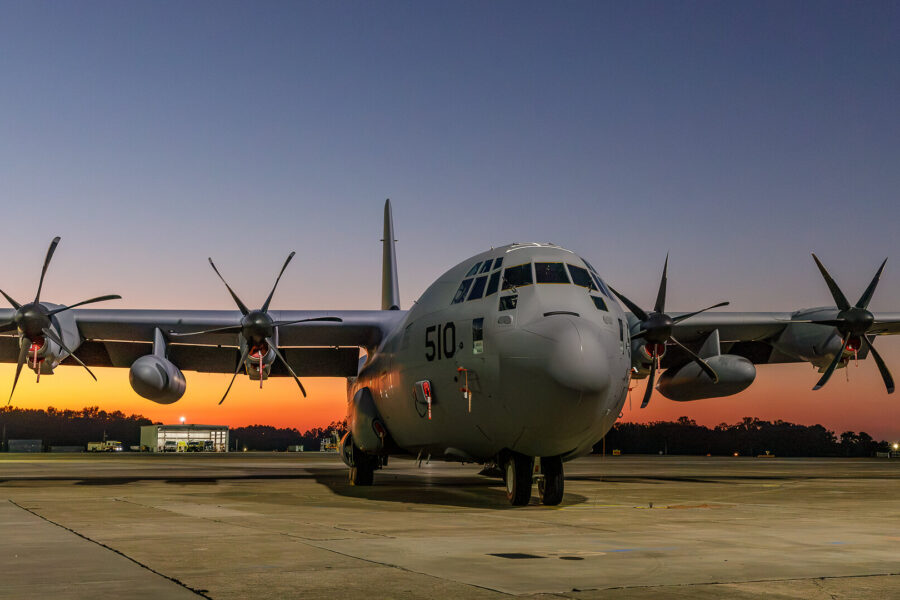
The U.S. Navy on Oct. 15 accepted a C-130J-30 Super Hercules plane that it will modify to become the first of its new nuclear command, control, and communications aircraft—a route the Air Force is considering for a similar NC3 mission under congressional direction.
Manufacturer Lockheed Martin delivered the aircraft to the Navy at its Marietta, Ga., facility, the company said in an Oct. 16 statement. When the modifications are complete, the C-130J-30 airframe will be designated an E-130J Phoenix II.
The E-130J is envisioned as the next-generation aircraft to take on the Navy’s TACAMO, mission. TACAMO, short for “Take Charge and Move Out,” is the mission of receiving, verifying, and relaying orders from the President, Secretary of Defense, and other military leaders, mainly to nuclear-armed submarines.
Since the late 1990s, the Navy has executed the TACAMO mission with the E-6B Mercury, derived from the Boeing 707. The Strategic Communications Wing 1 flies the mission from an Air Force installation—Tinker Air Force Base in Oklahoma.
Officials say the E-6B fleet, which includes 16 aircraft, is aging and must be replaced. The Navy announced in late 2020 its plan to buy new C-130Js for the purpose. From 1963 to 1993, the Navy flew the EC-130Q as its TACAMO platform.
“The C-130J platform has a storied history supporting our strategic communications mission, and accepting this first C-130J-30 marks an exciting new chapter,” Navy Capt. Roger Davis, airborne strategic command, control and communications program manager, said in Lockheed’s statement. “Lockheed Martin’s delivery of this battle-proven airframe provides the structure and performance backbone our mission requires as we transition into mission systems integration to field the E-130J Phoenix II.”
Now that the Navy has its first C-130J, the plane will transition into the mission systems integration process, led by Northrop Grumman as the prime contractor, U.S. Strategic Command said in a release. RTX’s Collins Aerospace will provide Very Low Frequency systems.
“This delivery marks a historic milestone for the U.S. Navy, Lockheed Martin, and the nation’s strategic communications network,” Trish Pagan, vice president of air mobility and maritime missions for Lockheed, said in the company’s statement. “The C-130J-30 Super Hercules continues to evolve and adapt to the needs of our customers, carrying the proven reliability of its lineage while transforming into a new, strategic mission set. It is built to deliver the capabilities our joint force demands and built to last through any operational challenge.”
The Navy wants a total fleet of 31 E-130Js; three are currently under contract.
The C-130J-30 is an extended version of the standard C-130J, which adds 15 feet to the plane’s fuselage. Yet the aircraft is still smaller than the E-6B, and the Navy’s use will be slightly different too.
For decades, the E-6B has been responsible for both the TACAMO and “Looking Glass” missions—Looking Glass is the nickname given to the Airborne Command Post mission—aircraft that fly with the systems and crews needed to receive and relay orders from the President and launch intercontinental ballistic missiles via the Airborne Launch Control System. But the E-130J will only perform the TACAMO mission, and the Air Force is taking back over the Looking Glass mission it performed from 1961 to 1998.
The Air Force is in the early stages of defining what it calls its “Looking Glass-Next” program. One option is to fold it into the still-in-development E-4C Survivable Airborne Operations Center, which is meant to replace the E-4B “Doomsday” plane as the flying command post for national leaders to direct nuclear and conventional forces, execute emergency war orders, and coordinate civil response actions in case of a major emergency.
Congress also included a section its 2026 National Defense Authorization Act directing the Air Force to submit a report on its acquisition strategy for Looking Glass-Next, including “options to expand production of the C-130J-30 Super Hercules aircraft to provide additional airframes to preserve the Airborne Command Post capability.”