
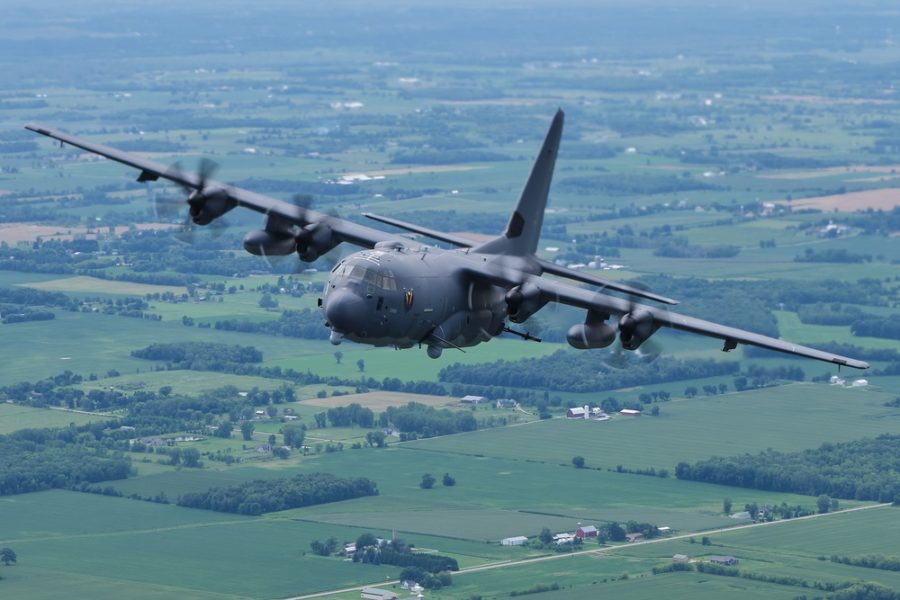
The AC-130J is AFSOC’s primary CAS, air interdiction, and armed reconnaissance platform optimized for convoy escort, point defense, and urban combat support. The advanced gunship provides ground forces a persistent direct-fire platform and is based on a highly modified MC-130J. Airframes are retrofit with the modular Precision Strike Package, wing-mounted weapons, and gunship-specific systems.
The initial aircraft was overstressed beyond repair when it departed controlled flight during a test sortie on April 21, 2015. Ghostrider deployed to combat for the first time in
Afghanistan in June 2019.
AC-130Js are upgraded and managed in common with the HC/MC-130J and are receiving Block 8.1 avionics upgrades along with the baseline C-130J. SOF-specific enhancements are rapidly developed and integrated in response to operational requirements. The aircraft’s PSP weapons system includes a dual mission management console, robust communications suite, two EO/IR sensors, advanced fire-control equipment, PGM delivery capability, and trainable cannons. Block 20 added a 105 mm gun, laser-guided SDB, side-facing pilot tactical HUD, and Large Aircraft Infrared Countermeasures (LAIRCM). Block 20+/30 improved gun accuracy, hardened GPS, and added Hellfire missile and Small Glide Munition. Block 30 upgrades completed in FY25 brought all AC-130Js to a common configuration.
SOCOM is upgrading both the AC-130J and MC-130J with the APG-83 AESA radar to enhance all-weather targeting, range, and accuracy, as well as survivability and collaboration against advanced threats. Modernization across AFSOC’s fleets is aimed at automating mission and comm/nav systems to alleviate crew workload. Ongoing upgrades include radio frequency countermeasures (RFCM) to detect, locate, and respond to threats, LAIRCM defensive systems upgrades, HF/VHF/UHF/SATCOM suite modernization, and laser SDB and SDB II integration.
Future modernization aims to optimize gunships for high-threat operations in USINDOPACOM by networking it with RPAs for stand-off ISR and electronic or kinetic strikes via the Airborne Adaptive Enterprise/Enhanced Precision Effects effort.
AC-130J Ghostrider Technical Data
Contractors: Lockheed Martin, Sierra Nevada Corp (RFCM).
First Flight: Jan. 31, 2014.
Delivered: July 29, 2015-Nov. 2, 2022.
IOC: Sept. 30, 2017.
Production: 31.
Inventory: 30.
Operator: AETC, AFSOC.
Aircraft Location: Cannon AFB, N.M.; Hurlburt Field, Fla.; Kirtland AFB, N.M.
Active Variants: • AC-130J Ghostrider Block 30. Production aircraft with post-operational test upgrades.
Dimensions: Span 132.6 ft, length 97.7 ft, height 39.1 ft.
Weight: Max T-O 164,000 lb.
Power Plant: Four Rolls-Royce AE 2100D3 turboprops, each 4,700 shp.
Performance: Speed 416 mph, range 3,000 miles (farther with air refueling).
Ceiling: 28,000 ft.
Armament: Trainable 30 mm GAU-23/A cannon; 105 mm cannon; up to eight wing pylon-mounted GBU-39 SDB or AGM-114 Hellfire; aft-firing GBU- 69B Small Glide Munition or AGM-176 Griffin (deployed from 10 Common Launch Tubes integrated into the aircraft’s ramp/door).
Accommodation: Two pilots, CSO, WSO, sensor operator, loadmaster, and three gunners.