
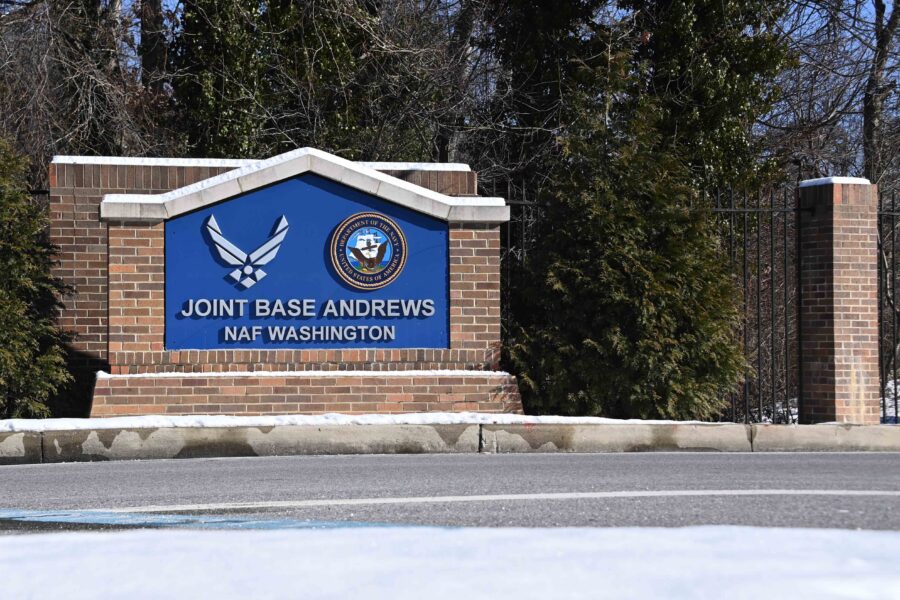
KISSIMMEE, Fla.—The military service chiefs have achieved consensus that they should “own and run” their own installations, Air Force Chief of Staff Gen. Kenneth S. Wilsbach said Nov. 6.
The Pentagon said no decision has been made on the matter, but in a statement confirmed that it “is conducting an internal review of its Joint Basing policy and related installation-support arrangements.”
The statement, from a Department of Defense spokesperson, continued: “We remain actively engaged with the Military Services and congressional committees of jurisdiction throughout the process. Our primary focus is to improve warfighter readiness and reduce bureaucracy to ensure our installation management practices are efficient, effective, and aligned to mission requirements. No base closures or force structure changes are anticipated.”
Abandoning “joint basing” would be a declaration that the nearly two-decade-old experiment failed to yield desired results.
The Joint Chiefs of Staff agreed about a year ago that each service should control its own bases, Wilsbach said while speaking at the Airlift/Tanker Association’s 2026 Symposium.
“We had consensus that we were very interested in having control of our own destiny, and what that meant for our bases was that we wanted to basically own and run our own bases and not rely on another service,” Wilsbach said.
Chief Master Sergeant of the Air Force David R. Wolfe told Air & Space Forces Magazine at the symposium that if the Pentagon and the services do reach an agreement to roll back joint basing, the effort could begin with “the places where the Navy and the Air Force are together” such as Joint Base Andrews, Joint Base Lindsey Graham, and Joint Base Pearl Harbor-Hickam.
Wilsbach said it’s natural for each service to want to run its own bases.
“If you think about the logic behind this, it makes sense,” Wilsbach said. “In a place where another service has to lead, do they have our interests at the top of their mind? Probably not. Just like we don’t when we have the lead for them.”
Services run their bases differently from one another, Wilsbach added.
“Our cultures are so different, and that’s a good,” he said. “We certainly run our services very differently. And so, being in charge of your own base is a goal of mine, and I hope to get that … late this year, or perhaps early next year.”
The joint base program was born out of recommendations from the 2005 Base Realignment and Closure Commission, with the goal of conserving resources by sharing support functions, including medical facilities, childcare, grounds maintenance, public affairs, safety, housing, dining, and finance departments.
Management of 26 bases—including 11 Air Force installations—were consolidated into 12 joint installations:
- Joint Base Lewis-McChord, Wash: McChord Air Force Base and Fort Lewis
- Joint Base McGuire-Dix-Lakehurst, NJ: Naval Air Engineering Station Lakehurst, Fort Dix, and McGuire Air Force Base
- Joint Base Andrews-Naval Air Facility Washington, Md.: Naval Air Facility Washington and Andrews Air Force Base
- Joint Base Anacostia-Bolling, D.C.: Bolling Air Force Base and Naval Station Anacostia
- Joint Base Myer-Henderson Hall, Va.: Henderson Hall and Fort Myer
- Joint Base Elmendorf-Richardson, Alaska: Fort Richardson and Elmendorf Air Force Base
- Joint Base Pearl Harbor-Hickam, Hawaii: Hickam Air Force Base and Naval Station Pearl Harbor
- Joint Base San Antonio, Texas: Fort Sam Houston, Randolph Air Force Base, and Lackland Air Force Base
- Joint Base Lindsey Graham, S.C.: Naval Weapons Station Charleston and Charleston Air Force Base
- Joint Base Langley-Eustis, Va.: Fort Eustis and Langley Air Force Base
- Joint Expeditionary Base Little Creek-Fort Story, Va.: Fort Story and Naval Expeditionary Base Little Creek
- Joint Region Marianas, Guam: Andersen Air Force Base and Naval Base Guam
The issue was controversial from the very start. Then-Air Force Secretary Michael W. Wynne remarked in 2008 that the service “has a very different concept of operations … in managing its bases,” and Chief of Staff Gen. T. Michael Moseley noted that the Air Force launches its forces directly from bases, making them “fighting positions.” The issue became a major point of contention between Wynne and then-Defense Secretary Robert Gates.
The concept never delivered on its promise, however. Projected to save the Pentagon more than $25 billion annually by 2011, joint basing failed to yield those savings due to higher-than anticipated construction costs, inflation, and incorrect assumptions. Instead of savings, the changes yielded a net cost increase, even when spread out over 20 years, according to the Government Accountability Office.