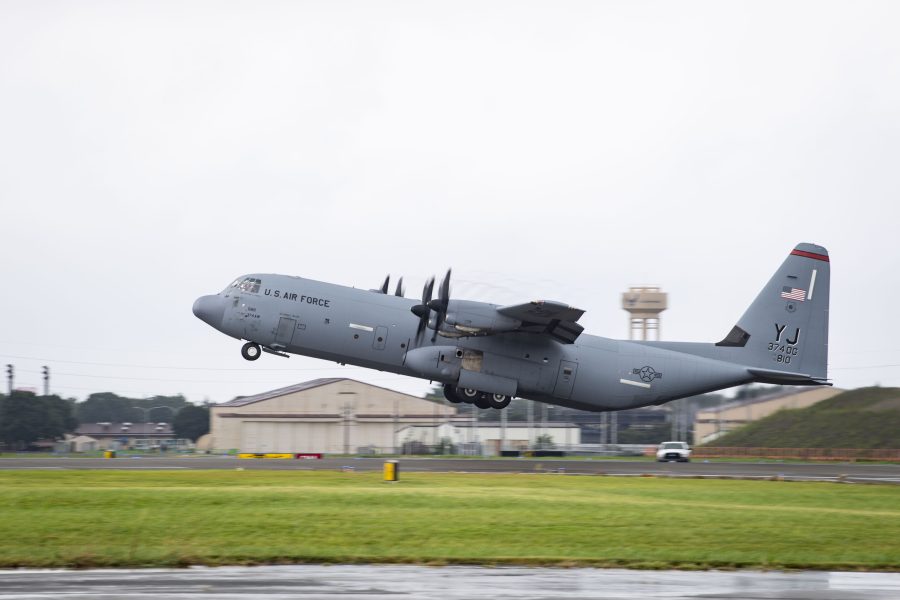
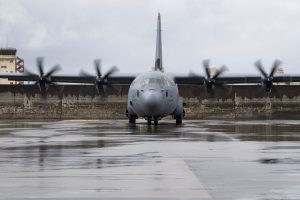
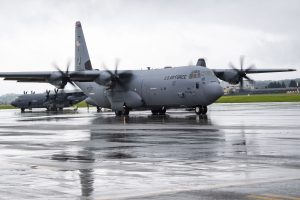
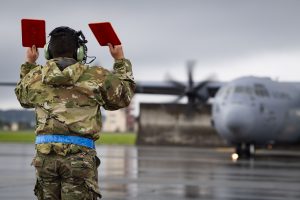
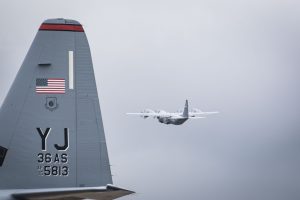
A U.S. Air Force C-130J Super Hercules assigned to the 36th Airlift Squadron takes off from Yokota Air Base Japan, August 16, 2024. At the direction of Col. Richard McElhaney, 374th Airlift Wing commander, the 374th Operations Group in tandem with the 374th Maintenance Group prepared, generated and launched eleven C-130Js in less than 24 hours as a preventive measure to avoid mission degradation due to Typhoon Ampil. In addition to aircraft generation, Yokota Air Base units also took additional measures to ensure readiness including placing sandbags in areas prone to water pooling and sheltering vehicles and other airframes for protection. (U.S. Air Force photo by Senior Master Sgt. DeAndre Curtiss)
Audio of this article is brought to you by the Air & Space Forces Association, honoring and supporting our Airmen, Guardians, and their families. Find out more at afa.org
Yokota Air Base evacuated 11 C-130J Super Hercules in under 24 hours ahead of a typhoon nearing Japan packing the punch of a Category 4 hurricane.
The 374th Airlift Wing flew the cargo aircraft out on Aug 16 out of “an abundance of caution” to maintain combat readiness and protect the aircraft from potential damage.
“For us, launching the fleet wasn’t just about the preventative measures, but that we can demonstrate deterrence to our adversaries,” Technical Sgt. Joshua Rice, 374th Aircraft Maintenance Squadron crew chief, said in a release.
Typhoon Ampil swiped eastern Japan on Aug. 16 with strong winds and torrential rain, causing power outage, hundreds of flight and train cancellations, and mandatory evacuations. Tokyo, the nation’s capital, saw flooded streets and fallen trees blocking roadways in the city and nearby prefectures, according to local reports.
Yokota, just 30 miles from Tokyo, is the only U.S. base in Japan with C-130J aircraft and serves as the Air Force’s primary airlift hub in the Western Pacific. The Airmen on site were initially put on ‘BRAVO’ status that signals a heightened state of readiness, and given the green light for the mass deployment of the fleet on the morning of the operation. Under BRAVO alert, aircraft are expected to be ready for departure 3 hours following the alert for C-17, C-130, and KC-10 missions.
“In 25 years of flying, I’ve never seen 100 percent mass generation and execution at this scale,” Col. Richard McElhaney, who took command of the 374th last month, said about the deployment.
The wing did not disclose to where the aircraft were evacuated, but did say the crew prepped the transport planes with maintenance gear to ensure smooth operations off-station and a safe return to Yokota after the typhoon threat passed.
Meanwhile, other aircraft were sheltered in hangars, sandbags were laid in flood-prone areas to protect infrastructure, and vehicles and airframes were tucked away to avoid damage. The base also hosts CV-22 Ospreys, UH-1N Iroquois, and C-12 Hurons.
“Today was easy because of all the work everyone put in, from the aircrews to maintenance and logistics, this showcases what Team Yokota is capable of,” Rice said.
Ampil tracked along Japan’s coast, prompting the evacuation of more than 300,000 residents due to high waves, potential landslides, and increasing rain into Aug. 17. The typhoon had maximum sustained winds of 132 miles per hour and gusts reaching 160 mph, equivalent to a Category 4 hurricane. But with the storm’s center mostly remaining over the ocean, it could weaken to a tropical storm by Aug. 18, and Japan will dodge a worst-case scenario, according to the local authorities. The other two USAF bases in Japan, Kadena and Misawa, are outside the storm’s primary impact zone.
Audio of this article is brought to you by the Air & Space Forces Association, honoring and supporting our Airmen, Guardians, and their families. Find out more at afa.org
The Air Force Life Cycle Management Center is moving forward with a program to upgrade a quarter-century-old computing system for some F-16 fighter jets.
The U.S. Navy on Oct. 15 accepted a C-130J-30 Super Hercules plane that it will modify to become the first of its new nuclear command, control, and communications aircraft—a route the Air Force is considering for a similar NC3 mission under congressional direction.
More than 40 years after the original YF-117 operational prototype flew test runs from a Lockheed Martin Skunk Works facility, an F-117 returned for a $1 million refurbishment to look its best when it assumes its place in history alongside other iconic aircraft on permanent exhibit at the National Air…
A U.S. Air Force F-22 pilot controlled a YFQ-44A Fury Collaborative Combat Aircraft this month while both aircraft were in flight, according to an Oct. 16 release, another milestone in the service’s ambitious CCA efforts.
The Marine Corps recently conducted its first-ever “ripple” release of eight Small Diameter Bomb IIs from an F-35B, a key early step in proving out the capability for all F-35 variants.
The Air Force will field operational prototypes for an autonomous drone to replace its MQ-9 Reaper in 2028, Secretary of the Air Force Troy Meink said Oct. 14.
One of the Air Force’s critical B-2 Spirit stealth bombers has returned to Whiteman Air Force Base, Mo., after an extensive course of maintenance to restore its stealth coating and preserve its structural integrity.
BAE Systems has received a contract from Lockheed Martin to install an upgraded Block 4 electronic warfare system into new F-35 Joint Strike Fighters, as well as to retrofit some older jets.
The Air Force has figured out a way for maintainers to inspect what had been a “blind spot” in F-16 engines, after problems in that area led to the catastrophic crashes of two jets in recent years.
✓
Thank You!
Check your inbox to verify your email address and finish setting up your AFA account.
★
Welcome Back!
An account with this email already exists. Please log in to continue.
Subscribe to the Air & Space Forces Daily Report
The latest news from Air & Space Forces Magazine, as well as news from other leading publications, delivered right to your inbox every morning!
We’re sorry, there has been an error. Please review your input or try again later.