
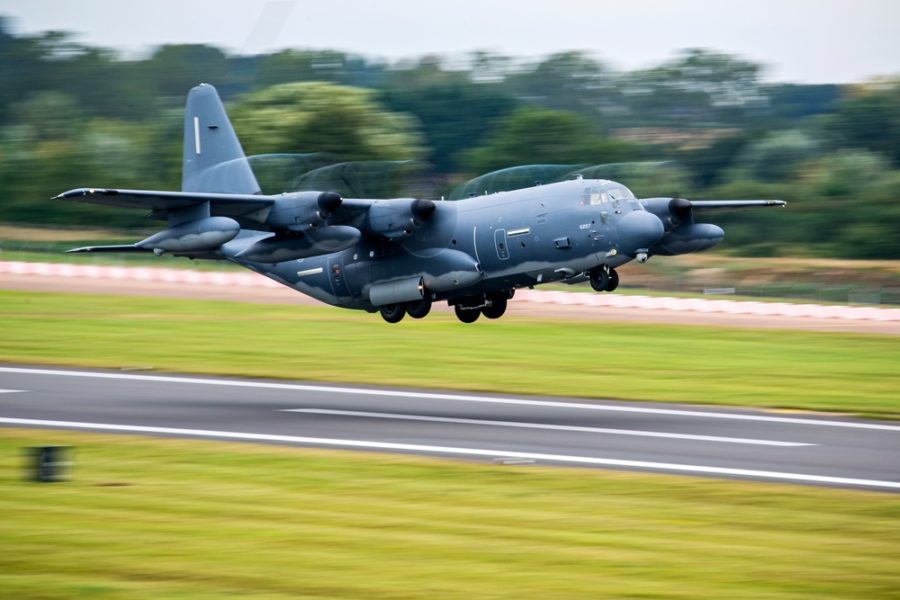
The MC-130J is AFSOC’s current special operations tanker/mobility aircraft based on the C-130J. Designated Commando II (previously Combat Shadow II) in honor of the WWII C-47, the aircraft are tasked with covert day, night, and adverse weather infiltration, exfiltration, and resupply of special operations forces in hostile or denied territory. They also provide airdrop resupply,
rotary wing aerial refueling, psyops, and rubber raiding craft deployment for littoral ingress/egress. Specialized mission systems include advanced, integrated defensive systems including LAIRCM, EO/IR targeting sensor, and an added CSO flight-deck station to manage refueling, tactical navigation, and comms.
MC-130Js are equipped with wing-mounted external tanks and drogue refueling pods to provision tilt-rotor and rotary-winged aircraft as well as a boom-style receptacle to receive fuel in flight. The MC-130J shares system commonality with both the HC-130J rescue and AC-130J gunship versions, sharing overlapping upgrades and modernization with both types.
The MC-130J was pulled out of baseline C-130J Block 7/8.1 software upgrades, which were then merged with comm/nav modernization in 2022. “Block 8.X” now comprises critical software for HF/VHF/UHF SATCOM upgrades, including secure, jam-resistant Mobile User Objective System (MUOS) BLOS and antijam NATO-interoperable SATURN UHF with installs starting in FY25. Link 16 mods were delayed for funding and a planned switch to high-capacity, jam-resistant MIDS-JTRS.
AFSOC is significantly enhancing the MC-130J’s ability to operate in future high-end-threat environments under Capability Release 2. This update includes Terrain-Following/Terrain Avoidance (TF/TA) radar, Radio Frequency Countermeasure (RFCM), and Airborne Mission Networking (AbMN). Silent Knight TF/TA is housed in a second radome below the cockpit and enables the MC-130J to conduct low-level nighttime/adverse weather penetration. RFCM modernizes EW and improves detection of, location of, and response to emerging threats, while AbMN gives the crew a
common air/ground picture to manage complex workloads.
Modernization also includes radar warning receivers, chaff, and flare systems. MC-130s are also receiving Variable Speed Drogues to refuel a wider-range of aircraft in a single sortie without reconfiguration. Upgraded aircraft are redesignated Combat Talon III and pave the way toward future open-architecture, highly integrated, and automated mission and defensive systems. Testers are also evaluating fuel-saving wingtip “winglets” to increase lift and aft cargo door “finlets” to reduce drag and improve fuel efficiency.
Lockheed Martin delivered the final production MC-130J to Kirtland Jan. 14, 2025. Two MC-130Js were destroyed by US forces on the ground during a combat rescue mission in Iran on April 5, 2026.
MC-130J Commando II/COMBAT TALON III Technical Data
Contractors: Lockheed Martin (airframe); Boeing; Sierra Nevada Corp. (RFCM); Raytheon (TF/TA radar).
First Flight: April 20, 2011.
Delivered: Sept. 29, 2011-Jan. 14, 2025.
IOC: Dec. 7, 2012.
Production: 65
Inventory: 65
Operator: AETC, AFSOC, ANG.
Aircraft Location: Cannon AFB, N.M.; Harrisburg Arpt., Pa.; Kadena AB, Japan; Kirtland AFB, N.M.; RAF Mildenhall, U.K.
Active Variants: •MC-130J. Commando II. SOF support and aerial refueling tanker based on the C-130J. •MC-130J. Combat Talon III. MC-130J upgraded with TF/TA radar, RFCM, and AbMN.
Dimensions: Span 132.6 ft, length 97.8 ft, height 38.8 ft.
Weight: Max T-O 164,000 lb.
Power Plant: Four Rolls-Royce AE2100D3 turboprops, each 4,591 shp.
Performance: Speed 416 mph, range 3,000 miles (further with air refueling).
Fuel Capacity: 61,360 lb at 150-300 gpm (100 gpm dual, simultaneous refueling).
Ceiling: 28,000 ft with 42,000-lb payload.
Accommodation: Two pilots, CSO, two loadmasters.
Load: 42,000 lb of cargo/personnel (see C-130J for configurations).