
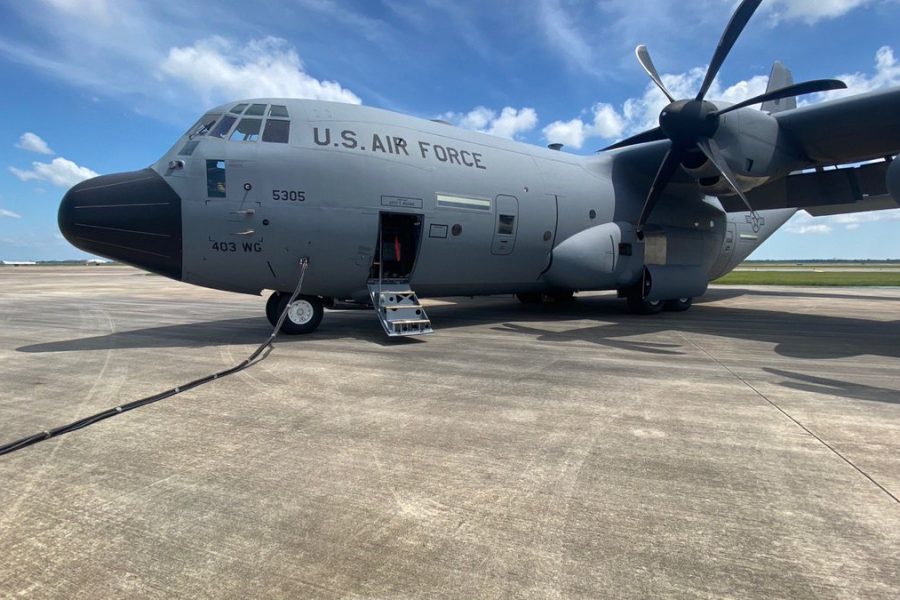
The WC-130J “Weatherbird” is a modularly configurable C-130J equipped with specialized systems to penetrate tropical and winter storms, capture meteorological data, and aid severe weather forecasting. Early WC-130Bs entered service in 1959, followed by the WC-130E in 1962, and WC-130H in 1964. The WC-130J began replacing legacy variants in 1999, though several H models remained in service with the Puerto Rico ANG until a fatal crash resulted in the fleet’s retirement in 2019. All WC-130Js are operated by AFRC’s 53rd Weather Reconnaissance Squadron “Hurricane Hunters” at Keesler.
Mission equipment includes a pod-mounted Stepped-Frequency Microwave Radiometer (SFMR) for monitoring surface winds and precipitation rates, parachute-deployed GPS dropsondes to gather vertical atmospheric profiles, and palletized operator stations/equipment running specialized software. WC-130Js are optionally equipped with two external wing tanks, as well as an internal auxiliary fuel tank to increase range and endurance. Crews include an added aerial weather reconnaissance officer/flight director and weather system specialist/loadmaster.
Aircraft can penetrate tropical cyclones from up to 10,000 ft to as low as 500 ft. The fleet primarily monitors oceanic weather over the Atlantic, Central Pacific, Caribbean, and Gulf of Mexico. Airframes are modernized alongside the baseline C-130J fleet, including Block 8.1 upgrades, and enhanced service-life center wing sections, MUOS jam-resistant BLOS and wide-band SATCOMS. AFRC is returning the fleet to the more weather-resistant gloss-gray paint scheme worn by WC-130s prior to 2007 and aims to add a dedicated weather radar as well as modular sensor pods for specific missions.
The small, hard-used WC-130J fleet has suffered a 65 percent mission capable rate, struggling with the demands of longer, busier storm seasons. WC-130Js flew 928 hours over 77 missions, collecting data on nine Atlantic and three Pacific hurricanes during the 2025 storm season. Crews flew a single storm in the Gulf of Mexico, as well as 17 missions collecting data on Category 5 Hurricane Melissa in the Caribbean, which was the most powerful storm to make landfall in 90 years.
WC-130J Hercules Technical Data
Contractor: Lockheed Martin.
First Flight: April 5, 1996 (C-130J).
Delivered: Sept. 30, 1999-September 2005.
IOC: October 2006.
Production: 10.
Inventory: 10.
Operator: AFRC.
Aircraft Location: Keesler AFB, Miss.
Active Variants: •WC-130J. Weather reconnaissance version of C-130J.
Dimensions: Span 132.6 ft, length 97.8 ft, height 38.8 ft.
Weight: Max T-O 155,000 lb; max payload 42,000 lb.
Power Plant: Four Rolls-Royce AE2100D3 turboprops, each 4,700 shp.
Performance: Speed 417 mph; range with 35,000 lb payload 1,841 miles (3,000+ miles with external/auxiliary tanks).
Ceiling: With max payload, 26,000 ft.
Accommodation: Two pilots, aerial reconnaissance weather officer, loadmaster/dropsonde operator.
Load: Palletized weather systems.